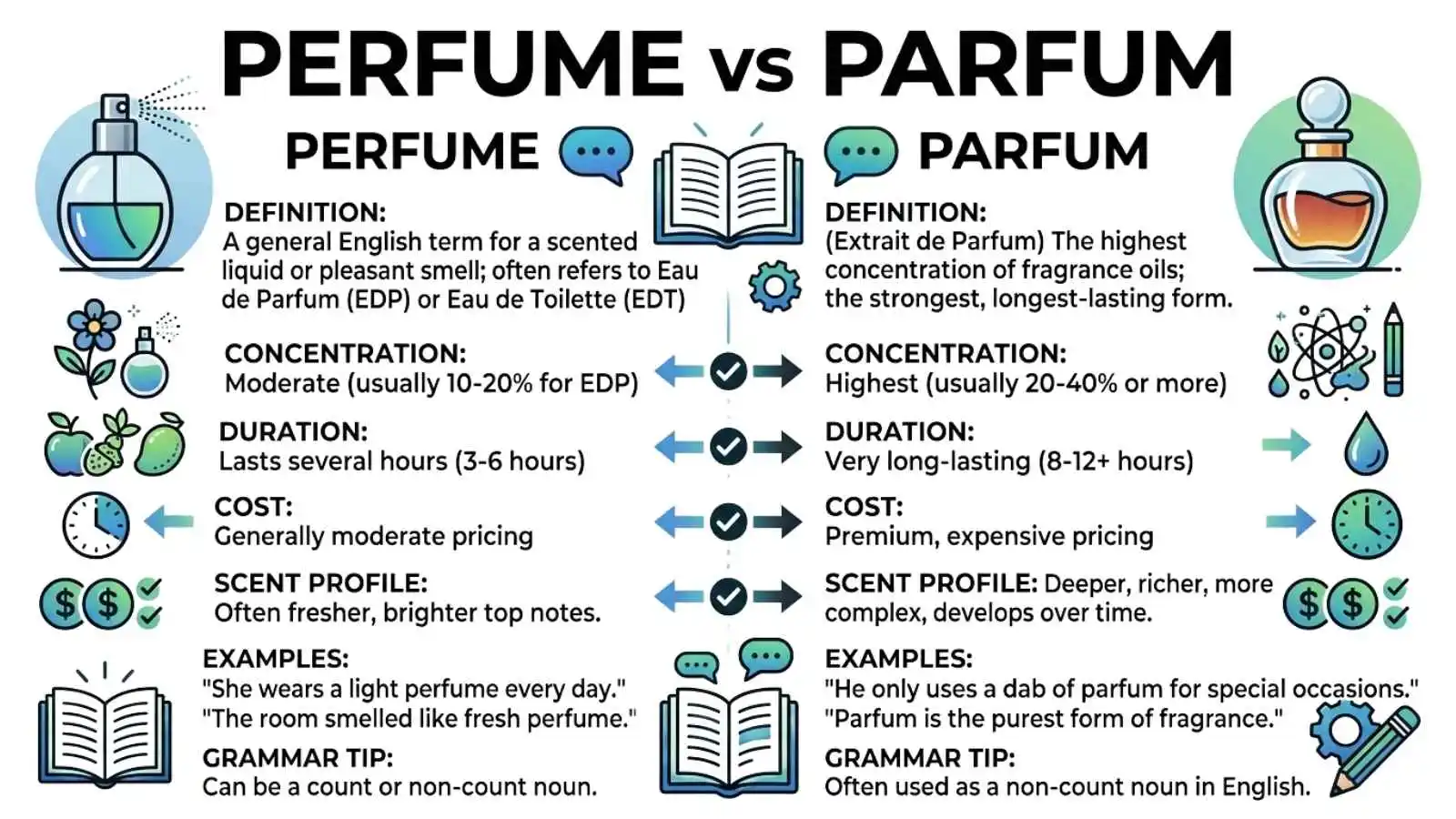
You are shopping for a new scent. You see “perfume” on one bottle and “parfum” on another. They look close. They may even mean the same thing to you. But now you are stuck. Is there a real difference? Or is it just fancy wording?
This mix-up happens a lot. It makes sense why. Both words point to the same basic idea: a scent you wear. But they come from different places. In the beauty world, they can also mean something a bit more specific.
This guide makes it easy. You will get a quick answer first. You will learn where both words came from. They will see how spelling changes by country. You will also learn what “parfum” means on a bottle, since that part confuses a lot of shoppers. By the end, you will know just what you’re buying.
Quick Answer
Perfume is the normal English word for a scented liquid you wear on your skin. It is used in the US, UK, and most English-speaking places.
Parfum is the French spelling of the same word. It shows up two ways. Sometimes it’s just the French way to write “perfume.” Sometimes it’s a label on a bottle, meaning the strongest kind of scent.
Easy examples:
- “I bought a new perfume for summer.” (normal English word)
- “This bottle says Eau de Parfum on the label.” (a scent strength label, often kept in French)
In short: perfume is the English word. Parfum is the French word. It also works as a label for scent strength.
Where These Words Came From
Both words go back to Latin. The root is “per fumum,” which means “through smoke.” Long ago, people let scent fill the air by burning incense or scented plants. The smell moved “through smoke” to reach the person smelling it.
Over time, this Latin phrase moved into French as “parfum.” France became a top place for making scents, for hundreds of years. Because of this, “parfum” stayed close to fine fragrance, even in English-speaking places today.
English later took the word and changed the spelling to “perfume,” to match normal English spelling. But since France stayed so linked to the perfume world, many bottles and labels kept the French word “parfum” on purpose. It often shows quality or old tradition.
British English vs American English Spelling
Good news here. This is not really a British vs American spelling case, like “color” and “colour.” Both the US and UK use “perfume” as the normal English word.
| Word | Region | Example Sentence |
| Perfume | US and UK, normal English | “She wore her favorite perfume to the party.” |
| Parfum | French, used on labels worldwide | “The label read Eau de Parfum.” |
| Eau de Parfum | Used worldwide | “Eau de Parfum lasts longer than Eau de Toilette.” |
So instead of a US vs UK split, the real split is between normal English talk (“perfume”) and French-based labels (“parfum”), which show up the same way almost everywhere.
Which Word Should You Use?
If you’re talking or writing in a normal, daily way about a scent: Use “perfume.” It’s the normal word in both American and British English.
If you’re reading or writing a fragrance product label: “Parfum” (or “Eau de Parfum”) often stays in French on purpose, even on English labels. This is normal in the fragrance world.
You’re comparing scent strength: Learn the French terms, since they show up on almost every bottle worldwide. “Parfum” (or “Extrait de Parfum”) means the strongest kind. “Eau de Parfum” is a bit lighter. “Eau de Toilette” is even lighter.
Easy rule: Say “perfume” in daily talk. Expect “parfum” on bottle labels, since that’s just how the fragrance world works.
Common Mistakes
Mistakes
1: Wrong: Thinking “parfum” is a spelling error for “perfume.” Fix: “Parfum” is a real, correct French word. It’s used on purpose in the fragrance world.
2: Wrong: Thinking “Eau de Parfum” and “perfume” always mean the exact same strength. Fix: “Eau de Parfum” is a set strength level. It’s usually stronger than “Eau de Toilette” but lighter than pure “Parfum.”
3: Wrong: Using “parfum” in casual English writing, like a text or blog post. Fix: Use “perfume” for daily writing. Save “parfum” for talking about labels or scent strength.
4: Wrong: Thinking all perfumes labeled “parfum” cost more just because of the French word. Fix: “Parfum” shows scent strength, not price. Though stronger types can cost more due to more scent oil inside.
Everyday Examples
In a text message: “Just got a new perfume today, it smells amazing!”
In a product review: “This Eau de Parfum lasts all day without needing more.”
On social media: “Perfume haul! Just added three new scents to my collection. “
In formal writing: “Available in both Eau de Toilette and Eau de Parfum, this fragrance gives a fresh, long-lasting scent.”
Search Trends & Usage Data
People search “perfume or parfum” mostly to understand fragrance labels before buying.
- United States and UK: Most searches want to check that “perfume” is the normal, everyday word. Some ask about “parfum” as a strength label.
- Global shoppers: Since brands sell worldwide, “parfum” search interest stays steady everywhere, tied to product labels more than region.
- Fragrance fans: A big chunk of searches come from people comparing scent strength, like Parfum vs Eau de Parfum vs Eau de Toilette, before buying.
Overall, “perfume” stays the more searched word in daily life, while “parfum” stays tied to shopping and product research.
Word Comparison Table
| Term | Meaning | Scent Strength | Common Use |
| Perfume | Normal English word for scent | Varies | Everyday talk |
| Parfum / Extrait de Parfum | Strongest scent type | Highest | Premium labels |
| Eau de Parfum | Strong, long-lasting scent | High | Common on many bottles |
| Eau de Toilette | Lighter, fresh scent | Medium | Everyday wear, light scents |
Frequently Asked Questions
1. Is “parfum” just French for “perfume”? Yes, at its root. But in the fragrance world, “parfum” also means the strongest scent type you can buy.
2. Which lasts longer, Parfum or Eau de Parfum? Parfum (or Extrait de Parfum) usually lasts the longest. It has the highest amount of scent oil inside.
3. Should I say “perfume” or “parfum” in daily talk? Use “perfume.” It’s the normal word in daily English, in both the US and UK.
4. Why do brands keep the French word “parfum” on English labels? It’s tradition, tied to France’s long history in the fragrance world. It also shows quality to many buyers.
5. Is Eau de Parfum the same as perfume? Not exactly. “Eau de Parfum” means a set scent strength. “Perfume” is a general word that can mean any strength.
6. Does more scent oil always mean a better fragrance? Not always. It means a stronger, longer-lasting scent. But your own taste still matters most when picking a scent.
7. Is “parfum” used the same way in the US and UK? Yes. Since it’s a label term, not a spoken word, it’s used the same way worldwide, no matter the English style.
The Bottom Line:
Perfume or parfum? “Perfume” is the normal English word most people use in daily talk, in both American and British English. “Parfum” is the French form of the same word. In the fragrance world, it also means the strongest scent type you can buy.
Next time you shop for a new scent, you’ll know just what those labels mean. Use “perfume” in daily talk. Watch for “parfum,” “Eau de Parfum,” and “Eau de Toilette” on labels to know how strong and long-lasting a scent will be.
Knowing this small difference makes shopping easier. It helps you pick a scent that really fits what you want, whether that’s something light for daily wear or something bold for a big night out.

Ethan Carter is a language writer at Wordellect who helps readers understand word differences, grammar rules, and spelling variations through simple and accurate guides.







