Choosing between miss or ms can feel confusing, especially when you are writing a letter, email, school form, job application, or formal message. Both Miss and Ms. are titles used before a woman’s name, but they do not mean exactly the same thing.
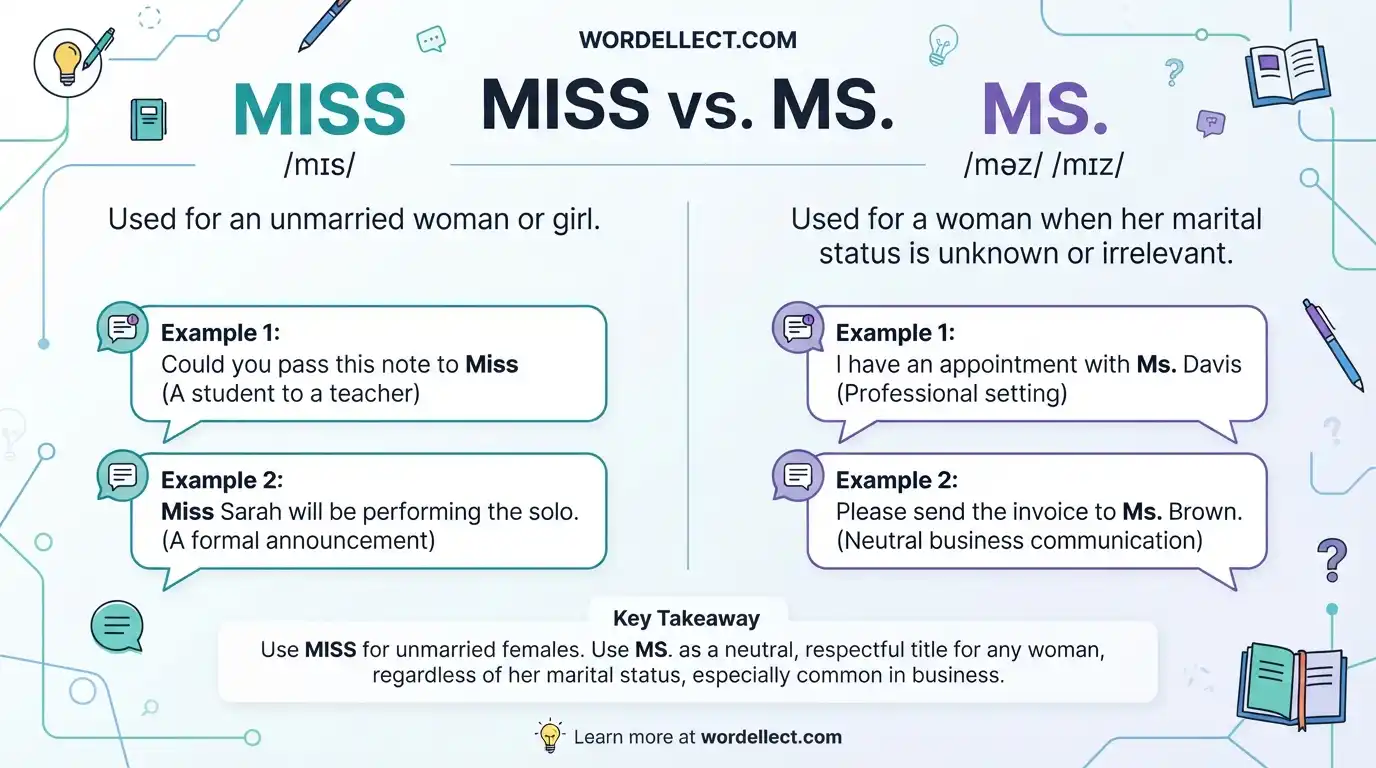
The main difference is simple. Miss traditionally refers to an unmarried woman or girl. Ms. is a neutral title that does not tell the reader whether a woman is married or unmarried. Because of this, Ms. is often the safest choice when you do not know a woman’s preference or marital status.
People often search for miss or ms because they want to use the right title in a professional or personal setting. They may also wonder whether Ms. means married, whether Miss is only for young women, or which title to use on a form.
This guide explains the difference in simple English. You will learn when to use Miss and Ms., how they are pronounced, how British and American English use them, common mistakes, and which title is best for different situations.
Miss or Ms – Quick Answer
Miss and Ms. are both correct titles, but they have different uses.
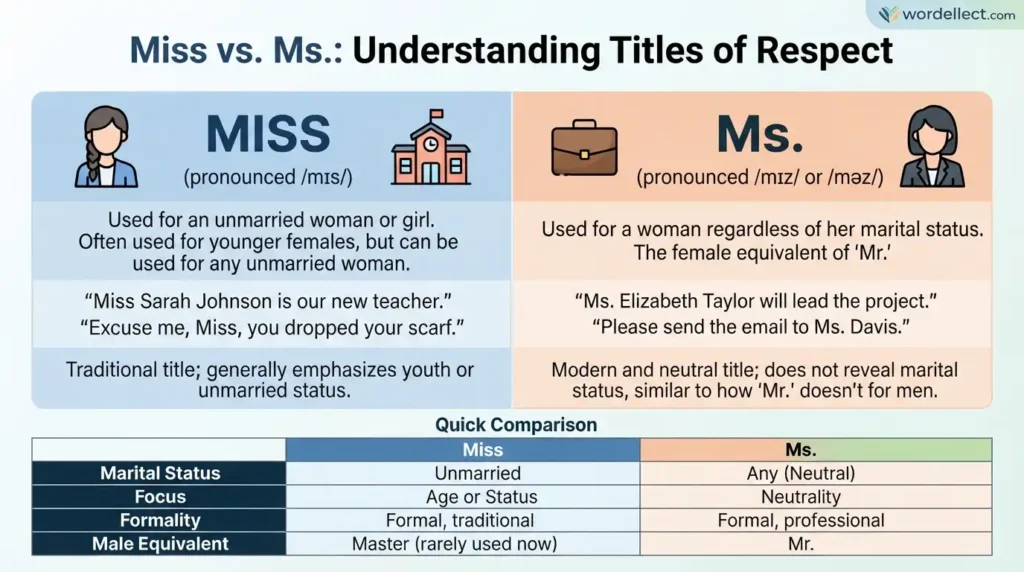
- Miss traditionally means an unmarried woman or girl.
- Ms. is a neutral title for a woman, whether she is married or unmarried.
- Use Ms. when you do not know or do not want to mention a woman’s marital status.
- Use Miss when a woman prefers that title or when you are following a known naming preference.
Examples
Miss Smith will meet you at 10 a.m.
Ms. Smith will meet you at 10 a.m.
Both sentences can be correct. The choice depends on the woman’s preferred title and the context.
For most professional situations, Ms. is a safe choice when you are unsure.
What Does Miss Mean?
Miss is a title traditionally used before the name of an unmarried woman or girl.
For example:
Miss Sarah Brown
Miss Emily Jones
The title can also be used for a young woman without giving her full name:
Excuse me, Miss.
In schools, Miss is also sometimes used as a form of address for a female teacher, even if the teacher’s marital status is not known.
For example:
Good morning, Miss.
The use of Miss can vary by country, age, culture, and personal preference.
What Does Ms. Mean?
Ms. is a title used before a woman’s name without showing whether she is married.
For example:
Ms. Sarah Brown
Ms. Emily Jones
This makes Ms. useful in workplaces, official letters, forms, and other formal situations.
You can use Ms. when you do not know whether someone is married.
You can also use it when the woman’s marital status is not relevant.
For example:
Dear Ms. Brown,
This does not tell the reader whether Ms. Brown is married.
Miss vs Ms: Main Differences
The main difference is the information each title gives.
| Title | Meaning | Common Use | Example |
| Miss | Traditionally an unmarried woman or girl | Young or unmarried women | Miss Brown |
| Ms. | Does not show marital status | Professional and formal settings | Ms. Brown |
| Mrs. | Traditionally a married woman | Married women who use the title | Mrs. Brown |
The key point is that Ms. does not mean married.
It is a neutral title.
Miss vs Ms vs Mrs
These three titles are often confused.
Miss
Miss Taylor
Traditionally used for an unmarried woman or girl.
Ms.
Ms. Taylor
Does not tell you whether she is married.
Mrs.
Mrs. Taylor
Traditionally used for a married woman.
Today, personal preference matters. A woman may choose the title she wants to use regardless of these traditional rules.
Is Ms. for Married or Unmarried Women?
Ms. can be used for both married and unmarried women.
This is one of the most important things to remember.
For example:
Ms. Johnson
You cannot tell from Ms. Johnson whether she is married.
That is the purpose of the title.
If you do not know a woman’s marital status, Ms. is often a good choice.
You should not assume that a woman is married or unmarried based only on her age or name.
Is Miss Only for Unmarried Women?
Traditionally, Miss is used for an unmarried woman or girl.
However, modern usage can depend on personal preference.
Some women may continue to use Miss even as adults. Some may prefer Ms. instead.
Because titles are personal, it is best to follow the person’s stated preference when you know it.
How Do You Pronounce Miss and Ms.?
Miss is pronounced like:
mis
Ms. is also commonly pronounced:
miz
The difference is easy to hear in careful speech.
Examples
Miss Brown
Sounds like:
mis Brown
Ms. Brown
Sounds like:
miz Brown
The pronunciation of Ms. does not tell you whether the woman is married.
The Origin and History of Miss and Ms.
The title Miss developed from mistress, which was once used as a form of address for a woman.
Over time, mistress was shortened into forms such as Mrs. and Miss.
Miss became widely used for unmarried women.
The title Ms. developed much later as a way to address women without stating their marital status. It became more widely accepted in the 20th century, especially in professional and public life.
The main reason for its growth was simple: a woman’s marital status does not always matter when addressing her.
Today, Ms. is common in business, government, education, and other formal settings.
British English vs American English
British and American English both use Miss and Ms.
The meanings are very similar.
There is one small style difference worth knowing.
American English
American English often writes:
Ms. Smith
with a period after Ms.
It also commonly writes:
Mr. Smith
Mrs. Smith
Dr. Smith
British English
British English often writes:
Ms Smith
without a period.
The same pattern may appear with other titles:
Mr Smith
Mrs Smith
Dr Smith
However, British style is not completely uniform. Different publishers and organizations can follow different style rules.
The important point is that Ms. and Ms mean the same title. The period is mainly a punctuation and style difference.
Which One Should You Use?
Choosing between Miss or Ms depends on the situation.
Use Ms. when you are unsure
If you do not know the woman’s marital status or preferred title, Ms. is often the safest formal option.
Example:
Dear Ms. Ahmed,
Use Miss when it is her preferred title
If a woman introduces herself as Miss Brown, follow her preference.
Example:
Thank you, Miss Brown.
Use Ms. in business writing
In professional emails and letters, Ms. is often a good choice.
Example:
Dear Ms. Wilson,
Use Miss in some school settings
In some schools and cultures, students address female teachers as Miss.
Example:
Good morning, Miss.
Use the person’s preference when known
This is the best rule.
If someone tells you to use Ms., use Ms.
If she prefers Miss, use Miss.
The person’s preference is more useful than a general rule about age or marriage.
Common Mistakes With Miss or Ms
1. Mistake: Thinking Ms. means married
Incorrect idea: Ms. means a married woman.
Correct: Ms. does not show marital status.
Example:
Ms. Carter may be married or unmarried.
2. Mistake: Using Mrs. when you do not know the person’s preference
Incorrect:
Dear Mrs. Ahmed,
when you have no reason to know that she uses Mrs.
Better:
Dear Ms. Ahmed,
This avoids making an assumption.
3. Mistake: Thinking Miss and Ms. mean exactly the same thing
They are not identical.
Miss traditionally gives information about marital status.
Ms. does not.
4. Mistake: Writing “Ms” as “Miss”
Incorrect pronunciation: treating Ms. as exactly the same as Miss.
Correct: Ms. is commonly pronounced “miz.”
5. Mistake: Assuming every young woman should be Miss
Age does not always tell you which title someone prefers.
A young adult woman may prefer Ms.
Follow her preference when possible.
6. Mistake: Using “Ms.” only for older women
Ms. is not an age-based title.
It can be used for adult women of different ages.
7. Mistake: Assuming the period changes the meaning
Ms. and Ms refer to the same title.
The difference is usually a style choice.
Everyday Examples of Miss and Ms.
Here are natural examples that show how each title works.
- Miss Brown is waiting outside.
- Please send the form to Ms. Taylor.
- Good morning, Miss.
- Ms. Khan will lead the meeting.
- I spoke with Miss Wilson yesterday.
- Dear Ms. Carter, thank you for your email.
- The students thanked Miss Davis after class.
- Please ask Ms. Green to call me.
- Miss Adams teaches English at the school.
- We sent the letter to Ms. Jones.
- The receptionist asked me to wait for Ms. Ali.
- I was not sure whether to write Miss or Ms, so I chose Ms.
Real-Life Usage
In emails
If you do not know the woman’s preferred title, a formal email can begin with:
Dear Ms. Brown,
This is usually safer than guessing her marital status.
At work
Ms. is common in professional communication.
Ms. Khan will join the meeting at 2 p.m.
It keeps the focus on the person’s name and role.
At school
Miss can be common when students address a female teacher.
Excuse me, Miss. Can I ask a question?
This usage depends on the school and country.
On forms
Some forms ask you to choose:
- Miss
- Ms.
- Mrs.
- Mr.
Choose the title that matches your preference or the information requested.
In formal letters
If you know the person’s preferred title, use it.
If you do not know it, Ms. is often a good choice for an adult woman.
On social media
People may use any title they prefer, or no title at all.
Social media is usually less formal, so a title may not be needed.
What Is the Difference Between Miss and Ms.?
The main difference is marital status.
Traditionally:
- Miss = unmarried woman or girl
- Ms. = woman of any marital status
Modern usage gives people more choice.
A woman may prefer Ms. because she does not want her marital status mentioned. Another woman may prefer Miss.
So the safest practical rule is:
When you do not know, use Ms. for an adult woman in a formal setting.
Is Ms. More Professional Than Miss?
Not always.
Both titles can be correct and polite.
However, Ms. is often more useful in professional writing because it does not require you to know or mention a woman’s marital status.
For example:
Dear Ms. Wilson,
works well in a business email when you do not know whether Wilson is married.
Miss can also be perfectly professional when it matches the person’s preferred title.
Is Miss or Ms Better for a Job Application?
Ms. is often a practical choice for a job application if the form asks for a title and you do not specifically prefer Miss.
For example:
Ms. Sarah Khan
The title does not reveal whether you are married.
However, if the application gives you a list of title options, choose the one you prefer.
Is Ms. Used for Married Women?
Yes.
A married woman can use Ms.
For example:
Ms. Sarah Brown
does not tell us whether Sarah Brown is married.
A woman may choose Ms. because she wants her marital status to remain private or because she simply prefers the title.
Is Miss Used for Adults?
Yes.
Miss can be used for adult women, especially when it is their preferred title or in certain cultural and social settings.
However, it traditionally refers to an unmarried woman.
So you should not assume that every adult unmarried woman wants to be called Miss.
Related Search Questions
Should I use Miss or Ms. in an email?
Use Ms. when you are writing a formal email to an adult woman and you do not know her preferred title or marital status. If you know that she prefers Miss, use Miss instead.
Does Ms. mean married?
No. Ms. does not tell you whether a woman is married. It is a neutral title that can be used for both married and unmarried women.
Does Miss mean unmarried?
Traditionally, yes. Miss has traditionally been used for an unmarried woman or girl. Modern usage can vary, so personal preference should guide you when you know it.
What is the difference between Miss, Ms., and Mrs.?
Miss traditionally refers to an unmarried woman. Ms. does not show marital status. Mrs. traditionally refers to a married woman. Today, women can choose the title they prefer.
How do you pronounce Ms.?
Ms. is usually pronounced “miz.” It sounds different from Miss, which is pronounced “mis.”
Can a married woman use Ms.?
Yes. A married woman can use Ms. The title does not indicate marital status and is often used in professional and formal settings.
Which title is safest when I do not know?
For an adult woman in a formal setting, Ms. is usually the safest choice when you do not know her preferred title. It avoids making an assumption about her marital status.
Usage and Search Trends
Miss and Ms. are both common English titles, but people often search for them when they need help with a specific situation.
Common search questions include:
- Miss or Ms for unmarried woman
- Miss vs Ms married
- Is Ms for married or unmarried?
- Miss or Ms on a form
- Miss or Ms in an email
- How to use Ms.
- What does Ms. mean?
Interest in these questions is usually linked to practical writing tasks such as forms, job applications, business emails, school communication, and formal letters.
Exact search volume and Google Trends scores can change over time and by country. Without current verified data, it would not be reliable to give a specific number.
The important usage pattern is clear: Ms. is especially useful when marital status is unknown or not relevant.
Miss vs Ms Comparison Table
| Term | Meaning | Marital Status | Pronunciation | Example |
| Miss | Traditionally an unmarried woman or girl | Traditionally unmarried | “mis” | Miss Brown |
| Ms. | Neutral title for a woman | Not stated | “miz” | Ms. Brown |
| Mrs. | Traditionally a married woman | Traditionally married | “miss-iz” | Mrs. Brown |
Simple rule
If you need one easy rule to remember:
Miss tells us traditionally that a woman is unmarried. Ms. does not tell us whether she is married.
FAQs About Miss or Ms
1. Is Ms. better than Miss?
Neither title is always better. The right choice depends on the woman’s preference and the setting. Ms. is often a good choice in professional writing when you do not know the woman’s marital status. Miss is also correct when that is the title she prefers.
2. Can I call a married woman Miss?
Traditionally, Miss refers to an unmarried woman, so it may not be the expected title for a married woman. However, titles are personal. If a woman says she prefers Miss, you should use Miss rather than assuming which title she should have.
3. Is Ms. respectful?
Yes. Ms. is a standard and respectful title. It is widely used in professional, academic, business, and formal communication. It is especially useful when marital status does not matter or when you do not know it.
4. Is Ms. short for Miss?
No. Ms. is not simply a shorter spelling of Miss. They are separate titles. Ms. is commonly pronounced “miz,” while Miss is pronounced “mis.” Ms. was developed as a neutral form of address for women.
5. Should a teenage girl be called Miss or Ms.?
There is no single rule for every situation. Miss is often used for girls and young unmarried women. For an adult woman, Ms. may be more appropriate in formal settings. Personal preference and local customs also matter.
6. Can I use Ms. without a period?
Yes. Both Ms. and Ms can be seen in English writing. American style often uses the period, while many British style guides omit it. The meaning does not change.
7. What should I use if I do not know if she is married?
For an adult woman in a formal setting, Ms. is usually the best choice. It does not make a claim about marital status. For example, you can write Dear Ms. Ahmed without needing to know whether she is married.
Conclusion
The choice between Miss or Ms becomes easy once you know what each title means. Miss traditionally refers to an unmarried woman or girl. Ms. is a neutral title that does not show whether a woman is married or unmarried.
For most formal situations, Ms. is a useful choice when you do not know a woman’s marital status or preferred title. It works well in business emails, letters, school forms, job applications, and other professional settings. You can write Dear Ms. Brown without making an assumption about her personal life.
That does not mean Miss is wrong. Miss remains a correct and widely used title. A woman may prefer it, and some schools, cultures, and social settings use it often.
The best rule is to respect personal preference whenever you know it. If you do not know the preference and you are addressing an adult woman formally, Ms. is usually the safer choice.
Remember the simple difference: Miss traditionally shows unmarried status, while Ms. does not show marital status.

Ethan Carter is a language writer at Wordellect who helps readers understand word differences, grammar rules, and spelling variations through simple and accurate guides.