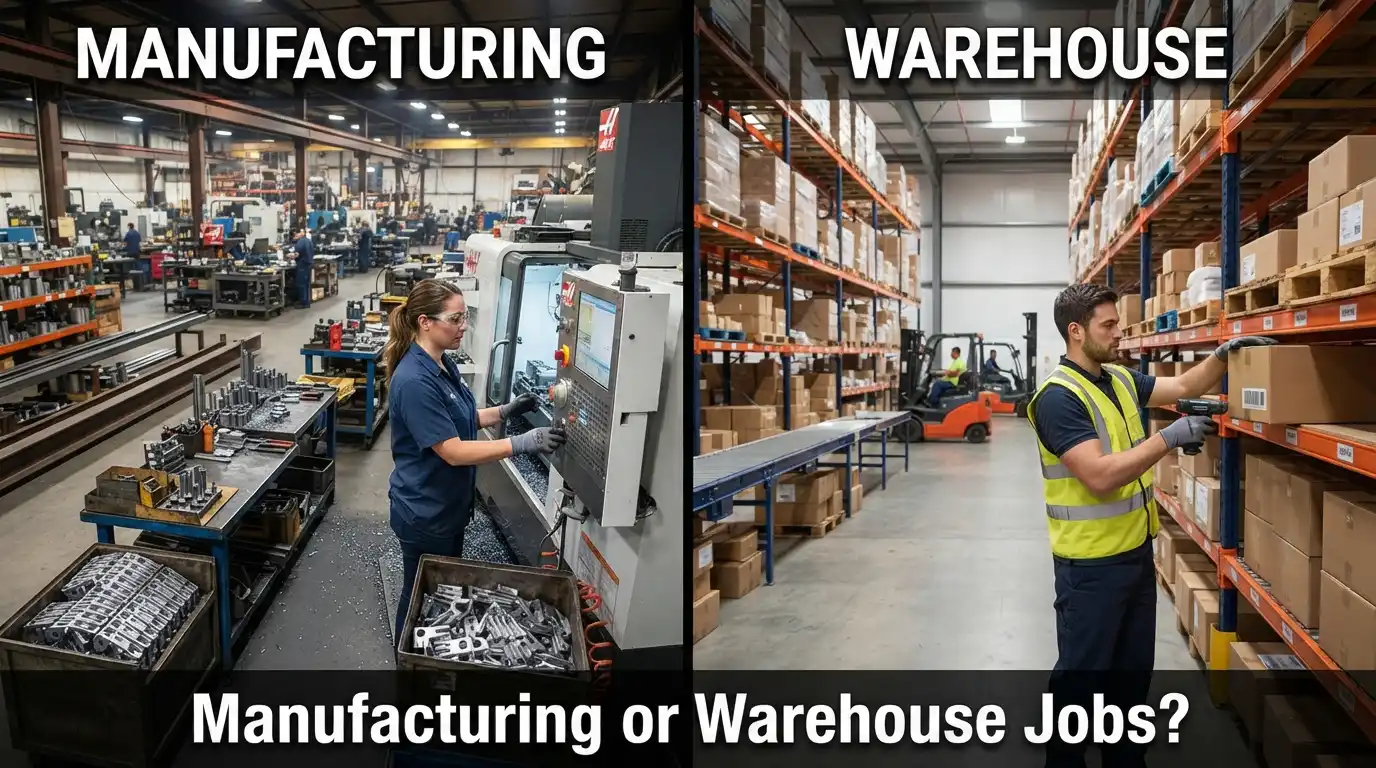
If you are looking for a job, you may be asking about manufacturing or warehouse jobs. Both can be good choices, but they are not the same.
A manufacturing job is mostly about making things. A warehouse job is mostly about keeping, moving, packing, and sending things.
For example, a worker in a factory may help make a car part. A warehouse worker may take that car part from a shelf and pack it for a customer.
Both jobs can be good for people who want to start working without a long degree or years of study. But the work, hours, pay, and skills can be different.
The best choice depends on what kind of work you like and what you want from your job.
Manufacturing or Warehouse Jobs: Quick Answer
The simple answer is:
Manufacturing jobs are about making products. Warehouse jobs are about storing and moving products.
Here is the main difference:
| Manufacturing Jobs | Warehouse Jobs |
| Make products | Store products |
| Put parts together | Pick and pack products |
| Use machines in some jobs | Move boxes and items |
| Check products | Check orders |
| Work in a factory | Work in a warehouse |
| Follow a set work process | Follow order and shipping steps |
Both jobs can include standing, walking, lifting, and working in shifts.
What Are Manufacturing Jobs?
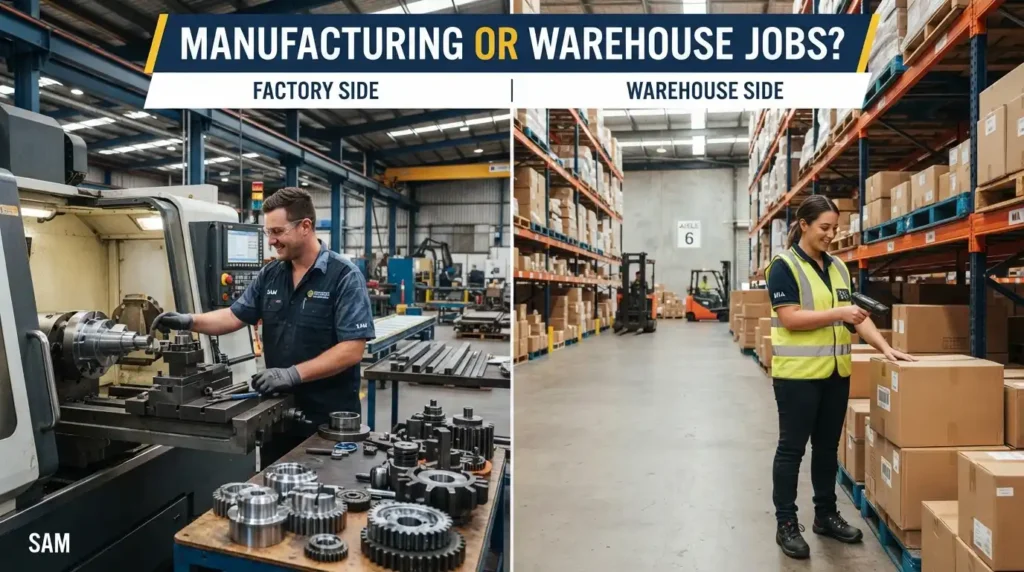
Manufacturing jobs are jobs where people help make products.
A factory can make many things. It may make food, cars, tools, clothes, electronics, furniture, or other products.
A worker may put parts together. Another worker may use a machine. Someone else may check the finished product.
Some jobs are simple and can be learned at work. Other jobs need special skills or training.
Common Manufacturing Jobs
Some common jobs are:
- Factory worker
- Production worker
- Machine operator
- Assembly worker
- Packing worker
- Quality checker
- Maintenance worker
- Production team leader
The work can be different at each factory.
What Are Warehouse Jobs?
Warehouse jobs are about storing and moving products.
A warehouse gets products from a factory or another company. Workers then put the products in the right place.
When someone buys a product, a warehouse worker may find it, take it from the shelf, pack it, and get it ready to ship.
Some workers also load and unload trucks.
Common Warehouse Jobs
Common jobs include:
- Warehouse worker
- Warehouse helper
- Order picker
- Packer
- Stock worker
- Shipping worker
- Receiving worker
- Forklift operator
- Warehouse team leader
Some warehouse jobs need special training. For example, a job that uses a forklift may have extra safety rules.
Manufacturing vs. Warehouse Jobs
The easiest way to understand the difference is to think about a product.
Imagine a company that makes tables.
A manufacturing worker may:
- Cut the parts
- Put the parts together
- Use tools
- Check the table
- Pack the finished table
A warehouse worker may:
- Receive the tables
- Put them in storage
- Find a table for an order
- Pack the order
- Put it on a truck
So, the factory makes the product, while the warehouse stores and sends the product.
Which Job Is More Physical?
Both types of jobs can be physical.
Warehouse workers may walk a lot during the day. They may also lift boxes, move items, push carts, or load trucks.
Manufacturing workers may stand for many hours. Some may lift parts, use tools, or do the same task many times.
The amount of physical work depends on the job.
For example, a warehouse worker who checks stock may do less heavy work than a worker who loads trucks.
In the same way, a person working at a desk inside a factory may do less physical work than someone working on a production line.
So, do not judge a job only by its name. Read the full job details before you apply.
Which Job Is Easier?
There is no single answer.
Some warehouse jobs are simple to learn. Some manufacturing jobs are also easy to learn after basic training.
But some jobs in both fields can be hard.
A warehouse job may be hard because you walk and lift for many hours.
A factory job may be hard because you stand in one place and do the same task again and again.
The best way to know is to ask:
- What will I do each day?
- How much will I lift?
- How many hours will I stand?
- Will I work day or night?
- Will I get training?
These questions can help you choose the right job.
Which Job Is Better for Beginners?
Both manufacturing and warehouse jobs can be good for beginners.
Some companies train new workers. You may not need years of work experience for some entry-level jobs.
For a beginner, employers may look for simple things such as:
- Being on time
- Working hard
- Following rules
- Listening to your manager
- Working safely
- Working well with others
- Paying attention
You do not always need a college degree for entry-level work.
Still, every company has its own rules. Always check the job post before applying.
Which Job Pays More?
There is no simple answer to this question.
Some manufacturing jobs pay more. Some warehouse jobs pay more.
Pay can depend on:
- Your location
- The company
- Your job title
- Your work experience
- Your shift
- Overtime
- Your skills
- Your training
For example, a basic warehouse job may pay less than a skilled machine job.
But an experienced warehouse worker may earn more than a new factory worker.
This is why you should compare the actual jobs instead of only comparing the two job types.
Also look at other things such as health benefits, paid time off, work hours, and overtime.
Pros of Manufacturing Jobs
Manufacturing work can be a good choice for people who like making things.
Some good points are:
- You can learn new skills.
- You may learn how to use machines.
- The work can have clear steps.
- You may get more training over time.
- You may move to a better job later.
- Some jobs offer overtime.
If you learn how to use certain machines, you may be able to apply for more skilled jobs later.
Cons of Manufacturing Jobs
Manufacturing jobs can also have some hard parts.
You may have to:
- Stand for a long time
- Do the same task many times
- Work around machines
- Work in a noisy place
- Work at night
- Work on weekends
- Meet daily work goals
The work can be different from one factory to another.
Pros of Warehouse Jobs
Warehouse work can be a good choice if you like active work.
Some good points are:
- Many jobs are entry level.
- You may not need much past work experience.
- You can learn warehouse skills.
- You can learn about shipping and orders.
- You may get overtime.
- You may move up to a team leader job.
Warehouse work can also help you learn about how products move from a company to customers.
Cons of Warehouse Jobs
Warehouse work can be hard too.
You may have to:
- Walk for many hours
- Lift boxes
- Stand for long periods
- Move products
- Work fast
- Work night shifts
- Work weekends
Some warehouses are very large. This means you may walk a lot during your shift.
Some warehouses also have trucks, forklifts, and other moving equipment, so safety is very important.
What Skills Do You Need?
You do not need the same skills for every job.
Manufacturing Skills
Useful skills can include:
- Using simple tools
- Following steps
- Checking products
- Basic math
- Using machines
- Paying attention
- Working safely
Some higher-level factory jobs may need more training.
Warehouse Skills
Useful skills can include:
- Reading labels
- Counting items
- Using a scanner
- Packing boxes
- Finding products
- Moving items safely
- Using simple computer systems
- Following orders
Some jobs may also need forklift training.
Which Job Has Better Career Growth?
Both can offer a path to a better job.
In manufacturing, you may start as a factory worker and later become a machine operator, team leader, or supervisor.
A possible path could look like this:
Factory Worker → Machine Operator → Team Leader → Supervisor
In a warehouse, you may start as a warehouse worker and later become a team leader or supervisor.
A possible path could be:
Warehouse Worker → Senior Worker → Team Leader → Supervisor
Your path will depend on your skills, work record, and the company.
Manufacturing or Warehouse Jobs With No Experience
If you have no work experience, do not worry.
Look for job posts that say:
- Entry level
- No experience needed
- Training provided
- Will train
- No degree needed
These words can help you find jobs that may be open to new workers.
But remember that “preferred” and “required” are different.
If a job says experience is preferred, you may still apply without it.
If it says experience is required, you may need that experience before you can get the job.
What Should You Check Before Taking a Job?
Before you accept a manufacturing or warehouse job, check the details.
Work Hours
Ask if the job is during the day or night.
Some jobs also have weekend or rotating shifts.
Physical Work
Ask how much lifting, walking, bending, and standing is needed.
Pay
Check the hourly pay and ask about overtime.
Training
Ask if the company trains new workers.
Benefits
Check if the job offers health benefits, paid time off, or other benefits.
Travel
Think about how far the job is from your home.
A job with good pay may not be a good choice if the daily travel is too hard or costly.
Growth
Ask if you can move to a better job after gaining skills and experience.
Which One Should You Choose?
Choose a manufacturing job if you like:
- Making things
- Machines
- Tools
- Assembly
- Factory work
- Learning how products are made
Choose a warehouse job if you like:
- Moving products
- Packing boxes
- Finding orders
- Stock work
- Shipping
- Active work
If you are still not sure, apply for both.
Then compare the actual job offers.
Look at the pay, work hours, travel, physical work, benefits, and chance to move up.
Manufacturing or Warehouse Jobs: Simple Comparison
| Question | Manufacturing | Warehouse |
| What is the main work? | Making products | Storing and moving products |
| Where do you work? | Factory | Warehouse |
| Is it physical? | Often | Often |
| Do you stand? | Often | Often |
| Do you lift things? | Sometimes | Often |
| Are machines used? | Often | Sometimes |
| Are scanners used? | Sometimes | Often |
| Is training available? | Sometimes | Sometimes |
| Can beginners apply? | Often | Often |
| Can you move up? | Yes | Yes |
Frequently Asked Questions
What is the difference between manufacturing and warehouse jobs?
Manufacturing jobs are mainly about making products. Warehouse jobs are mainly about storing, packing, picking, and moving products.
Which is better, manufacturing or warehouse jobs?
It depends on you. Manufacturing may be better if you like machines and making things. Warehouse work may be better if you like active work and moving products.
Can I get a warehouse job with no experience?
Yes. Some warehouse jobs are open to people with no past experience. Some companies provide training.
Can I get a manufacturing job with no experience?
Yes. Some factories hire new workers and teach them the job. Check each job post for its own rules.
Are warehouse jobs hard?
Some can be hard because you may walk, stand, lift, and move things for many hours. The work depends on the job.
Are manufacturing jobs hard?
Some can be hard because you may stand for a long time, repeat the same task, or work around machines.
Which job is better for the future?
Both can lead to better jobs. Manufacturing can lead to machine and production work. Warehouse jobs can lead to team leader, shipping, stock, and management work.
Conclusion
When you compare manufacturing or warehouse jobs, the main difference is easy to remember.
Manufacturing means making products. Warehouse work means storing and moving products.
A manufacturing job may be right for you if you like machines, tools, and making things.
A warehouse job may be better if you like moving products, packing orders, and active work.
Before you choose, check the real job duties, pay, hours, physical work, benefits, and training. Do not choose only because a job title sounds good.
The best job is the one that fits your skills, needs, and future plans.

Ethan Carter is a language writer at Wordellect who helps readers understand word differences, grammar rules, and spelling variations through simple and accurate guides.







