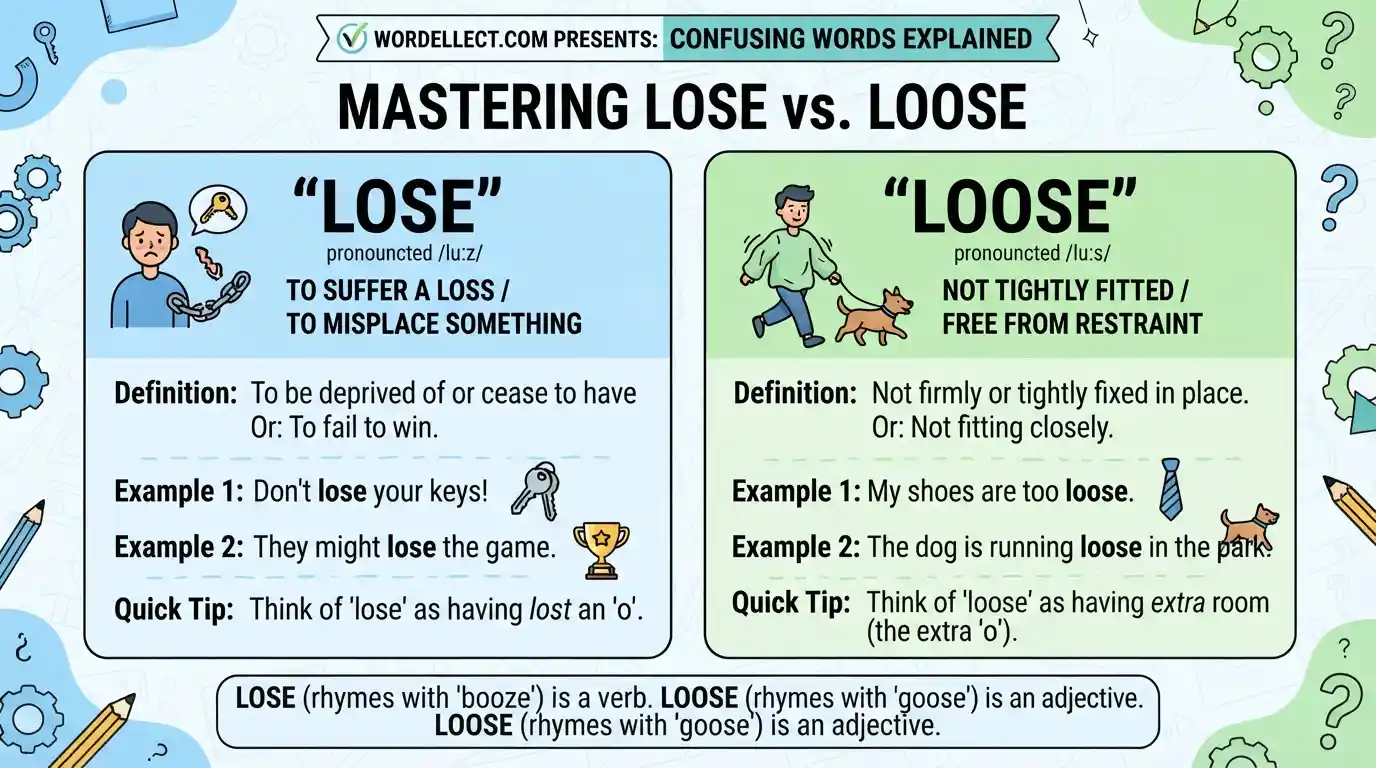
Many people confuse lose or loose because the words look and sound similar. But they have different meanings and different uses. One small spelling change can completely change a sentence.
If you want to say that you cannot find something, you need lose. If you mean something is not tight, you need loose. For example, “I do not want to lose my phone” is correct. “My shirt is loose” is also correct.
This confusion is common in emails, school work, social media posts, and everyday writing. It can also cause problems in formal writing because a wrong word may change the meaning of a sentence.
The good news is that the difference is easy to learn. Lose is mainly a verb. Loose is usually an adjective. Once you learn this simple rule, you can quickly choose the right word.
This guide explains lose or loose, their meanings, origins, spelling, common mistakes, and real-life examples.
Lose or Loose – Quick Answer
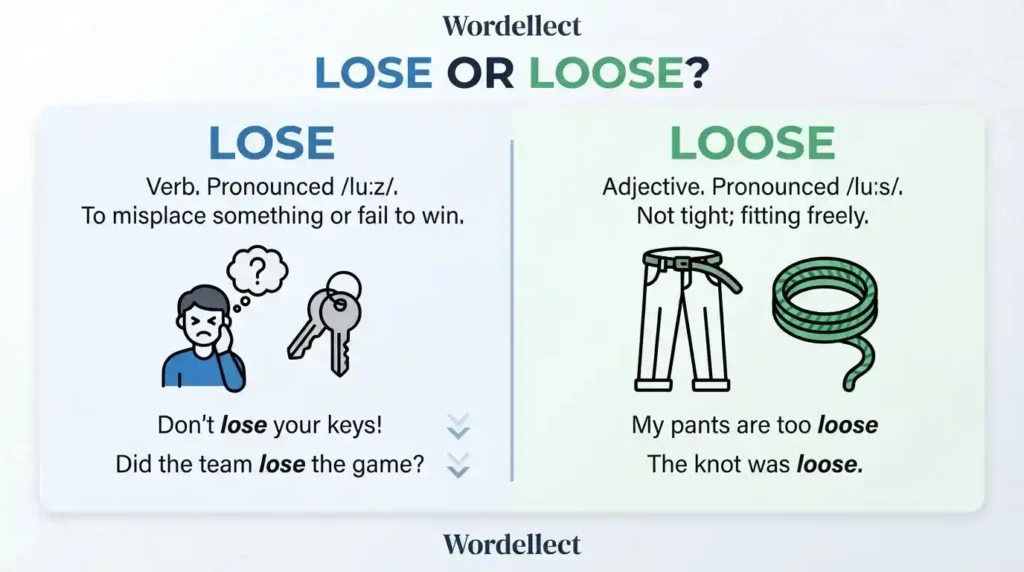
Lose and loose are different words.
- Lose means to misplace something, fail to keep something, or not win.
- Loose means not tight, not firmly fixed, or free.
Examples
Lose:
- I do not want to lose my keys.
- Our team may lose the game.
- She does not want to lose her job.
Loose:
- My shoes are loose.
- This screw is loose.
- The dog is loose in the yard.
A simple trick is:
Lose = misplace or fail
Loose = not tight
Remember that lose has one “o,” while loose has two.
The Origin of Lose or Loose
The words lose and loose come from different language roots, even though they look similar today.
Lose comes from Old English losian. It was linked to the idea of being lost, destroyed, or separated from something. Over time, its spelling and meaning developed into the modern word lose.
Loose has a different history. It comes from Old English los, which was connected with being free or released. It later developed into the word loose, meaning not tight or not firmly held.
The similar spelling can cause confusion because both words have the letters “l” and “s.” However, they do not have the same meaning.
Their pronunciation also helps show the difference:
- Lose sounds like “looz.”
- Loose sounds like “loos.”
The extra o in loose does not make it the same as lose.
British English vs American English Spelling
There is no major British-American spelling difference between lose and loose.
Both British English and American English use:
- lose
- lost
- losing
- loose
- loosely
The main issue is not regional spelling. It is choosing the correct word.
| Word | British English | American English | Meaning |
| Lose | Lose | Lose | Misplace, fail, or not win |
| Lost | Lost | Lost | Past form of lose |
| Losing | Losing | Losing | Present participle of lose |
| Loose | Loose | Loose | Not tight or firmly fixed |
| Loosely | Loosely | Loosely | In a loose way |
Examples
British English:
I do not want to lose my wallet.
American English:
I do not want to lose my wallet.
British English:
These trousers are loose.
American English:
These pants are loose.
The word choice stays the same in both forms of English.
Which Spelling Should You Use?
The correct word depends on what you mean, not where you live.
If you mean “misplace”
Use lose.
I always lose my glasses.
If you mean “not win”
Use lose.
They might lose the match.
If you mean “not tight”
Use loose.
This jacket is too loose.
If you mean “not fixed”
Use loose.
The handle is loose.
For US, UK, Canadian, Australian, and other English readers, these rules are the same.
If you write for a global audience, focus on the meaning of the sentence. Do not choose between lose and loose based on American or British English.
Common Mistakes with Lose or Loose
1. “I do not want to loose my phone.”
Incorrect:
I do not want to loose my phone.
Correct:
I do not want to lose my phone.
You mean that you do not want your phone to go missing.
2. “My shoes are lose.”
Incorrect:
My shoes are lose.
Correct:
My shoes are loose.
You mean the shoes are not tight.
3. “We could loose the game.”
Incorrect:
We could loose the game.
Correct:
We could lose the game.
The team could fail to win.
4. “The bolt is lose.”
Incorrect:
The bolt is lose.
Correct:
The bolt is loose.
The bolt is not tight.
5. “Do not loose hope.”
Incorrect:
Do not loose hope.
Correct:
Do not lose hope.
Here, lose means to stop having hope.
6. “The rope is lose.”
Incorrect:
The rope is lose.
Correct:
The rope is loose.
The rope is not tight.
Lose or Loose in Everyday Examples
Knowing the rule is useful, but seeing the words in real sentences makes the difference easier to remember.
In Emails
I do not want to lose this important document.
The strap on the package is loose, so please check it.
In News
The team could lose the final match.
Police reported that a dangerous animal was loose in the area.
On Social Media
I never want to lose my best friend.
These jeans are too loose for me.
In School Writing
Students can lose marks for spelling mistakes.
The wheel became loose after several hours of use.
In Formal Writing
The company may lose customers if service quality falls.
The connection became loose after repeated use.
These examples show why choosing the right word matters. Lose usually describes an action or result. Loose usually describes the condition of something.
Lose or Loose – Google Trends & Usage Data
Searches for lose or loose are mainly driven by spelling confusion. People often search the phrase when they are unsure which word belongs in a sentence.
Both words are widely used in English-speaking countries, including the United States, United Kingdom, Canada, Australia, and other countries where English is commonly used.
The search context is also different:
- Lose appears often with words such as game, weight, money, job, hope, and keys.
- Loose often appears with words such as clothes, shoes, screw, bolt, rope, and fit.
The two words should not be treated as spelling variations. They are separate words with different meanings.
Because search interest can change over time, exact Google Trends numbers should be checked directly for a specific date and country rather than guessed.
Lose or Loose Comparison Table
| Word | Part of Speech | Main Meaning | Example |
| Lose | Verb | Misplace something | I may lose my keys. |
| Lose | Verb | Not win | We may lose the game. |
| Lose | Verb | No longer have | She could lose her job. |
| Loose | Adjective | Not tight | My shirt is loose. |
| Loose | Adjective | Not firmly fixed | The screw is loose. |
| Loose | Adjective | Free or not contained | The dog is loose. |
Easy Memory Trick
Think of the two words this way:
Lose = looz
Loose = loos
You can also remember:
Lose has one “o” when you lose something.
Loose has two “o”s when something is too loose.
FAQs About Lose or Loose
Is it lose or loose?
Both words are correct, but they have different meanings. Use lose for misplacing something or not winning. Use loose for something that is not tight.
Is it “lose weight” or “loose weight”?
The correct phrase is lose weight.
Example:
I want to lose weight.
Is it “lose the game” or “loose the game”?
The correct phrase is lose the game.
Example:
Our team might lose the game.
Is it “loose clothes” or “lose clothes”?
The correct phrase is loose clothes when you mean clothes that are not tight.
Example:
She likes to wear loose clothes.
Is “loose” a verb?
Yes. Loose can be a verb, although it is less common. It can mean to release or set free.
Example:
They loosed the animals from the cage.
In everyday writing, however, loose is most often used as an adjective.
Why do people confuse lose and loose?
They look very similar and have related sounds. Many people also add an extra “o” to lose by mistake.
How can I remember the difference?
Remember:
Lose = misplace or fail.
Loose = not tight.
This simple rule works in most everyday sentences.
Conclusion
Understanding lose or loose is easier once you focus on meaning. The two words look similar, but they are not interchangeable.
Use lose when you mean to misplace something, stop having something, or fail to win. For example, you can lose your keys, lose money, lose hope, or lose a game.
Use loose when something is not tight, firmly fixed, or contained. You can have loose clothes, a loose screw, or a loose dog.
There is no special British or American spelling rule that changes these words. Both forms of English use lose and loose in the same way.
The easiest memory trick is simple: lose means misplace or fail, while loose means not tight. Once you remember this difference, you can avoid one of the most common English spelling mistakes in emails, school work, social media, and formal writing.

Ethan Carter is a language writer at Wordellect who helps readers understand word differences, grammar rules, and spelling variations through simple and accurate guides.







