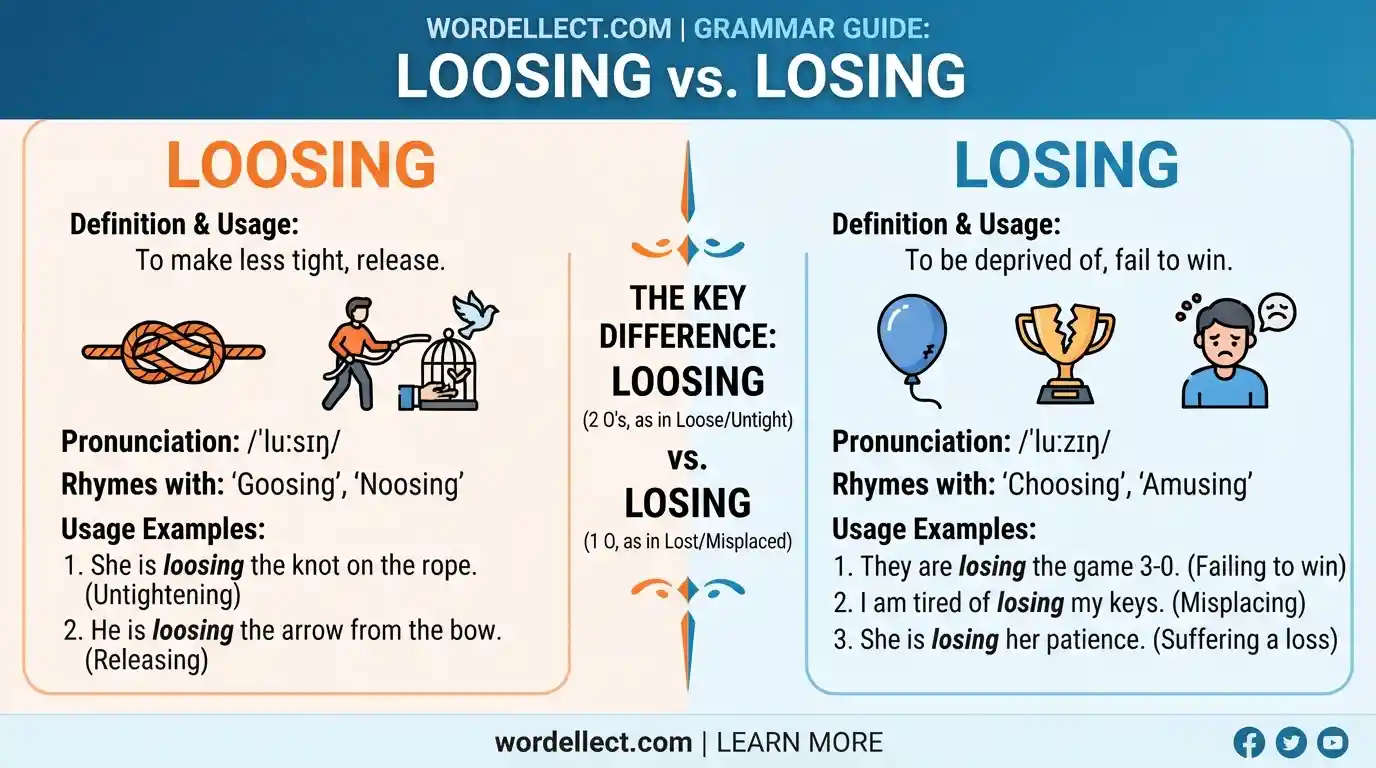
Loosing or losing is a common spelling question. The two words look almost the same, but they have different meanings. Only one is normally correct when you mean that you no longer have something, are not winning, or are becoming less tight.
The correct word in these cases is losing.
For example, you should write:
I am losing my keys.
Not:
I am loosing my keys.
However, loosing is a real English word. It is simply much less common. It comes from the verb loose, which means to release something or set it free.
For example:
The farmer is loosing the horses.
The main reason people confuse these words is simple. Lose becomes losing, not loosing, when you add -ing. The extra o is not needed.
This guide explains the difference between loosing and losing, their meanings, correct use, common mistakes, examples, and an easy way to remember which spelling to use.
Loosing or Losing – Quick Answer
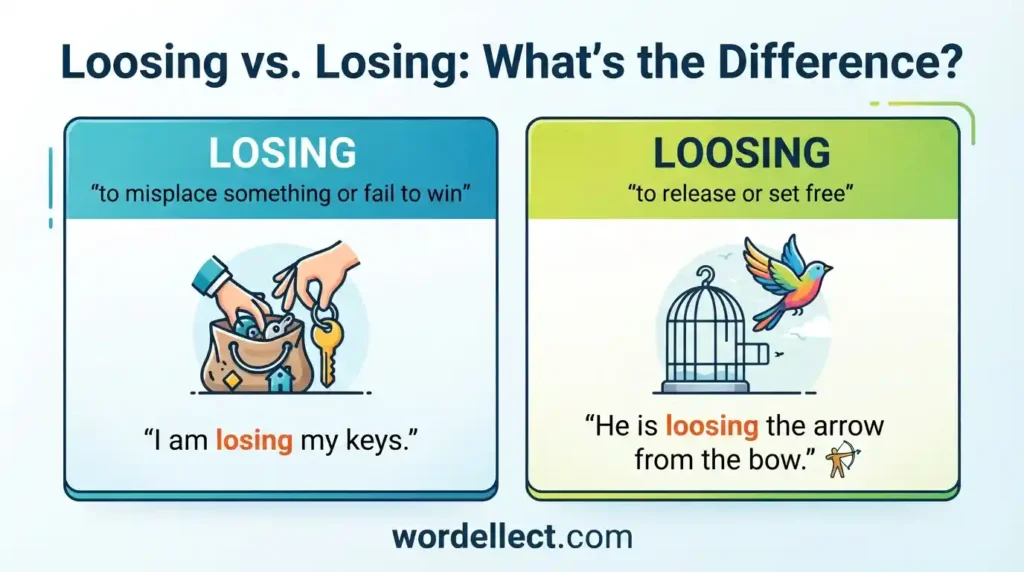
Losing is the correct word when you mean failing to win, no longer having something, or gradually getting less of something.
Loosing is also a real word, but it has a different meaning. It comes from loose and means releasing or setting something free.
Easy rule
- Lose → losing
- Loose → loosing
Examples:
- I am losing my phone.
- Our team is losing the game.
- She is losing weight.
- He is loosing the rope.
So, if you are asking “loosing or losing, which is correct?”, the answer depends on the meaning. For most everyday uses involving lose, use losing.
What Does Losing Mean?
Losing is the present participle or -ing form of the verb lose.
The verb lose can have several meanings.
It can mean:
- To no longer have something
- To fail to win
- To misplace something
- To become less successful
- To experience a reduction
- To fail to keep something
Examples:
I keep losing my keys.
Our team is losing the match.
She is losing weight.
He is losing interest in the job.
In all of these sentences, losing is correct.
What Does Loosing Mean?
Loosing is the -ing form of the verb loose.
The verb loose means to release, free, or let something go.
It is much less common than losing.
For example:
The soldier is loosing the arrow.
They are loosing the animals from the cage.
The word loosing can be correct when the sentence means releasing something.
However, many people write loosing by mistake when they actually mean losing.
Main Difference Between Loosing and Losing
The easiest way to understand the difference is to look at the base words.
Lose means to no longer have something, fail to win, or misplace something.
Loose means not tight or to release something.
| Word | Base Word | Meaning | Example |
| Losing | Lose | Failing to win or no longer having something | I am losing my keys. |
| Loosing | Loose | Releasing or setting free | He is loosing the animals. |
| Loose | Loose | Not tight | My shirt is loose. |
| Lose | Lose | No longer have or fail to win | Do not lose your phone. |
The extra o changes the base word and therefore changes the meaning.
Why Do People Confuse Loosing and Losing?
The confusion comes from the similar spelling of lose and loose.
They look almost identical:
- lose
- loose
- losing
- loosing
But they are different words.
The most common mistake happens when someone thinks that lose + ing = loosing.
That is not correct.
The correct spelling is:
lose + ing = losing
The final e in lose disappears before -ing is added.
Compare:
- lose → losing
- make → making
- use → using
- move → moving
This gives you a useful spelling pattern.
How to Remember Losing
A simple trick can help.
Think:
Lose = one O
Loose = two O’s
So:
Lose → losing
Loose → loosing
You can also remember the meanings:
- Lose = fail or no longer have
- Loose = not tight or release
If you mean fail, misplace, or no longer have, use losing.
If you mean release, loosing may be correct.
Origin and History
The words lose and loose have different histories.
Lose comes from Old English forms related to the idea of losing or being deprived of something.
Loose also has Old English roots and has long been connected with the idea of being free, unbound, or not tightly held.
Over time, both words developed into the forms used in modern English.
Because their spellings are so similar, they are often confused even though they have different meanings.
British English vs American English
There is no major British English versus American English difference between losing and loosing.
Both varieties of English use:
- losing for the -ing form of lose
- loosing for the -ing form of loose
For example:
American English: I am losing the game.
British English: I am losing the game.
The spelling stays the same.
So this is not a British-versus-American spelling issue. It is a difference between two English words.
Which One Should You Use?
For normal everyday writing, losing is the word you will usually need.
Use losing when you mean:
- Not winning
- Misplacing something
- No longer having something
- Becoming less
- Failing to keep something
- Experiencing a reduction
Examples:
We are losing the game.
I keep losing my phone.
He is losing interest.
Use loosing only when you mean releasing or setting something free.
Examples:
The hunter is loosing an arrow.
They are loosing the birds from the cage.
In school, work, emails, and formal writing, check the meaning before choosing the spelling.
Common Mistakes With Loosing and Losing
1. Writing “loosing” when you mean “losing”
Incorrect:
I am loosing my keys.
Correct:
I am losing my keys.
Why?
The sentence means you can no longer find your keys. The correct verb is lose.
2. Writing “loosing” when a team is not winning
Incorrect:
Our team is loosing the game.
Correct:
Our team is losing the game.
Why?
A team that is not winning is losing.
3. Writing “loosing weight”
Incorrect:
She is loosing weight.
Correct:
She is losing weight.
Why?
The phrase means her weight is becoming lower. The correct verb is lose.
4. Writing “loosing interest”
Incorrect:
He is loosing interest in the project.
Correct:
He is losing interest in the project.
Why?
The person is becoming less interested. The correct word is losing.
5. Writing “losing” when you mean releasing
Incorrect:
The guard is losing the animals from the cage.
Correct:
The guard is loosing the animals from the cage.
Why?
Here, the meaning is releasing the animals. The verb is loose.
6. Confusing “loose” with “lose”
Incorrect:
My shoes are lose.
Correct:
My shoes are loose.
Why?
Loose means not tight.
7. Adding an extra “o” to losing
Incorrect:
I am loosing money.
Correct:
I am losing money.
Why?
The base verb is lose, so its -ing form is losing.
10 Everyday Examples
Here are simple examples showing the difference.
- I am losing my phone again.
- Our team is losing the match.
- She is losing patience.
- He is losing money on the deal.
- They are losing interest in the project.
- I do not want to lose my wallet.
- The guard is loosing the dogs.
- The hunter is loosing an arrow.
- The farmer is loosing the horses.
- The cage door opened, loosing the birds.
The first six examples use losing because they relate to the verb lose.
The last four use loosing because they describe releasing something.
Real-Life Usage
In Conversations
Someone might say:
“I think we are losing the game.”
Here, losing means the team is not winning.
Another person might say:
“I keep losing my keys.”
Again, losing is correct because the person cannot find the keys.
In Emails
You might write:
“We are losing valuable time.”
This means time is being wasted or lost.
At School
A teacher might explain:
“Do not confuse losing with loosing.”
This is a common spelling lesson because the two words look very similar.
At Work
You might say:
“The company is losing customers.”
This means the company no longer has some of its customers.
On Social Media
People often write:
“We are losing followers.”
This means the number of followers is going down.
Is Losing Always Correct?
No.
Losing is not always correct because loosing is also a real English word.
The right choice depends on the meaning.
Use losing when the base verb is lose.
Use loosing when the base verb is loose and the meaning is releasing something.
For example:
I am losing my bag.
This means you cannot find or keep your bag.
But:
He is loosing the horse.
This means he is releasing the horse.
Is Loosing a Real Word?
Yes.
Loosing is a real English word.
It is the present participle of loose.
However, it is much less common than losing.
This is why many people think loosing is always a spelling mistake. In many everyday sentences, it is a mistake, but it can be correct when the meaning is releasing.
Is Losing a Word?
Yes.
Losing is the standard -ing form of lose.
It is used in many common expressions:
- losing money
- losing weight
- losing time
- losing hope
- losing interest
- losing a game
- losing a job
- losing a friend
- losing control
- losing focus
These all use losing, not loosing.
Related Search Questions
Is loosing or losing correct?
Both words are correct, but they have different meanings. Losing comes from lose and means failing, misplacing, or no longer having something. Loosing comes from loose and means releasing something. In normal everyday sentences, losing is much more common.
Is it losing weight or loosing weight?
The correct phrase is losing weight.
For example:
She is losing weight.
The word losing comes from lose. Loosing weight is not correct because the sentence does not mean releasing or setting something free.
Is it losing money or loosing money?
The correct phrase is losing money.
For example:
The business is losing money.
Here, losing means the business is experiencing a financial loss.
Is it losing a game or loosing a game?
The correct phrase is losing a game.
For example:
Our team is losing the game.
Use losing because the team is failing to win.
Is loosing ever correct?
Yes. Loosing is correct when it means releasing or setting something free.
For example:
The farmer is loosing the horses.
It is less common than losing, but it is a valid word.
How do you remember the difference?
Remember the base words:
Lose → losing
Loose → loosing
One o in lose gives you losing. Two o’s in loose give you loosing.
Why does losing have only one “o”?
Because losing comes from lose, not loose. When the -ing ending is added, the final e is dropped:
lose → losing
The spelling does not add another o.
Usage and Search Trends
The search loosing or losing has clear informational intent. People who search it are usually trying to check spelling or understand the difference between the two words.
Common related searches include:
- loosing vs losing
- losing or loosing which is correct
- is loosing a word
- is losing a word
- losing weight or loosing weight
- losing money or loosing money
- losing a game or loosing a game
- how to spell losing
- difference between loose and lose
- loose or lose
Exact search volume, traffic, and keyword difficulty should not be stated without reliable current data. The most useful answer is the meaning and spelling difference.
Loosing vs Losing Comparison Table
| Word | Base Word | Meaning | Example |
| Losing | Lose | Failing, misplacing, or no longer having something | I am losing my keys. |
| Loosing | Loose | Releasing or setting something free | He is loosing the horse. |
| Lose | Lose | To no longer have or to fail | Do not lose your phone. |
| Loose | Loose | Not tight or firmly fixed | My shoe is loose. |
A Simple Trick to Never Confuse Them
Use this four-word rule:
Lose = no longer have.
Loose = not tight.
Then remember the -ing forms:
Lose → losing
Loose → loosing
For example:
I am losing my keys.
You no longer have them.
The rope is loose.
It is not tight.
He is loosing the horse.
He is releasing it.
This small rule can help you choose the right spelling quickly.
FAQs
1. Which is correct, loosing or losing?
Both are real words, but losing is the correct choice in most everyday situations. Use it when you mean failing to win, misplacing something, or no longer having something. Loosing is used when you mean releasing or setting something free.
2. Is loosing a spelling mistake?
Not always. Loosing is a real word, but people often use it by mistake when they mean losing. If you are talking about losing a game, losing money, losing weight, or losing something, use losing.
3. Why do people spell losing as loosing?
The mistake happens because lose and loose look very similar. People may think that adding “-ing” to lose creates “loosing.” The correct spelling is losing because the base word is lose.
4. Is “loosing weight” correct?
No. The correct phrase is losing weight. It means that a person’s weight is becoming lower. Loosing would suggest releasing something, which does not fit the meaning of the sentence.
5. Is “loosing the game” correct?
No. If a team is not winning a game, the correct phrase is losing the game. The verb is lose, so the -ing form is losing.
6. What is the difference between loose and lose?
Loose usually means not tight or not firmly held. Lose means to no longer have something, fail to win, or misplace something. For example, “My shirt is loose” and “I do not want to lose my shirt.”
7. Is losing the same in British and American English?
Yes. There is no spelling difference between British and American English for losing. Both use losing as the -ing form of lose. The same applies to loosing when it is used as the -ing form of loose.
Conclusion
When you are choosing between loosing or losing, look at the meaning first.
Losing is the word you need in most everyday situations. It is the -ing form of lose and can mean failing to win, misplacing something, no longer having something, or experiencing a reduction.
For example, you can be losing a game, losing money, losing weight, or losing your keys.
Loosing is also a real word, but it has a different meaning. It comes from loose and means releasing or setting something free. For example, someone can be loosing a horse or loosing an arrow.
The easiest way to remember the difference is:
Lose → losing
Loose → loosing
So, if you are writing about a game, money, weight, time, a job, or something you can no longer find, choose losing.
In short, losing is usually the correct spelling, while loosing is correct only when you mean releasing something.

Ethan Carter is a language writer at Wordellect who helps readers understand word differences, grammar rules, and spelling variations through simple and accurate guides.







