You’re writing an email or a school paper. You want to say something is part of a bigger plan. You type “envolve,” but something feels a little off. Is that even a real word? Or should it be “involve”?
Here’s the good news. This one has a clear, simple answer. Once you see the small trick behind it, you won’t second-guess yourself again.
The Fast Answer
Involve is correct. Always.
Envolve is never correct. It’s a common typing slip, but it’s not a real word in English.
- “This project will involve the whole team.” ✅
- “This project will envolve the whole team.” ❌
If you remember just one thing from this article, remember that line. Involve, every single time.
Why People Get This Wrong
This mix-up happens for a simple reason. The letters “n” and “m” sit close together, and the sounds of “in-” and “en-” can feel almost the same when said fast out loud.
English has a lot of words that start with “en-,” like “enjoy,” “enter,” and “enable.” Since that pattern shows up so often, your brain can sometimes borrow it for a word that doesn’t follow that pattern, like “involve.”
The Real Reason Behind the Spelling
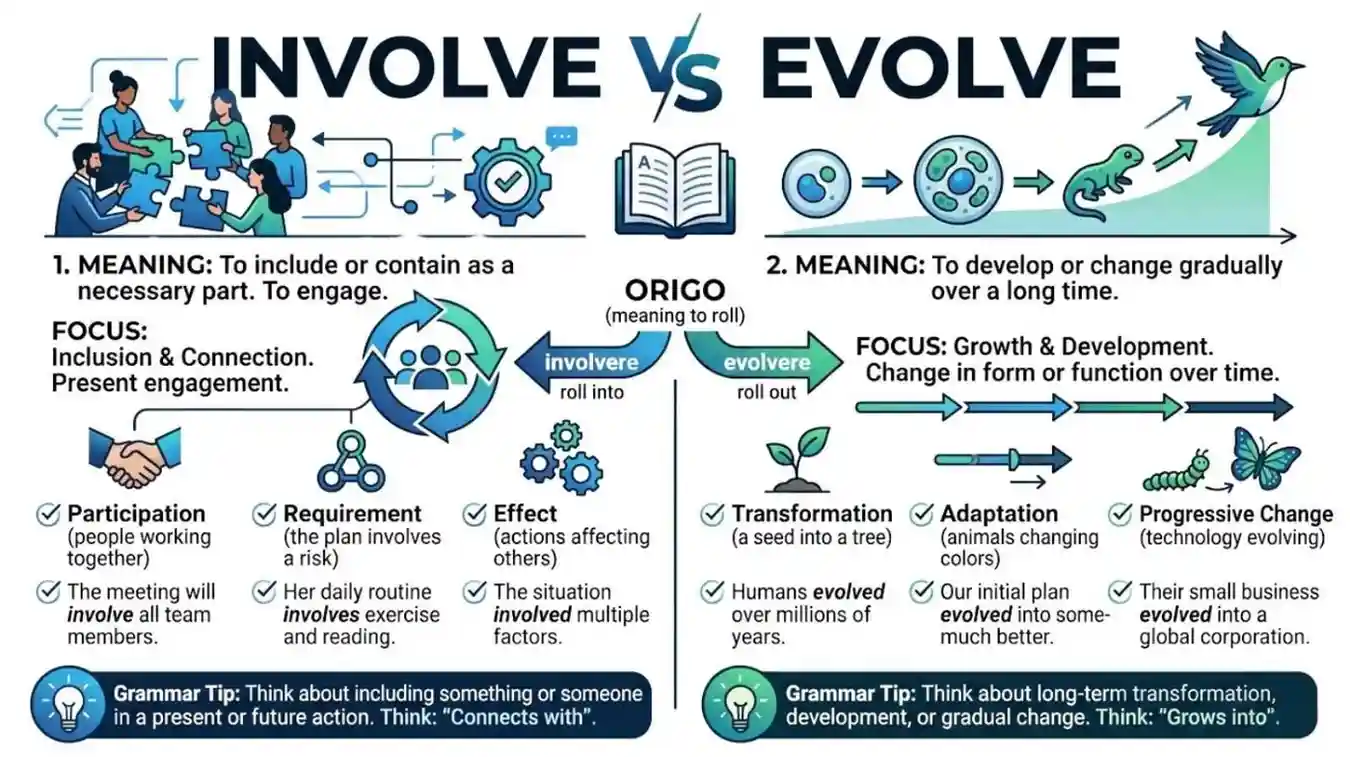
“Involve” comes from an old Latin word. It was built from “in-,” meaning “into,” joined with a word that meant “to roll.” Put together, the word once carried the idea of something being “rolled into” a situation. Over time, this grew into the meaning we use today: being part of, or tied to, something.
Since the word is built on “in-,” not “en-,” the correct spelling has always stayed “involve.” There was never a version with “en-” at any point in the word’s past. “Envolve” isn’t some old, forgotten spelling either. It’s simply a modern typing slip that happens to sound close to the real word.
Words That Share the Same “In-” Pattern
| Word | Meaning |
| Involve | To include or be part of something |
| Inform | To tell someone something |
| Inspect | To look closely at something |
| Invite | To ask someone to join or attend |
Seeing “involve” next to other common “in-” words shows it’s not some strange, standalone case. It’s part of a much bigger, steady group of English words that all start the same way.
Words That Really Do Start With “En-“
To be fair, plenty of real English words do start with “en-,” which is exactly why this mix-up feels so natural in the first place.
| Word | Meaning |
| Enjoy | To take pleasure in something |
| Enter | To go into a place |
| Enable | To make something possible |
| Endure | To keep going through something hard |
Notice how none of these words connect back to “involve” in meaning or history. They just happen to share a similar sound at the start, which is enough to trip up even careful writers now and then.
A Simple Way to Remember
Try this trick: think of the word “inside.” Involve starts the exact same way, with “in-,” and the meaning even connects a little, since being involved in something often means being on the inside of it, part of the group, part of the plan.
Easy shortcut: inside starts with “in.” Involve starts with “in.” Keep those two words linked together in your head, and the spelling should stick for good.
A Quick Way to Check Yourself
Next time you’re not sure, try saying the word slowly out loud, part by part: “in,” then “volve.” If you can hear that clear “in” sound at the start, you already know the right spelling to use.
This little trick works well since it forces you to slow down for just a second, which is often all it takes to catch a fast typing mistake before it happens.
You can also try this with other tricky words too. Breaking a word into small parts and saying each part slowly almost always makes the correct spelling feel more obvious, since your ear picks up on sounds that your eyes sometimes miss while reading fast.
Common Mistakes People Make
Mistake 1: Wrong: “I don’t want to envolve myself in that situation.”
Fix: “I don’t want to involve myself in that situation.” (Involve always uses “in-,” never “en-.”)
Mistake 2: Wrong: Typing “envolve” fast without noticing, since it sounds close to the real word when spoken.
Fix: Slow down for a second and picture the word “inside” to help lock in the right spelling before hitting send.
Mistake 3: Wrong: Assuming spell-check will always catch this mistake.
Fix: Most spell-check tools do catch “envolve” and flag it, but it still helps to know the correct spelling yourself, mostly for handwriting or fast typing.
Mistake 4: Wrong: Mixing up “envolve” with the real word “evolve,” which does exist but means something totally different.
Fix: “Evolve” means to grow or change slowly over time. It has no link to “involve” at all, even though it looks a bit close on the page.
Everyday Examples
In a work email: “The new project will involve three different teams working closely together.”
In a school paper: “The test involves checking how plants grow under different light levels.”
On social media: “Can’t wait for this trip, it’s going to involve so many new things!”
In a casual conversation: “I don’t want to get involved in their argument, it’s really not my business.”
Search Trends and Usage Data
Search interest in “involve or envolve” often comes from people checking their spelling before sending an important message, essay, or work paper.
- Students and English learners: Many searches come from people studying English, since word starts like “in-” and “en-” can feel confusing at first.
- Fast typists and texters: Some searches come from people who typed “envolve” out of habit and paused, unsure if it looked right.
- Writers and workers: Careful writers sometimes search this just to check their own memory before turning in something formal, like a report or a job letter.
This word pair stays a steady, common search topic, since the mix-up is easy to make but also easy to clear up once explained well.
Frequently Asked Questions
1. Is “envolve” a real word in any other language? It’s not a real word in English, though some other languages have close-sounding words with different spellings and meanings, which can add to the mix-up for some people.
2. Why does “involve” use “in-” instead of “en-“? It comes from its old Latin root, built on “in-,” meaning “into.” The spelling has stayed the same as that root all through its history.
3. Is “involve” spelled the same in British and American English? Yes. Both places use the exact same spelling, with no regional change at all for this word.
4. Are there other common words people mix up this same way? Yes, quite a few. Words like “inspire” and “insist” sometimes get typed with “en-” too, by the same kind of slip.
5. Does “involve” ever change spelling in other forms, like “involved” or “involving”? No. The “in-” spelling stays the same across every form of the word, including “involved,” “involving,” and “involvement.”
6. Is there a trick to remember this for good? Yes. Link “involve” to the word “inside” in your head. Both start with “in,” and the meanings even connect a little, which makes the spelling much easier to recall.
7. Can this mistake make writing look less careful? It can, mostly in formal writing like emails, reports, or job letters, where small spelling slips can catch a sharp reader’s eye more than you’d think.
The Bottom Line:
Involve or envolve? Only one is a real word: involve. This word has always used the start “in-,” going back to its old Latin roots, and there’s never been a correct form spelled with “en-” at any point in its history.
This is one of those small spelling slips that feels small in the moment but can quietly shape how careful your writing looks to someone else. Since “in-” and “en-” sound so close when said fast, it’s an easy trap to fall into, mostly while typing quickly on a phone or rushing through an email.
The good news is, once this small trick sticks in your head, it tends to stick for good. Just picture the word “inside” the next time you’re about to type “involve,” and you’ll land on the right spelling without even having to stop and think twice. A tiny habit like this can save you from a small but noticeable mistake, again and again, for the rest of your writing life.

Ethan Carter is a language writer at Wordellect who helps readers understand word differences, grammar rules, and spelling variations through simple and accurate guides.







