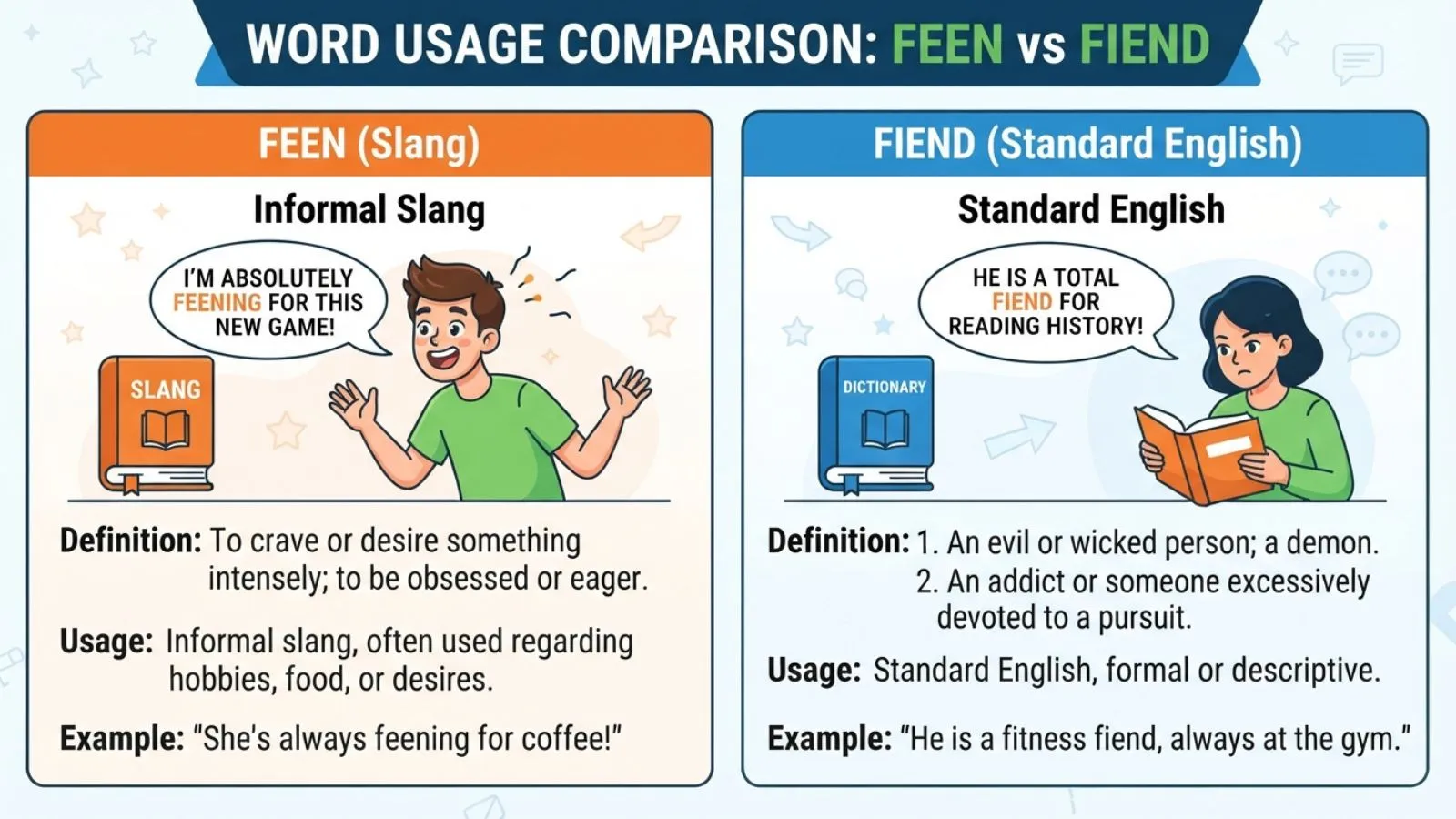
Feen or fiend can be confusing because the two words look and sound close, but they have very different meanings. If you see the word feen online, you may wonder if it is a real English word or a spelling mistake for fiend.
The answer depends on the context.
Fiend is a standard English word. It can mean a very cruel or evil person. It can also mean someone who really loves or wants something, such as a “coffee fiend.”
Feen is different. It is often used as an informal spelling of fiend, especially in slang or online writing. It may also appear as a name or in other special uses.
This guide explains feen or fiend, their meanings, spelling, pronunciation, history, and common uses. You will also see simple examples that show when each form makes sense.
If you need standard English for school, work, or formal writing, knowing the difference can help you choose the right word.
Feen or Fiend – Quick Answer
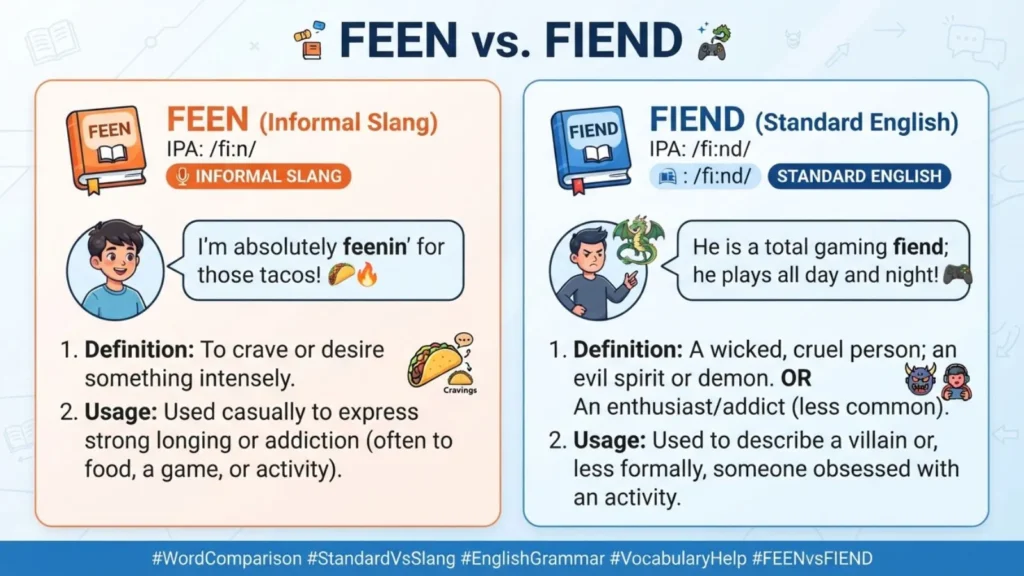
Fiend is the standard English word. Feen is usually an informal slang spelling of fiend when people mean someone who strongly wants or needs something.
Examples:
- He is a coffee fiend.
- She is a caffeine fiend.
- He’s feening for some food. Informal slang
The spelling fiend is the one to use in standard English.
Feen may appear in slang, songs, social media, and casual messages.
What Does Fiend Mean?
Fiend is a standard English noun.
It can have more than one meaning.
1. A cruel or evil person
A fiend can mean a person who is very cruel or evil.
Example:
The story describes the killer as a fiend.
This meaning is often found in books, stories, and older writing.
2. A person who strongly likes something
Fiend can also describe someone who really likes or wants something.
Examples:
- He is a coffee fiend.
- She is a chocolate fiend.
- My brother is a video game fiend.
Here, fiend does not mean an evil person. It means someone who has a very strong interest in something.
What Does Feen Mean?
Feen is not the usual standard spelling of the word fiend.
In informal slang, feen can be used to show a strong desire for something. You may also see forms such as feening or feenin’ in casual online writing and music.
For example:
I’m feening for some pizza.
This means the person really wants pizza.
The spelling is informal. It is not the normal choice for formal English.
Feen vs Fiend: Main Difference
The main difference is standard English vs informal slang.
Fiend is a normal dictionary word with several meanings.
Feen is often an informal slang spelling used to show a strong desire for something.
The words can appear similar, but you should not treat them as exact replacements in every sentence.
| Word | Meaning | Usage | Example |
| fiend | A cruel person or someone who strongly likes something | Standard English | He is a coffee fiend. |
| feen | Informal slang for wanting something badly | Casual writing | I’m feening for pizza. |
Is Feen a Correct Word?
Feen can appear in informal slang, but it is not the standard spelling of the common English word fiend.
If you are writing an essay, email, school assignment, report, or other formal text, fiend is the safer standard form.
If you are writing dialogue, a social media post, or casual slang, you may see feen used.
Context matters.
Is Fiend Always a Bad Word?
No.
The word fiend can have a negative meaning, but it does not always mean something bad.
For example:
He is a music fiend.
This simply means he really loves music.
You can use fiend after a noun to describe someone who has a strong interest in something.
Examples include:
- fitness fiend
- coffee fiend
- chocolate fiend
- movie fiend
- sports fiend
In these examples, the word does not mean an evil person.
Feen, Feening, and Feenin’
The slang form can appear in several ways.
Feen
This can be used as a slang spelling.
Example:
I’m a feen for good food.
Feening
This is a common informal form used to describe a strong desire.
Example:
I’m feening for a burger.
Feenin’
This is another casual spelling.
The apostrophe shows that the final sound or letters have been left out in informal speech or writing.
These forms are mainly suited to casual settings.
Origin and History
The word fiend is much older than the modern slang spelling feen.
Fiend comes from Old English fēond, which was related to the idea of an enemy or one who hates. Over time, the word developed into the modern English fiend.
The word later gained the sense of an evil or cruel person.
It also developed another use for a person who has a very strong liking for something.
The informal spelling feen is associated with modern slang use. It should not be confused with the older standard word fiend.
British English vs American English
There is no major British vs American spelling difference between feen and fiend.
Fiend is the standard English spelling in both varieties.
The slang form feen can appear in informal speech and writing, especially in modern slang.
| English type | Standard form |
| American English | fiend |
| British English | fiend |
| Formal writing | fiend |
| Informal slang | feen may appear |
The meaning can change with context, so always look at the full sentence.
Which One Should You Use?
Use fiend when you need standard English.
Use fiend for:
- School work
- Essays
- Business writing
- Formal emails
- Reports
- Academic writing
- Standard English
- General writing
Feen may fit:
- Text messages
- Social media
- Informal dialogue
- Slang
- Song lyrics
- Casual online writing
If you are unsure, choose fiend for formal or standard writing.
Common Mistakes
1. Writing “feen” in formal English
Incorrect in standard usage:
He is a coffee feen.
Better:
He is a coffee fiend.
Why: Fiend is the standard spelling.
2. Thinking fiend always means evil
Wrong idea:
A fiend always means a bad person.
Correct:
A fiend can also mean someone who strongly likes something.
Example:
She is a chocolate fiend.
3. Treating feen and fiend as exact spellings
Mistake:
Using feen everywhere that you would use fiend.
Why: The slang spelling does not fit all uses of the standard word.
4. Using slang in formal writing
Mistake:
I am feening for a new laptop.
in a formal report.
Better:
I really want a new laptop.
5. Assuming feen is the standard spelling
Mistake:
Thinking that feen is the normal dictionary spelling of fiend.
Correct:
Fiend is the standard English spelling.
Everyday Examples
Here are some simple examples:
- He is a coffee fiend.
- She is a chocolate fiend.
- My brother is a movie fiend.
- The book describes a cruel fiend.
- He is a fitness fiend.
- I’m feening for some pizza.
- She was feening for a cold drink.
- He said he was feening for a burger.
- I am a music fiend.
- The story’s villain was called a fiend.
Real-Life Usage
In conversations
People may use fiend in normal speech:
“My sister is a coffee fiend.”
You may also hear feening in casual slang:
“I’m feening for some fries.”
In emails
Use standard English in work emails.
Better:
I’m really looking forward to the event.
Avoid slang unless you are writing to someone in a very casual setting.
At school
Use fiend when the word fits your meaning.
Avoid feen in essays unless you are discussing slang itself.
On social media
Both forms may appear, depending on the writer’s style.
Feen is more likely to appear as slang.
In formal writing
Use standard words and avoid slang forms such as feen.
Related Search Questions
What is the difference between feen and fiend?
Fiend is a standard English word. It can mean an evil person or someone who strongly likes something. Feen is usually an informal slang spelling linked to the idea of strongly wanting something.
Is feen a spelling mistake?
Not always. In standard English, fiend is the normal spelling. Feen can be intentional slang, especially in casual online writing or speech-based writing.
Is fiend a bad word?
Not always. Fiend can describe a cruel or evil person, but it can also describe someone who strongly enjoys something, such as a coffee fiend.
What does feening mean?
Feening is an informal slang form used to show that someone strongly wants or desires something.
Can I use feen in an essay?
It is better to avoid feen in a normal school or academic essay unless you are talking about the slang word itself. Use standard English instead.
What does coffee fiend mean?
A coffee fiend is someone who really likes coffee or drinks a lot of coffee. The word fiend has a less negative meaning in this type of phrase.
Is fiend British or American?
Fiend is used in both British and American English. It is not a spelling difference between the two varieties.
Usage and Search Trends
Exact search-volume or Google Trends data is not included here, so no specific numbers should be claimed.
People who search feen or fiend may be trying to understand a slang word, check a spelling, or learn the difference between the two forms.
Searches may also include questions such as:
- Is feen a word?
- What does feen mean?
- What does fiend mean?
- Feening meaning
- Is fiend a bad word?
- Feen vs fiend
Feen or Fiend Comparison Table
| Feature | Feen | Fiend |
| Standard English | No, usually slang | Yes |
| Common meaning | Strong desire in slang | Evil person or strong enthusiast |
| Formal writing | Usually avoid | Appropriate when meaning fits |
| Casual writing | Common in slang | Common |
| British English | Slang use | Standard |
| American English | Slang use | Standard |
| Example | I’m feening for pizza. | He is a coffee fiend. |
FAQs
Is “feen” a real English word?
Feen can be found in informal slang, but it is not the normal standard spelling of fiend. In formal English, use fiend when that is the word you mean. If you are writing dialogue or casual slang, feen may be used to show an informal style.
What does “fiend” mean in simple English?
A fiend can mean a very cruel or evil person. It can also mean someone who really likes or wants something. For example, a coffee fiend is someone who loves coffee or drinks a lot of it.
What does “feening” mean?
Feening is an informal slang form that means strongly wanting or craving something. For example, “I’m feening for pizza” means “I really want pizza.” It is mainly used in casual speech, texts, social media, and other informal settings.
Should I write “fiend” or “feen”?
Use fiend in standard and formal English. Use feen only when you want the informal slang form or when the style of the text calls for it. In school, work, and formal writing, standard spelling is usually the better choice.
Is “fiend” the same as “fan”?
They can be similar in some phrases, but they are not exact synonyms. A fiend can mean someone with a very strong interest in something. A fan simply means someone who likes or supports something. The word fiend can sound stronger.
Is “feen” short for “fiend”?
In modern informal slang, feen is often used as a slang spelling related to fiend, especially in expressions about strongly wanting something. However, it should not be treated as the standard spelling in all contexts.
Can “fiend” be positive?
Yes. In phrases such as music fiend or coffee fiend, it can simply describe someone who has a very strong interest in something. The word does not always describe an evil or cruel person.
Conclusion
When comparing feen or fiend, the most important point is that fiend is the standard English word, while feen is mainly used as an informal slang form.
Fiend has more than one meaning. It can describe a cruel or evil person. It can also describe someone who strongly likes or wants something. For example, a coffee fiend is someone who really likes coffee.
Feen appears mostly in casual slang. It can be used to show a strong desire for something. You may see forms such as feening in texts, social media, songs, and casual speech.
For school, work, business, and other formal writing, fiend is the safer standard choice when it fits your meaning.
The easiest way to remember the difference is simple: fiend is the standard word, while feen is usually slang. Always check the context before choosing the spelling.

Ethan Carter is a language writer at Wordellect who helps readers understand word differences, grammar rules, and spelling variations through simple and accurate guides.







