You write a word. Then you stop. Is it “daddy’s car” or “daddies car”? Many people get stuck here. It is a common problem.
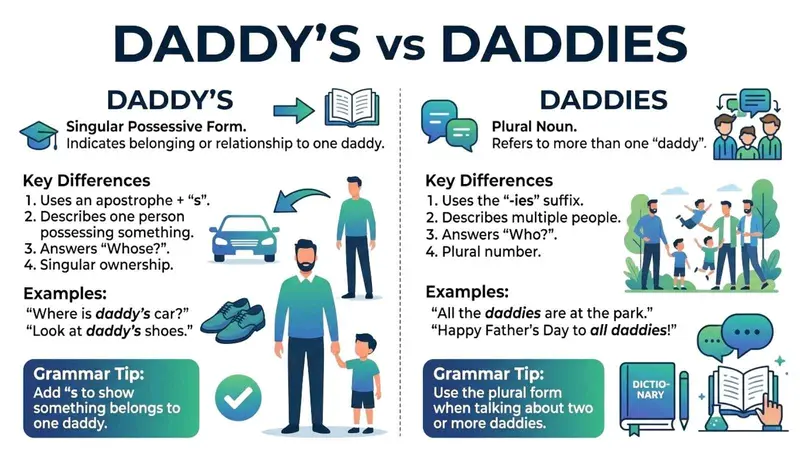
The trick is one small mark. It is called an apostrophe. This little mark changes the meaning a lot. “Daddy’s” means something belongs to one daddy. “Daddies” means more than one daddy. The two words sound almost the same. But they mean different things.
People look this up when they write texts, school work, cards, or social media posts. Some want to show that something belongs to one dad. They want to talk about many dads. Some just want to avoid a mistake.
This article gives you the answer fast. Then it shows the history, the spelling rules, common mistakes, and easy examples. After this, you will not get confused again.
Daddy’s or Daddies – Quick Answer
Here is the short answer:
- Daddy’s = it belongs to one daddy. Example: Daddy’s keys are on the table.
- Daddies = more than one daddy. Example: Three daddies came to the park.
- Daddies’ = it belongs to more than one daddy. Example: The daddies’ group meets on Tuesday.
The apostrophe tells the whole story. One daddy who owns something gets an apostrophe before the “s.” Many daddies with no ownership get no apostrophe at all.
The Origin of Daddy’s or Daddies
“Daddy” is a child’s word for “father.” Babies often say simple sounds like “da-da” first. This happens in many languages, not just English. That is why father-words sound alike around the world.
English shows ownership with an apostrophe and “s.” This rule is very old. It comes from Old English. People still use it today for one owner.
The plural rule is different. Most English words add “s” to become plural. But “daddy” ends in “y.” So we change the “y” to “i” and add “es.” This gives us “daddies.”
These two rules do different jobs. One shows who owns something. The other shows how many there are. That is why the spelling changes.
British English vs American English Spelling
Good news. British and American English use the same rules here. There is no spelling fight like with “color” and “colour.”
| Form | British English | American English | Meaning |
| Singular | Daddy | Daddy | One father |
| Possessive | Daddy’s | Daddy’s | Belongs to one daddy |
| Plural | Daddies | Daddies | More than one daddy |
| Plural Possessive | Daddies’ | Daddies’ | Belongs to many daddies |
The only small difference is how often people use the word. British kids may say “Daddy” longer. American kids may switch to “Dad” sooner. But the spelling does not change.
Which Spelling Should You Use?
Pick the word based on what you mean, not where you live.
- Writing for US readers: Use “daddy’s” for one owner. Use “daddies” for many dads.
- Writing for UK or Commonwealth readers: Same rule. No change needed.
- Writing for readers everywhere: Use the correct spelling. Do not use “daddys.” It is wrong and may confuse readers.
- Writing for social media: People often forget the apostrophe. For work or brand posts, always check it.
The real question is simple: one owner, or many people?
Common Mistakes with Daddy’s or Daddies
Here are mistakes people make a lot:
- Writing “daddys” instead of “daddy’s.” Wrong: This is daddys phone. Right: This is daddy’s phone.
- Using “daddy’s” when you mean many dads. Wrong: Two daddy’s came to pick up. Right: Two daddies came to pick up.
- Forgetting the apostrophe for many owners. Wrong: The daddies cars are parked outside. Right: The daddies’ cars are parked outside.
- Mixing up “daddies” and “daddy’s” in one sentence. Wrong: Best daddy’s day ever with both daddies. Right: Best daddy’s day ever (one dad) or Best day ever with both daddies (two dads, no ownership).
- Adding an apostrophe to a normal plural. This is a common mistake in English. Plain plural words rarely need an apostrophe.
Daddy’s or Daddies in Everyday Examples
In a text message: “Can you grab daddy’s jacket before we go?”
In a social media post: “Park day with both daddies! “
In a news story: “The event welcomed daddies from across the city for breakfast.”
formal writing: “The study looked at forty daddies’ habits in the first year.”
In a greeting card: “Happy Father’s Day to the best daddy’s girl.”
Each example shows the same rule. One owner gets the apostrophe before “s.” Many people get “daddies.” Many owners get the apostrophe after “s.”
Daddy’s or Daddies – Google Trends & Usage Data
People search this word a lot near Father’s Day, back-to-school time, and family shopping events. They search it while writing cards, captions, and product names.
The US, UK, Canada, and Australia all show the same search habits. Most people search on their phone. They want a fast answer, not a long lesson. That is why a quick answer at the top helps the most.
Shops and card brands also need the right spelling. They use phrases like “Daddy’s Day Out” or “World’s Best Daddies.”
Comparison Table: Keyword Variations
| Variation | Correct? | Use Case |
| Daddy’s | ✅ Yes | One owner |
| Daddies | ✅ Yes | Many people, no ownership |
| Daddies’ | ✅ Yes | Many owners |
| Daddys | ❌ No | Common mistake |
| Daddy’s’ | ❌ No | Wrong, extra mark |
| Daddiess | ❌ No | Wrong, extra letter |
FAQs:
1. Is it “daddy’s” or “daddies” for more than one dad? Use “daddies” for more than one dad with no ownership.
2. How do you make “daddy” plural? Change the “y” to “i” and add “es.” This gives “daddies.”
3. What does “daddy’s” mean? It means something belongs to one daddy, like “daddy’s car.”
4. Is “daddys” ever right? No. “Daddys” is always wrong. The right word is “daddy’s.”
5. How do you show many daddies own something? Add an apostrophe after the “s” in “daddies.” This gives “daddies’.”
6. Do British and American English spell this word differently? No. Both use the same spelling and the same rules.
7. Why do people misspell this word so often? Because the rules for “one owner” and “many people” look alike. People skip or misplace the apostrophe.
Conclusion:
The choice between “daddy’s” and “daddies” comes down to one easy question. Do you mean one owner, or many people? “Daddy’s” means something belongs to one daddy. “Daddies” means more than one daddy, with no ownership. Add the apostrophe after the “s” only when many daddies own something together.
This rule stays the same in American English, British English, and English around the world. There is no regional spelling change to worry about. It is just one grammar rule for one owner and another rule for many people.
Watch out for the biggest mistake: skipping the apostrophe in “daddy’s,” or adding one in the wrong place in “daddies.” Check your sentence before you send it, post it, or print it. Once you know the difference between “one owner” and “many people,” this word becomes easy every time.

I explore and explain the difference between commonly confused English words to make writing clearer and more accurate. I provide simple, SEO-friendly explanations with examples to help you understand usage easily. I help improve grammar skills by making word differences easy to learn and remember.







