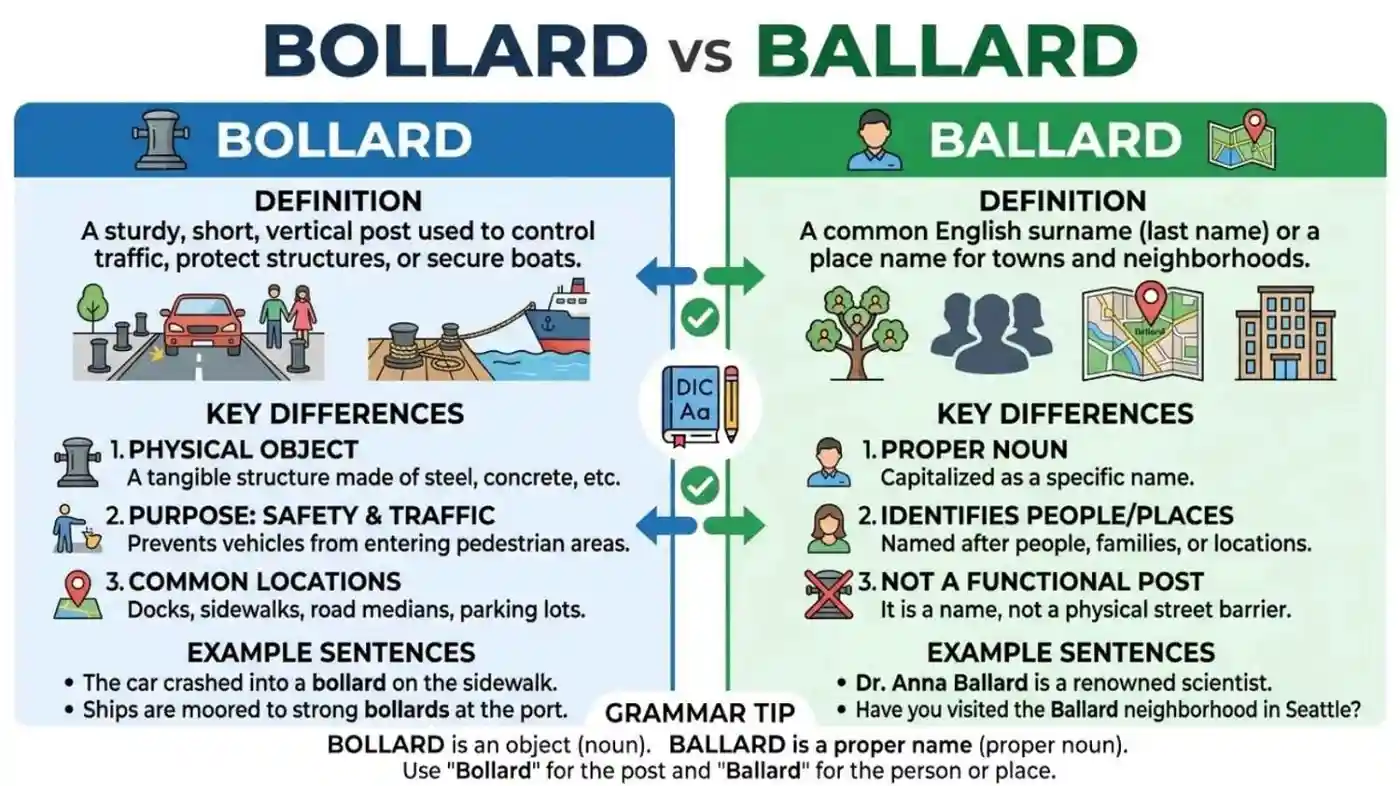
Here it is.
Bollard is a short post. You see it on streets. It stops cars.
Ballard is a name. It can be a person’s last name. It is also a place in Seattle.
Easy examples:
- “The city put up new bollards.” (a post)
- “She lives in Ballard.” (a place)
These two words sound close. But they mean two different things.
Why People Mix These Up
You hear one word. It sounds close to the other. Your mind picks the wrong one. This happens a lot with words that sound alike but look a bit different.
Both words are a bit rare too. You don’t hear “bollard” every day. You don’t hear “Ballard” every day either. This makes it easy to mix them up.
This kind of mix-up is common. If you don’t hear a word often, your brain does not get much practice with it. Words you hear every day are easy to sort out. Words you rarely hear are not.
Where These Words Came From
Bollard comes from an old word for a wood post. Long ago, sailors used strong posts to tie up boats. Over time, the word grew to mean any short, strong post. Today, you see bollards near shops, on sidewalks, and near bike paths. They all do the same job. They stop cars but let people walk through.
Ballard is a name, not a normal word. As a last name, it may come from an old word tied to being bold or brave. As a place name, Ballard in Seattle got its name from an early settler.
One word is for a thing. The other is a name. They never really share the same meaning. They just sound close.
A Closer Look at Ballard, the Place
Ballard is a well-known place name. It sits in Seattle, in the state of Washington. It had strong ties to fishing and boats, since it sits near water.
Over time, Ballard became part of the bigger city of Seattle. But it kept its own name and its own feel. Today, people know Ballard for its shops and food. Locals still talk about Ballard like it’s its own little world.
This does not change the spelling rule. Whether it’s the place, a school, or a last name, it’s always “Ballard,” with two L’s. Never “Bollard.”
Side-by-Side Table
| Word | Type | Meaning | Example |
| Bollard | Thing | A post that blocks cars | “Bollards line the street.” |
| Ballard | Name | A person or a place | “He grew up in Ballard.” |
| Bollards | Thing, more than one | Many posts | “New bollards were added.” |
| Ballard High School | Place name | A school in Seattle | “She went to Ballard High School.” |
A Simple Way to Remember
Try this: bollard starts with “boll,” close to “bowl.” Picture a round post on the street.
Ballard starts with “ball,” easy to link to a name.
Easy rule: Talking about a street post? Use “bollard.” Talking about a person or a place? Use “Ballard.”
Other Words That Sound Close But Mean Different Things
Bollard and Ballard are not the only pair like this. Many English words sound close but mean very different things. Here are a few more:
| Word Pair | Meaning 1 | Meaning 2 |
| Bollard / Ballard | Street post | Person or place name |
| Desert / Dessert | Dry land | Sweet food after a meal |
| Affect / Effect | To change something | The result of a change |
| Complement / Compliment | Something that completes | A kind, nice comment |
This shows that this kind of mix-up is normal in English. The trick is the same each time. Slow down. Think about what you really mean. Then pick the right word.
Common Mistakes People Make
Mistakes
1: Wrong: “The city put up new ballards.”
Fix: “The city put up new bollards.” (This is the street post, so use “bollard.”)
2: Wrong: “She’s from Bollard, near Seattle.”
Fix: “She’s from Ballard, near Seattle.” (This is the place, so use “Ballard.”)
3: Wrong: Using “bollard” like it’s someone’s name.
Fix: “Bollard” is not a name. If you mean a person, you likely mean “Ballard.”
4: Wrong: Spelling it “bolard,” with one L.
Fix: The right spelling is “bollard,” with two L’s, just like “Ballard” has two L’s too.
Everyday Examples
In a city report: “New bollards will go near the school to keep walkers safe.”
In daily talk: “I used to live in Ballard before I moved downtown.”
A news story: “The plan adds bollards to block cars from the plaza.”
On social media: “Getting coffee in Ballard this morning. Love this area.”
Search Trends and Usage Data
People search “bollard or ballard” for a few clear reasons.
- City workers: Many search “bollard” while working on street safety plans. They want to check the right spelling for reports.
- People who know Seattle: Others search “Ballard” just to learn about the area, its shops, or its past.
- People who typed the wrong word: Some searches come from people who heard one word and typed the other by mistake.
Both words stay in steady, separate use. One is tied to street safety. The other is tied to a well-loved place name.
Why Getting This Right Matters
In daily talk, mixing up these two words is not a big deal. Most people get what you mean either way. But in written work, like a city report or a news story, the wrong word can look like a mistake.
Picture a report that says “new ballards will be added downtown.” A careful reader might stop and wonder what that means, since “Ballard” is also a real place name. Getting this right keeps writing clear and easy to trust.
Frequently Asked Questions:
1. Is “bollard” only used for street safety? Mostly, yes. Bollards almost always block or guide cars, while still letting people walk through.
2. Is Ballard a common last name? It’s a known English last name, though not one of the most common ones.
3. Why do bollards exist on streets? They help keep sidewalks and people safe from cars driving into walking areas.
4. Is Ballard only a place in Seattle? It’s the best-known Ballard, but the name can also be a person’s last name, with no link to the place.
5. Do bollards ever move? Some stay fixed in place. Others can be lowered to let in trucks, like fire trucks, when needed.
6. Is there a fast way to remember the spelling? Yes. “Bollard” starts with “boll,” close to “bowl.” “Ballard” starts with “ball,” which is easier to link to a name.
7. Can these two words ever mean the same thing? No. One is a thing. One is a name. They should never be swapped.
The Bottom Line:
Bollard or Ballard? These two words sound close, but they mean very different things. Bollard is a short, strong post that blocks or guides cars on streets. Ballard is a name, most often tied to a well-known Seattle area, or used as a person’s last name.
Next time you hear one of these words, stop for a second. Think about what is really being said. A street topic points to “bollard.” A person or place points to “Ballard.” That one quick check will help you pick the right word every time.

Ethan Carter is a language writer at Wordellect who helps readers understand word differences, grammar rules, and spelling variations through simple and accurate guides.







