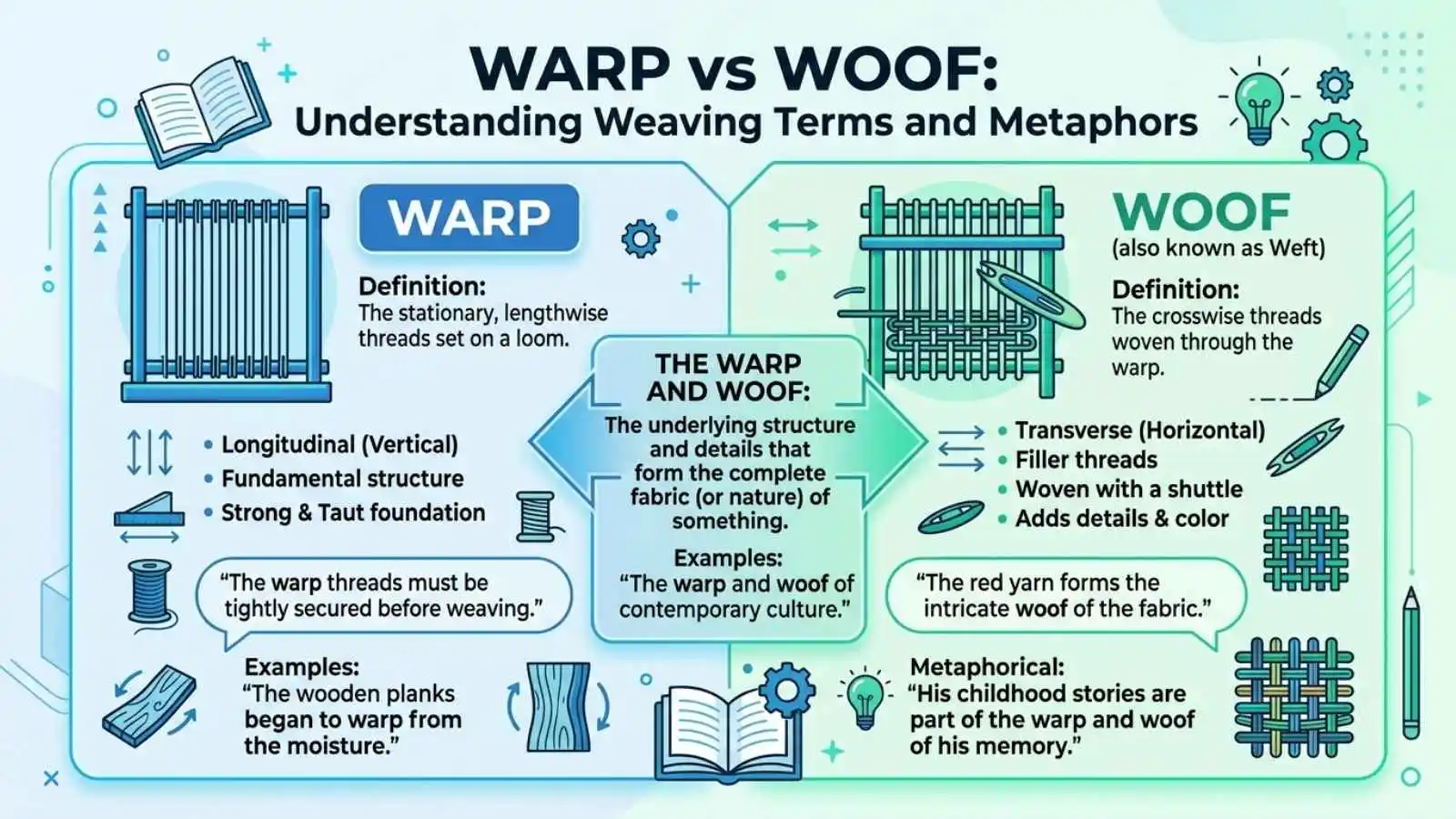
You’re reading about weaving, maybe trying a craft project, and you keep seeing “warp” and “woof” used together. They sound like they should mean the same thing, or maybe like one is just an old-timey word for the other. But they’re actually two different parts of the exact same piece of cloth.
This isn’t a spelling mix-up like some word pairs. Warp and woof are both real, correct words, and they’re not competing for the same job. They’re a team. Once you see how they work together, this whole thing clicks fast.
The Simple Answer
Every woven fabric, from a basic cotton shirt to a fancy rug, is made of two sets of threads crossing each other.
- The warp is the set of threads held tight and running the long way, top to bottom, on a loom before any weaving even starts.
So warp holds still. Woof does the moving. Together, they make the fabric.
Where These Words Come From
Both words are old, going back to early English, long before factories made cloth by machine.
“Woof” comes from an old word tied to weaving itself, and it’s closely related to another word you might already know: “weft.” In fact, “woof” and “weft” mean the exact same thing, the thread that crosses the warp. “Weft” is more common in modern weaving talk, but “woof” is just as correct, just a bit older-sounding.
Why People Mix These Up
Honestly, it’s mostly because most people never need these words in daily life. Unless you weave, sew seriously, or work with textiles, you might go years without hearing either word, so when they show up together, they just sound like two versions of the same idea.
There’s also the sound of “woof,” which doesn’t help. It’s spelled just like the sound a dog makes, so it can feel like a strange, almost jokey word to take seriously in a craft context.
How to Keep Them Straight
Here’s an easy way to remember it: warp stays still, like something “warped” or fixed into place on the loom before weaving starts. Woof moves across, weaving in and out, the same way the word “weave” and “woof” share that soft “w” sound.
Or picture a loom directly. The tight vertical threads, the ones you’d have to thread carefully before you even start? That’s the warp. The thread on the shuttle, going back and forth, over and under? That’s the woof.
Which One Should You Use?
Since both words are correct and mean two different things, this isn’t really about picking the “right” one. It’s about knowing which direction you’re talking about.
Use “warp” when talking about:
- The lengthwise threads set up on a loom
- The threads that stay in place while weaving happens
- Warp threads specifically, like “the warp needs to be tighter before we start”
Use “woof” when talking about:
- The thread that crosses side to side
- The thread carried by the shuttle during weaving
- The older or more traditional term for what’s now often called “weft”
A Few Common Mix-Ups
Thinking warp and woof are just two spellings of the same thread. They’re not. They’re two separate parts of the weaving process, working in opposite directions.
Assuming “woof” is a typo or a joke because of the dog sound. It’s a completely real, traditional weaving term, just one that sounds unusual out of context.
Forgetting that “woof” and “weft” mean the same thing. If you’ve heard “weft” before but not “woof,” just know they’re basically interchangeable, weft is simply the more common modern word for the same idea.
Real Examples:
old textile guide: “The woof passes over and under the warp to form the pattern.”
casual crafting talk: “I always mix up warp and woof, so I just remember warp stays put.”
weaving class: “Today we’re focusing on how tension in the warp affects the finished fabric.”
Quick Answers to Common Questions
Is “woof” the same as “weft”? Yes, they mean the same thing, the thread that crosses the warp. “Weft” is just the more commonly used modern term today.
Which one stays still, warp or woof? The warp stays still, stretched tight on the loom. The woof is the thread that moves back and forth across it.
Is “woof” an old-fashioned word? Somewhat, yes. It’s still correct and understood, but “weft” has become more common in everyday weaving language.
Do I need to know both words to weave? Not necessarily, since “weft” works fine on its own today, but knowing “woof” helps if you’re reading older books or traditional weaving guides.
Why does warp sound related to the word “warped”? They share the same old root, tied to the idea of something being stretched, cast, or pulled into place, which fits how warp threads get set up on a loom.
This isn’t a regional spelling issue at all.
Are there other words like this in weaving? Yes, weaving has its own set of specific terms, like “shuttle,” “loom,” and “selvedge,” each describing a different tool or part of the process, much like warp and woof.
Wrapping This Up:
Warp and woof aren’t two spellings of one idea, they’re two threads doing two different jobs in the same piece of fabric. Warp is the set of threads held tight, running the long way on a loom. Woof is the thread woven back and forth across it, also known today as “weft.”
Once you picture an actual loom, tight threads running one way, a single thread crossing through them, this pair stops being confusing fast. They’re not fighting for the same spot. They’re literally what holds the whole fabric together.

Ethan Carter is a language writer at Wordellect who helps readers understand word differences, grammar rules, and spelling variations through simple and accurate guides.







