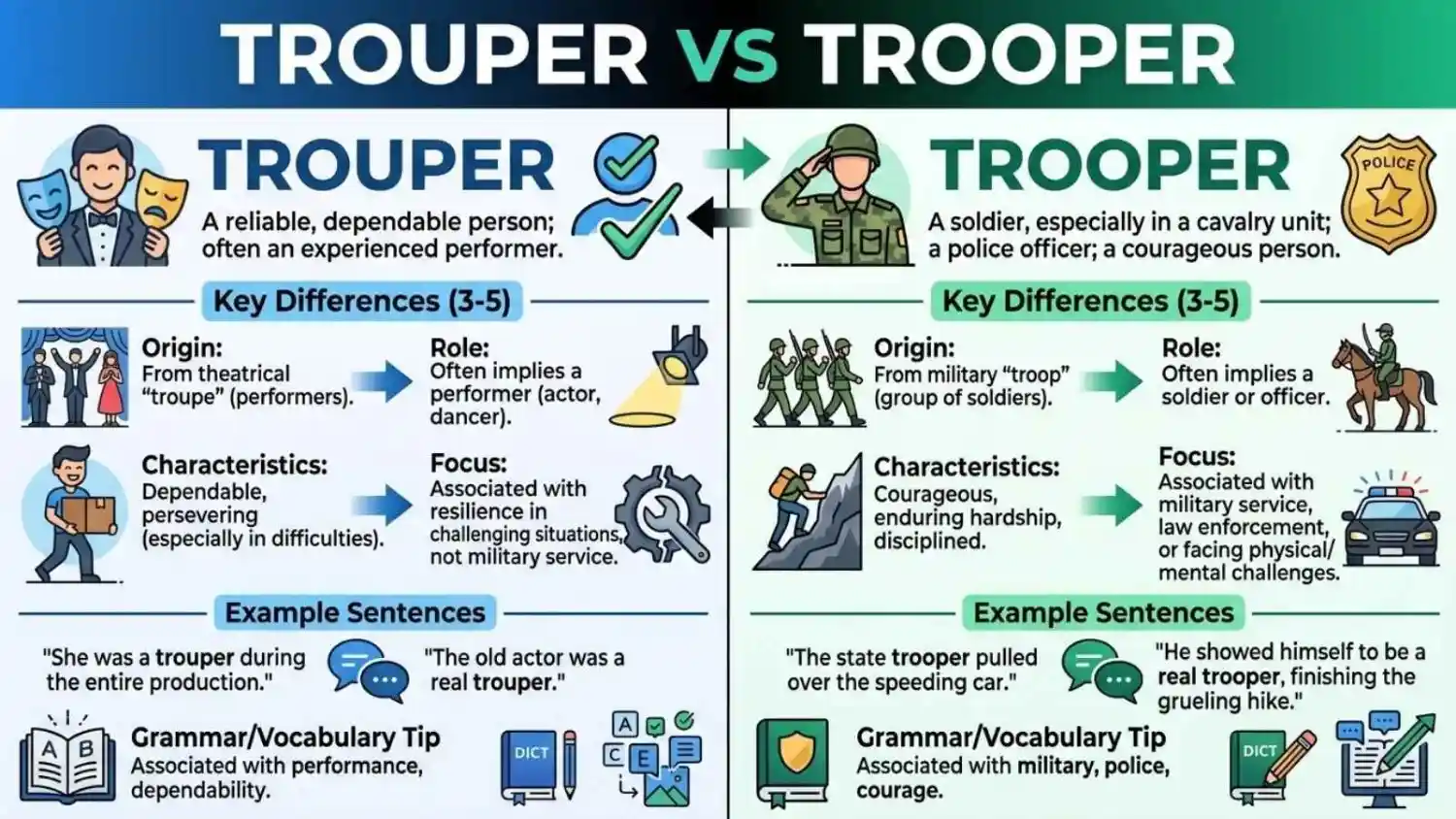
This is one of the most searched word mix-ups in English. People search it because the two words sound exactly the same. They are spelled almost the same. But they mean different things. One word comes from the theater. The other comes from the military and the police.
Most people meet this problem when they want to compliment someone. They want to say someone “handled a hard situation well.” They are not sure which word fits. Spell-check does not always catch it, because both words are real and correctly spelled. That is the real confusion: this is not a typo issue. It is a meaning issue.
This guide gives you a quick answer first. Then it explains the history, the correct use for each word, and the mistakes most people make. By the end, you will never second-guess this choice again.
Trouper or Trooper – Quick Answer
Use trouper when you mean someone who is tough, dependable, and keeps going even when things get hard.
- “She was a real trouper during the long flight delay.”
- “Despite the rain, the whole team was troupers about it.”
Use trooper when you mean a soldier, a state police officer, or a member of a mounted or armored unit.
- “The state trooper pulled the car over.”
- “Cavalry troopers rode through the valley.”
Same sound. Different jobs. Different meanings.
The Origin of Trouper or Trooper
These two words did not start as spelling variants. They started as two separate words with two separate histories.
Trouper comes from “troupe,” a French word for a group of traveling performers. A trouper was originally an actor or entertainer who toured with a troupe. Life on the road was hard. Shows had to go on, even with illness, bad weather, or low pay. Over time, “trouper” grew into a compliment for anyone who pushes through difficulty without complaint.
Trooper comes from “troop,” a word for a group of soldiers. A trooper was a soldier, especially a cavalry soldier who rode a horse into battle. Later, many police departments adopted the word for officers who patrol highways, especially in the United States. A “state trooper” is a police title in many US states.
So the confusion is not about regional spelling rules. It is about two old, unrelated words that now sound identical. Because “trooper” is more common in daily life, many people use it by mistake when they actually mean “trouper.”
British English vs American English Spelling
Both words exist in both versions of English, and both keep the same spelling and meaning everywhere.
What differs is frequency, not spelling rules.
- In American English, “trooper” appears often because of the job title “state trooper.”
- In British and Commonwealth English, “trooper” is used more for soldiers, since most UK police are called “officers” or “constables,” not troopers.
- “Trouper” is used the same way in both American and British English, mainly to praise someone’s toughness or reliability.
| Region | Common word seen | Typical context |
| United States | Trooper | State police, highway patrol |
| United Kingdom | Trooper | Army, cavalry, armored units |
| United States | Trouper | Praise for resilience, entertainment world |
| United Kingdom | Trouper | Praise for resilience, theater tradition |
| Global / Commonwealth | Trouper | Same meaning everywhere, no regional shift |
No dialect changes the spelling. The words are just used in different settings, and that is what creates the mix-up.
Which Spelling Should You Use?
Your choice depends on meaning, not on where you live.
If you mean “tough and dependable”: always use trouper. This applies whether you are in the US, the UK, Canada, Australia, or anywhere else. “She’s such a trouper” means the same thing worldwide.
If you mean “a police officer or soldier”: use trooper. In the US, this often means a state highway patrol officer. In the UK and other Commonwealth countries, it usually means a soldier in a mounted, armored, or airborne unit.
If you are writing for a global audience: check your sentence’s meaning first. Ask yourself: am I praising resilience, or am I talking about a uniformed officer or soldier? That answer decides the word, not your audience’s country.
Common Mistakes with Trouper or Trooper
- Wrong: “He was a real trooper after the surgery.”
- Right: “He was a real trouper after the surgery.” (You mean he stayed strong, not that he is a police officer.)
- Wrong: “The state trouper wrote me a ticket.”
- Right: “The state trooper wrote me a ticket.” (Police title needs “trooper.”)
- Wrong: Assuming this is a US/UK spelling rule, like “color” vs “colour.”
- Right: It is not regional. It is two different words with two different meanings.
- Wrong: Using “trouper” for any soldier or officer.
- Right: Use “trooper” for military and police roles.
- Wrong: Mixing the words in formal writing without checking meaning.
- Right: Always pause and ask: toughness, or uniformed role?
Trouper or Trooper in Everyday Examples
In emails: “Thank you for covering my shift last minute. You’re a total trouper.”
In news headlines: “State Trooper Rescues Driver From Flooded Highway”
In social media posts: “My mom drove six hours in a snowstorm to get here. What a trouper. “
In military or police reports: “Two troopers responded to the scene within minutes.”
Notice the pattern: “trouper” shows up where someone is being praised. “Trooper” shows up where someone holds an official, uniformed role.
Trouper or Trooper – Google Trends and Usage Data
People search “trouper or trooper” mostly because:
- They are writing a thank-you message or tribute and want to sound correct.
- They read a news story about a “state trooper” and wondered about the spelling.
- They saw “trouper” in an old song or movie title and were unsure what it meant.
Usage by context tends to split clearly:
- “Trooper” dominates in US news, due to heavy use of “state trooper” in crime and traffic reporting.
- Both words appear at similar rates globally, since neither one is rare or old-fashioned.
| Keyword Variation | Meaning | Typical Source | Region Most Common |
| Trouper | Tough, dependable person | Tributes, entertainment, personal praise | Global |
| Trooper | Soldier or police officer | News, military reports | US, UK, Commonwealth |
| Old trouper | Veteran performer, well used | Theater history | Global |
| State trooper | US highway patrol officer | News, official titles | United States |
| Cavalry trooper | Mounted soldier | Military history | UK, Commonwealth |
FAQs:
1. Is “trouper” a real word? Yes. It means a person who is reliable and keeps working hard despite difficulty. It comes from “troupe,” a group of performers.
2. Is “trooper” a real word? Yes. It means a soldier, often cavalry, or a police officer, especially in US state police forces.
3. Which one is British and which is American? Neither is exclusively British or American. Both words exist in both dialects with the same spelling and meaning.
4. Why do people mix up trouper and trooper? Because they sound identical and look almost identical. Since “trooper” is more common in daily news, people often use it by mistake when they mean “trouper.”
5. What does “she’s a real trouper” mean? It means she handled a hard situation with strength, patience, and a good attitude.
6. Can “trooper” ever mean the same as “trouper”? Some informal speech blends them, but careful writers keep them separate. For correctness, use “trouper” for resilience and “trooper” for military or police roles.
7. Is there a quick way to remember the difference? Think: “Trouper” rhymes with “super,” like a superstar performer who never quits. “Trooper” rhymes with “super-vision,” like someone who watches the road, a police officer.
Conclusion:
“Trouper or trooper” is not a spelling-rule question. It is a meaning question disguised as one. “Trouper” praises a person’s strength and reliability, rooted in old traveling theater groups. “Trooper” names a soldier or police officer, rooted in military troop life.
There is no British-versus-American divide here. Both words appear in every English-speaking country with the same spelling and the same meanings.The fix is simple. Before you write either word, ask one question: am I complimenting someone’s grit, or am I naming a uniformed officer? If it is grit, write “trouper.” If it is a job title, write “trooper.” Keep that one rule in mind, and you will never confuse the two again, no matter where you live or who you are writing for.

I explore and explain the difference between commonly confused English words to make writing clearer and more accurate. I provide simple, SEO-friendly explanations with examples to help you understand usage easily. I help improve grammar skills by making word differences easy to learn and remember.







