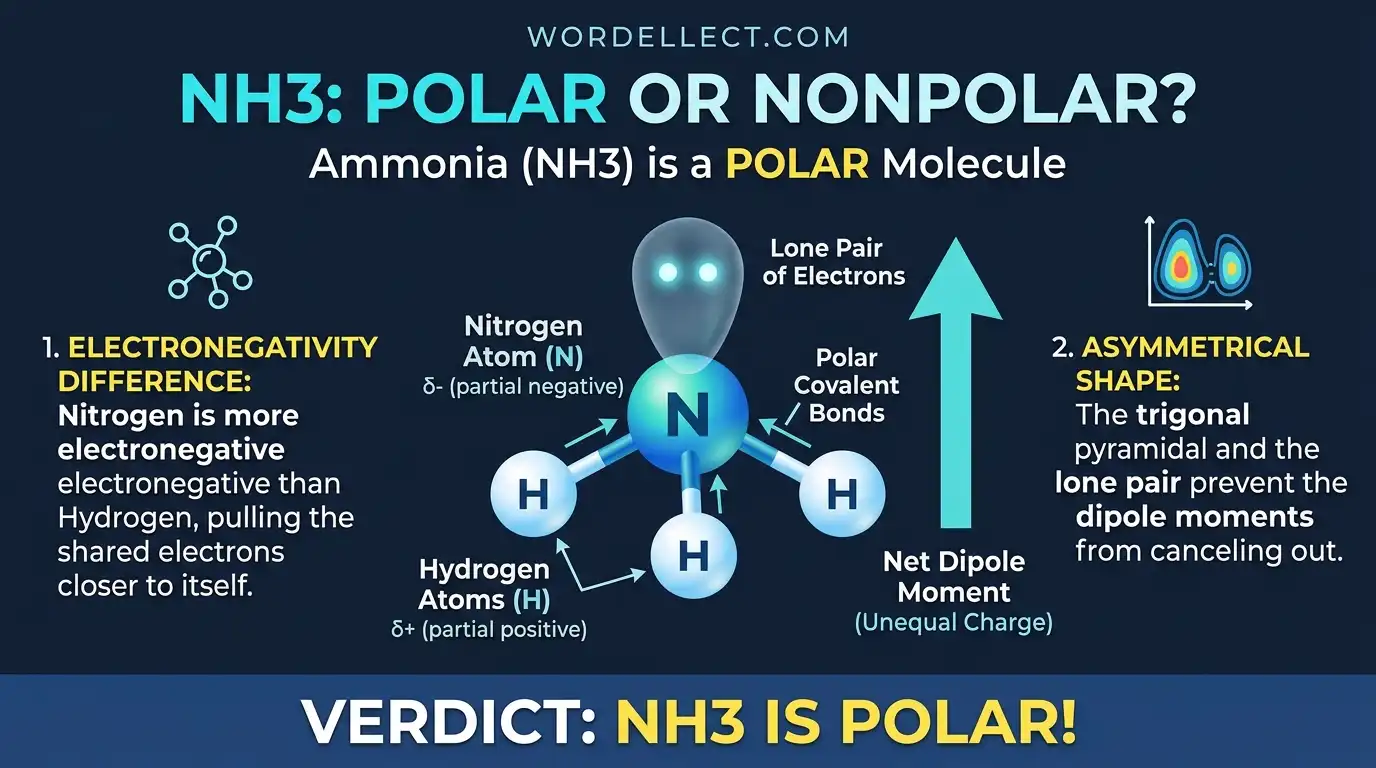
NH₃ (ammonia) is a polar molecule. It is polar because nitrogen attracts the shared electrons more strongly than hydrogen does, and the molecule has a shape that prevents the bond dipoles from canceling each other out.
The key to understanding NH₃ polarity is its trigonal pyramidal shape. Nitrogen is the central atom, three hydrogen atoms are bonded to it, and nitrogen has one lone pair of electrons.
These features create an uneven distribution of electrical charge. The nitrogen side of the molecule has more negative character, while the hydrogen side has more positive character.
If you are solving a chemistry question that asks whether NH₃ is polar or nonpolar, the correct answer is polar. To understand why, you need to look at its bonds, Lewis structure, molecular shape, and dipole moments.
Quick Answer: Why Is NH₃ Polar?
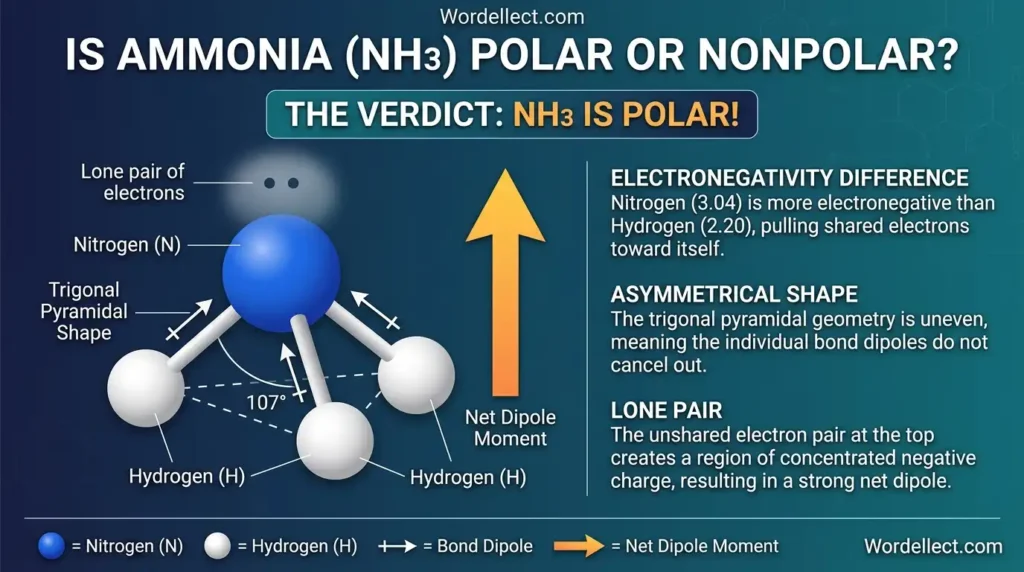
NH₃ is polar for two main reasons:
- Polar N–H bonds: Nitrogen attracts the shared electrons more strongly than hydrogen.
- Asymmetrical molecular shape: NH₃ has a trigonal pyramidal shape because nitrogen has one lone pair. The bond dipoles do not cancel out.
As a result, ammonia has a net dipole moment. This means the molecule has an uneven distribution of electrical charge.
| Property | NH₃ (Ammonia) |
| Molecular formula | NH₃ |
| Central atom | Nitrogen (N) |
| Number of N–H bonds | 3 |
| Lone pairs on nitrogen | 1 |
| Molecular shape | Trigonal pyramidal |
| Bond type | Polar covalent |
| Overall polarity | Polar |
| Approximate H–N–H bond angle | 107° |
The most important point is that molecular polarity depends on both the polarity of the bonds and the shape of the molecule. NH₃ has polar bonds and a shape that allows their dipole moments to produce a net dipole.
What Is NH₃?
NH₃ is the chemical formula for ammonia, a compound made of nitrogen and hydrogen.
One ammonia molecule contains:
- One nitrogen atom.
- Three hydrogen atoms.
Nitrogen is in the center of the molecule. Each hydrogen atom forms a single covalent bond with nitrogen.
In a covalent bond, atoms share electrons. However, the electrons are not always shared equally. The atom that attracts the shared electrons more strongly pulls the electron cloud closer to itself.
This difference is important when deciding whether a molecule is polar or nonpolar.
Nitrogen attracts electrons more strongly than hydrogen. Therefore, each N–H bond is polar. The next step is to look at how these three bonds are arranged in space.
Is the N–H Bond Polar?
Yes. Each N–H bond in ammonia is polar covalent.
The reason is electronegativity. Electronegativity describes how strongly an atom attracts shared electrons in a chemical bond.
Nitrogen has a higher electronegativity than hydrogen. As a result, the shared electrons in an N–H bond spend more time closer to nitrogen.
This creates a small difference in electrical charge across the bond.
- Nitrogen develops a partial negative charge, written as δ−.
- Each hydrogen develops a partial positive charge, written as δ+.
The symbol δ means partial. These are not full ionic charges. The atoms still share electrons through covalent bonds.
A simple way to show the direction of a bond dipole is:
H (δ+) → N (δ−)
The arrow points toward nitrogen because nitrogen attracts the bonding electrons more strongly.
All three N–H bonds are polar. However, that fact alone does not explain the polarity of the entire NH₃ molecule. You must also consider its three-dimensional shape.
What Is the Molecular Shape of NH₃?
NH₃ has a trigonal pyramidal molecular shape.
This means the nitrogen atom sits near the top of a three-dimensional pyramid, while the three hydrogen atoms form the lower part of the structure.
The molecule is not flat. Its shape comes from the arrangement of electron pairs around the nitrogen atom.
Nitrogen has five valence electrons. In NH₃, it uses three of these electrons to form three N–H bonds. The remaining two electrons form one lone pair.
Therefore, nitrogen has four electron regions around it:
- Three bonding pairs.
- One lone pair.
These four electron regions arrange themselves in a roughly tetrahedral pattern. But when naming the molecular shape, we look at the positions of the atoms, not the lone pair. Since there are three bonded hydrogen atoms and one lone pair, the molecular shape is trigonal pyramidal.
Why Does the Lone Pair Matter?
A lone pair is a pair of electrons that belongs to one atom and is not shared in a bond.
In ammonia, the lone pair sits on nitrogen. It takes up space and repels the bonding electron pairs.
This repulsion pushes the three N–H bonds closer together. The H–N–H bond angle becomes about 107°, which is smaller than the ideal tetrahedral angle of 109.5°.
The lone pair is important because it helps create the trigonal pyramidal shape. That shape means the three bond dipoles cannot cancel completely.
Remember this for chemistry exams: NH₃ has four electron regions, but its molecular shape is trigonal pyramidal, not tetrahedral.
How Does the Shape Make NH₃ Polar?
To understand the full reason, imagine the three N–H bonds as three arrows pointing toward nitrogen. Each arrow represents a bond dipole caused by the unequal sharing of electrons.
If a molecule has a highly symmetrical shape, its bond dipoles may point in directions that cancel each other. In that case, the molecule can be nonpolar even if its individual bonds are polar.
But NH₃ is different.
Its trigonal pyramidal shape places nitrogen above the three hydrogen atoms. The three bond dipoles point toward nitrogen, and their combined effect does not equal zero.
This leaves the molecule with a net dipole moment. A net dipole moment means there is an overall direction of charge separation across the molecule.
That is why NH₃ is polar.
The important lesson is that polarity is not decided by bond polarity alone. Both the bonds and the three-dimensional arrangement of the atoms matter.
Does NH₃ Have a Net Dipole Moment?
Yes. NH₃ has a net dipole moment, which is another way to confirm that it is polar.
A dipole moment measures the separation of positive and negative charge in a molecule. When bond dipoles cancel completely, the net dipole moment is zero, and the molecule is nonpolar.
In ammonia, the three bond dipoles do not cancel because of the trigonal pyramidal shape.
The molecule therefore has a net dipole moment directed toward the nitrogen side. The nitrogen end has more negative character, while the hydrogen side has more positive character.
You do not need to calculate the dipole moment to answer a basic polarity question. Knowing the N–H bond polarity and the molecular shape is usually enough.
How to Draw the Lewis Structure of NH₃
The Lewis structure helps explain both the shape and polarity of ammonia.
Follow these steps.
Step 1: Count the valence electrons.
Nitrogen has five valence electrons. Each hydrogen has one.
Total electrons:
5+(3×1)=85 + (3 \times 1) = 8
So, NH₃ has eight valence electrons.
Step 2: Place nitrogen in the center.
Hydrogen can form only one covalent bond in this molecule, so nitrogen goes in the middle.
Step 3: Draw three single bonds.
Connect nitrogen to each of the three hydrogen atoms. The three bonds use six electrons.
Step 4: Add the lone pair.
Two electrons remain. Place them on nitrogen as one lone pair.
A simple Lewis structure looks like this:
..
N
/ | \
H H H
The two dots represent the lone pair. Each line represents a single covalent bond.
This drawing is a simplified two-dimensional representation. The actual molecule is three-dimensional and has a trigonal pyramidal shape.
The Lewis structure shows why nitrogen has three bonds and one lone pair. These features help us predict the molecular shape and understand why NH₃ is polar.
NH₃ vs. CH₄: Why Is One Polar and the Other Nonpolar?
Comparing ammonia with methane is a useful way to understand molecular polarity.
CH₄ is methane. It contains one carbon atom bonded to four hydrogen atoms. Its shape is tetrahedral and symmetrical, so the bond dipoles cancel.
NH₃ has one nitrogen atom bonded to three hydrogen atoms and one lone pair. Its trigonal pyramidal shape is less symmetrical, so the bond dipoles do not cancel.
| Feature | NH₃ | CH₄ |
| Compound name | Ammonia | Methane |
| Central atom | Nitrogen | Carbon |
| Atoms bonded to the center | 3 hydrogen atoms | 4 hydrogen atoms |
| Lone pairs on central atom | 1 | 0 |
| Molecular shape | Trigonal pyramidal | Tetrahedral |
| Overall polarity | Polar | Nonpolar |
The main difference is the combination of bond polarity and molecular shape. In methane, the bond dipoles cancel because of its symmetrical arrangement. In ammonia, they do not cancel.
How to Tell Whether a Molecule Is Polar or Nonpolar
You can use a simple method to solve many molecular polarity questions.
1. Check the bonds
Ask whether the bonded atoms attract electrons equally.
If one atom attracts the shared electrons more strongly, the bond may be polar. If both atoms have the same electronegativity, the bond is generally nonpolar.
2. Draw the Lewis structure
Count the valence electrons and identify the bonds and lone pairs.
Lone pairs can affect a molecule’s shape, so do not ignore them.
3. Find the molecular shape
Use the Lewis structure and VSEPR theory to work out the positions of the atoms.
For NH₃, three bonds and one lone pair around nitrogen give a trigonal pyramidal shape.
4. Check whether the bond dipoles cancel
Look at the direction of the bond dipoles in three dimensions.
If they cancel completely, the molecule has no net dipole moment. If they do not cancel, the molecule is polar.
5. Give the final answer
For NH₃, the N–H bonds are polar and the trigonal pyramidal shape prevents their dipoles from canceling.
Final result: NH₃ is polar.
Frequently Asked Questions
Is NH₃ polar or nonpolar?
NH₃ is polar. Nitrogen attracts the shared electrons more strongly than hydrogen, and the molecule’s trigonal pyramidal shape creates a net dipole moment.
Why is NH₃ polar even though it has three identical bonds?
All three N–H bonds are polar, but identical bonds do not always cancel each other. In NH₃, the trigonal pyramidal shape means their dipole moments do not add up to zero.
Is the N–H bond polar or nonpolar?
The N–H bond is polar covalent because nitrogen attracts the shared electrons more strongly than hydrogen. This creates a partial negative charge near nitrogen and a partial positive charge near hydrogen.
What is the shape of NH₃?
NH₃ has a trigonal pyramidal shape. Nitrogen has three N–H bonds and one lone pair of electrons.
How many lone pairs are in NH₃?
There is one lone pair on the central nitrogen atom. The lone pair affects the molecular shape and helps explain why ammonia is polar.
Is NH₃ symmetrical?
NH₃ has a three-dimensional arrangement of atoms that is not symmetrical in the way needed for its bond dipoles to cancel. Its trigonal pyramidal shape gives it a net dipole moment.
Is NH₃ polar because of its lone pair?
The lone pair helps determine the trigonal pyramidal shape, but the complete explanation also includes the polar N–H bonds. Both factors are needed to understand the molecule’s overall polarity.
Conclusion
NH₃, or ammonia, is a polar molecule. Nitrogen attracts the shared electrons in each N–H bond more strongly than hydrogen does, making the bonds polar.
Nitrogen also has one lone pair, which gives ammonia its trigonal pyramidal shape. Because of this shape, the three bond dipoles do not cancel, leaving NH₃ with a net dipole moment.
For a chemistry test, remember this simple rule: polar N–H bonds + trigonal pyramidal shape = polar NH₃.
Internal Linking Opportunities
| Anchor Text | Suggested Related Topic |
| Polar and Nonpolar Molecules | How molecular polarity works |
| NH₃ Lewis Structure | How to draw ammonia’s Lewis structure |
| Molecular Geometry | Common molecular shapes and VSEPR theory |
| Electronegativity | How atoms attract shared electrons |
| CH₄ Polar or Nonpolar | Why methane is a nonpolar molecule |

Ethan Carter is a language writer at Wordellect who helps readers understand word differences, grammar rules, and spelling variations through simple and accurate guides.







