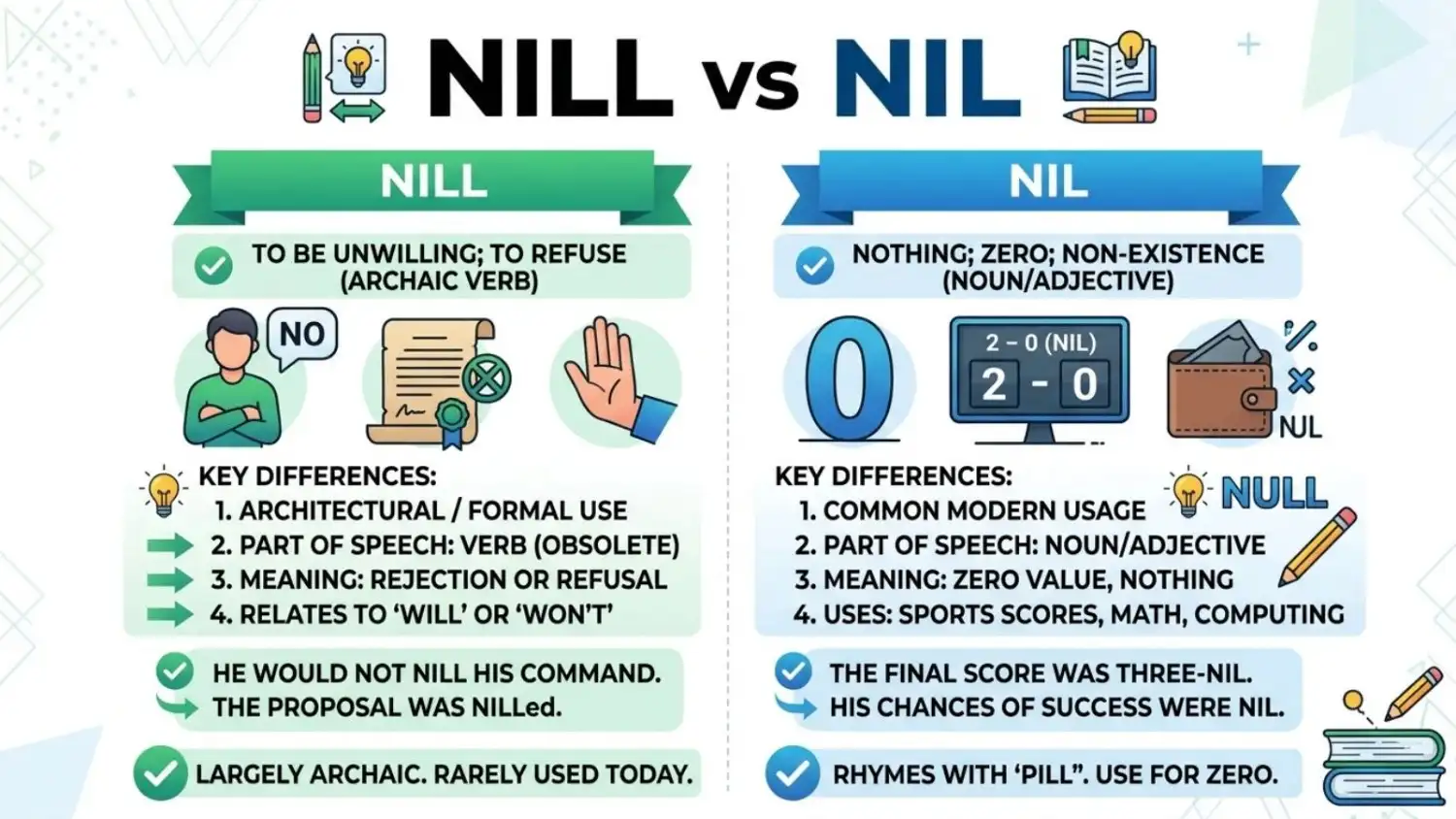
Have you ever written a score or filled out a form and stopped to ask, “Is it nill or nil?” This small word can be confusing. It looks short and easy, but many people are not sure how to spell it.
People often want to add an extra “l” because other short words like “will” or “still” have two L’s. So it feels right to do the same here. But this word does not work that way.
You will see this word in sports scores, school papers, and forms you fill out at school or work. If you spell it wrong, your writing can look messy. That is why it helps to know the right way.
In this guide, you will get a quick answer first. Then we will look at where this word came from, how people use it in different places, and the mistakes people often make. By the end, you will always know the right way to write it.
Nill or Nil – Quick Answer
Here is the easy answer.
The right way to spell it is nil, with just one “l” at the end. “Nill” is not a real word.
Example: “The final score was two-nil for the home team.”
Nil means zero, or nothing at all. You will see it a lot in sports scores and forms.
Easy trick to remember: Nil is short, just like the number zero it stands for. It does not need any extra letters.
Where the Word Nil Comes From
The word “nil” comes from an old language called Latin. It comes from the word “nihil,” which means “nothing.” Over time, people made this word shorter, and we use “nil” today.
This is how many English words work. A lot of words started as longer words in old languages and got shorter over time.
Because “nil” was already made shorter long ago, it never had a version with two L’s. It has always had just one “l,” from the very start.
This is not like some other words that changed shape over hundreds of years. Nil stayed the same and simple.
British English vs American English
Here is something fun to know. The word “nil” is used a lot more in British English than in American English.
In the UK, and in places like Australia, India, and Ireland, people use “nil” all the time. You will hear it in football games, like “three-nil.”
In the US, people usually say “zero” instead of “nil.” The word nil is used less in daily talk there.
But no matter where you are, when people do use the word, it is always spelled the same way: nil. There is no different way to spell it in any country.
| Word | UK Use | US Use | Where You See It |
| Nil | Very common | Not as common | Sports scores, forms |
| Zero | Common | Very common | Math, everyday talk |
| Naught | Rare, old | Very rare | Old books, old talk |
Which One Should You Use?
Since “nil” is spelled the same way everywhere, this is not about which country you are from. It is just about picking the right word.
If you live in the US: You can use “nil,” but most people say “zero” instead in daily talk.
If you live in the UK or nearby countries: Nil is a normal word you will hear often, especially in sports.
You are writing for people all over the world: Nil is easy to understand almost everywhere, so it works well in most kinds of writing.
Just remember, the spelling never changes. Only how often people use the word changes from place to place.
Mistakes People Make with Nil
Here are some common mistakes, and the right way to fix them.
Mistake 1: “The score was two-nill.”
Right way: “The score was two-nil.”
Mistake 2: “My account has nill in it.”
Right way: “My account has nil in it.”
Mistake 3: “There were nill results from the test.”
Right way: “There were nil results from the test.”
Mistake 4: “The form asked for a nill value.”
Right way: “The form asked for a nil value.”
Mistake 5: “We ended the game nill to nill.”
Right way: “We ended the game nil to nil.”
The easy fix is to remember that “nil” only has one “l.” If you write two, stop and fix it.
Nil in Everyday Life
Let’s look at how people use “nil” in real life.
In emails: “The amount you owe right now is nil.” “There is nil risk with this small task.”
In news: “The game ended one-nil for the home team.” “Chances of this plan working look like nil.”
On social media: “One-nil and we made it to the final! ” “My energy today is basically nil, need coffee.”
In school or work papers: “If nothing was broken, write nil on the form.” “The report shows nil change this month.”
These show how “nil” fits into many kinds of writing, from fun posts to school papers.
Nil – What People Search Online
People search for “nil” a lot in places where football is a big deal, like the UK, Ireland, Australia, and India. Most searches happen right after a big game, when people look up scores like “two-nil.”
In the US, fewer people search for “nil.” When they do, it is often about forms or papers, not sports, since American sports rarely use this word for scores.
People who search “nill or nil” are often trying to check their spelling before they finish writing something. This kind of search stays about the same all year.
No matter the country, people search this topic for the same reason: they are not sure if the word needs one “l” or two.
Nil and Similar Words
| Word | Meaning | Where It’s Used Most | Common Use |
| Nil | Nothing, zero | UK and nearby countries | Sports scores, forms |
| Zero | The number 0 | Everywhere | Math, daily talk |
| Naught | Old word for zero | UK, old writing | Old books |
Questions People Ask
1. Is “nill” ever right to use? No. “Nill” is not a real word. The right spelling is always “nil,” with just one “l.”
2. What does “nil” mean? Nil means zero, or nothing. It shows that there is none of something.
3. Where did the word “nil” come from? It comes from an old Latin word, “nihil,” which means “nothing.” People made it shorter over time.
4. Do British people use “nil” more than Americans? Yes. British people use it a lot, especially in sports. Americans usually say “zero” instead.
5. How is “nil” used in sports? It is used to show a score, like “two-nil,” which means one team got two points and the other got none.
6. Can “nil” be used on school or work forms? Yes. People often write “nil” on forms to show there is nothing to report, like a bill of zero.
7. Is the spelling of “nil” different in the UK and the US? No. It is spelled the same way everywhere. Only how often people use it changes.
Conclusion:
Nil and nill may look like they could both be right, but only “nil,” with one “l,” is the correct way to spell it. This word came from an old Latin word that means “nothing,” and it has kept the same short spelling ever since. People in the UK and nearby countries use it a lot, especially in sports, but people everywhere can understand it.
The main thing to remember is easy: no matter where you live, “nil” always has just one “l.” There is no other way to spell it.
Now that you know the right spelling and where it comes from, you can use it with ease. Whether you are talking about a game score or filling out a form, you will always get it right. Keep this guide close, and you will never mix up nill and nil again.

Ethan Carter is a language writer at Wordellect who helps readers understand word differences, grammar rules, and spelling variations through simple and accurate guides.







