When people hear the words Navy and Army, they may think both words mean the same thing: a group of people who serve in the military. But they are not the same. The Navy and Army are different parts of a country’s armed forces, and they have different main jobs.
People often search for “navy or army” because they want to understand the difference between these two military services. They may also want to know which word to use when talking about soldiers, ships, land forces, or military careers.
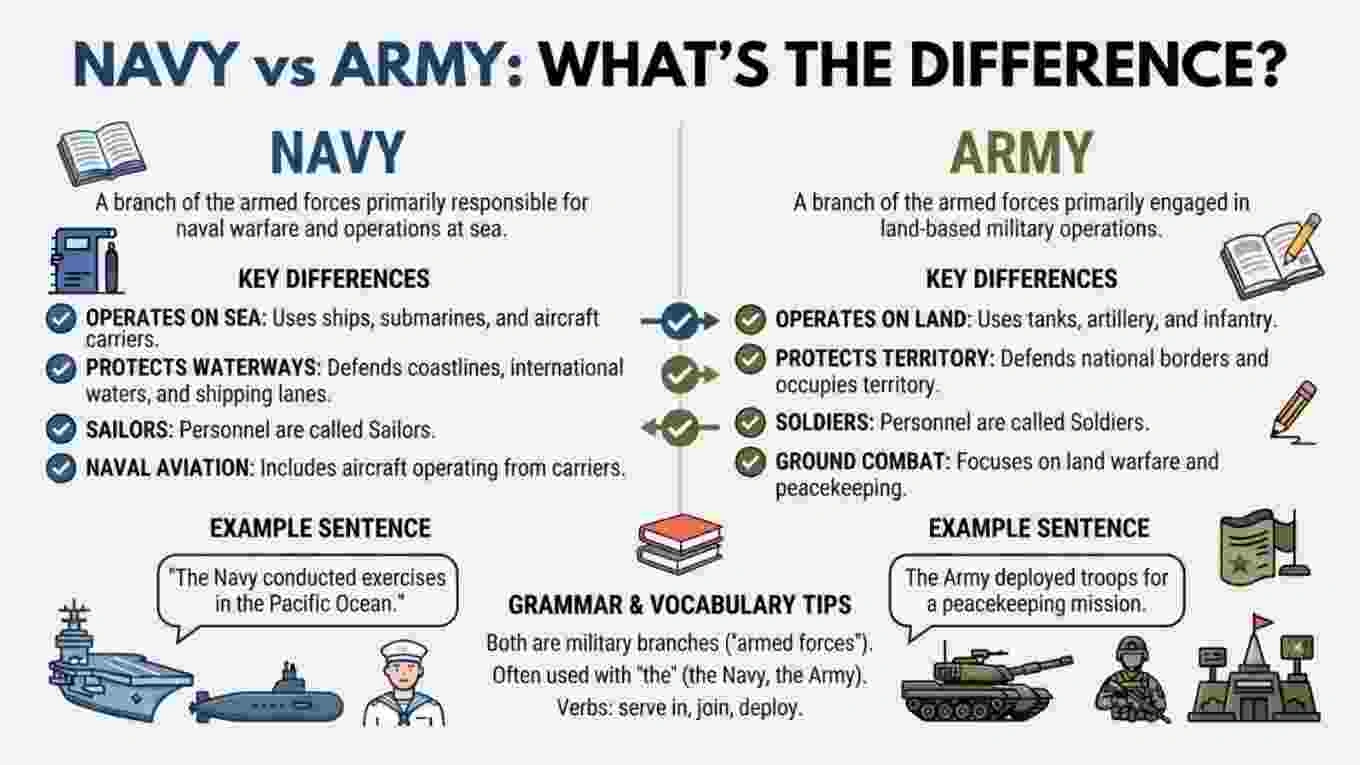
The simple answer is easy. The Army mainly operates on land, while the Navy mainly operates at sea and uses ships and other naval forces. Both can work together during military operations, but their main roles are different.
The word army is usually linked to land forces. The word navy is linked to naval forces and the sea. Both words have long histories in English and are used in many countries around the world.
In this guide, we will explain navy vs army, their meanings, origins, spelling, common mistakes, everyday examples, and the key differences between them.
Navy or Army – Quick Answer
The simple answer is:
- Army = a country’s land-based military force.
- Navy = a country’s naval military force, mainly operating at sea.
For example:
My brother joined the Army.
This means he joined the country’s land military service.
Another example:
Her brother joined the Navy.
This means he joined the country’s naval military service.
Quick Comparison
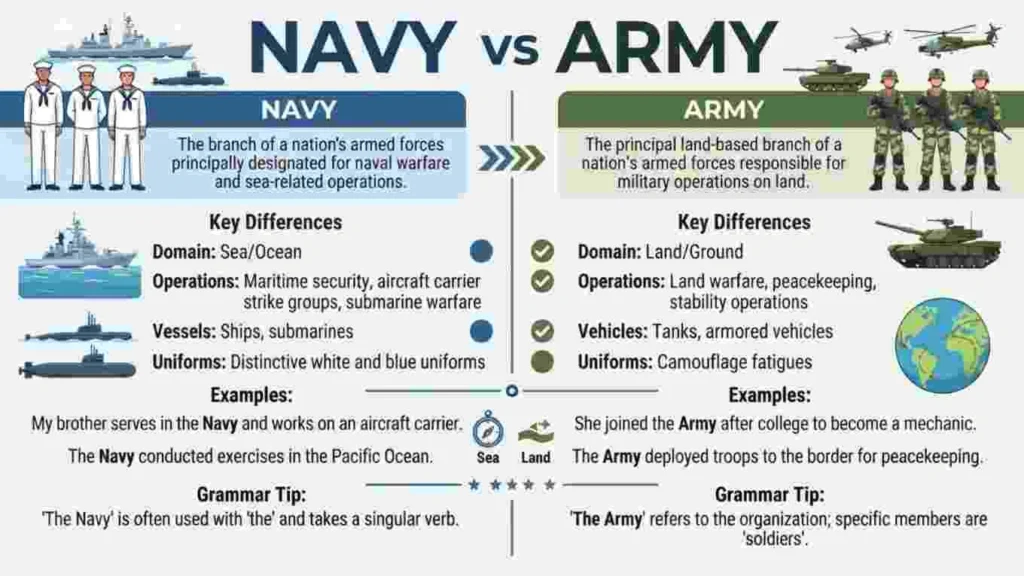
| Word | Main role | Common equipment |
| Army | Land operations | Tanks, vehicles, aircraft, weapons |
| Navy | Sea and naval operations | Ships, submarines, aircraft |
Both are parts of the military, but their main areas of operation are different.
The Army focuses mainly on land.
The Navy focuses mainly on water and naval operations.
The Origin of Navy or Army
The words army and navy have different histories.
The Origin of Army
The word army comes from an Old French word related to an armed force or military group. It entered English many centuries ago.
The word is linked to the idea of an organized group of people prepared for war.
Today, army usually means the land-based military force of a country.
For example:
The Army sent troops to the area.
The word can also be used more broadly.
For example:
An army of workers helped clean the city.
Here, army does not mean a real military force. It means a very large group of people.
The Origin of Navy
The word navy comes from Latin navis, meaning ship. It is also related to words connected with ships and sailing.
The word became associated with a country’s organized naval forces.
Today, a navy usually operates ships, submarines, aircraft, and other equipment used for naval missions.
For example:
The Navy sent a ship to the area.
So, the two words developed from different roots:
- Army → armed military force
- Navy → ships and naval forces
British English vs American English Spelling
There is no major British-versus-American spelling difference between army and navy.
Both words are spelled the same in standard American and British English.
| Word | American English | British English |
| Army | Army | Army |
| Navy | Navy | Navy |
| Soldier | Soldier | Soldier |
| Sailor | Sailor | Sailor |
| Military | Military | Military |
For example:
American English:
He joined the Army.
British English:
He joined the Army.
The spelling stays the same.
However, military names can be different from country to country. A country’s official name for a military service may vary, so formal writing should use the official name used by that country.
Which Spelling Should You Use?
The spelling is simple:
Army
and:
Navy
The important part is choosing the correct word for the military service you mean.
Use “Army” for Land Forces
Use Army when talking about a country’s land military force.
Example:
He serves in the Army.
You can also use soldier for a member of an army.
Use “Navy” for Naval Forces
Use Navy when talking about a country’s naval military force.
Example:
She serves in the Navy.
You can use sailor for many members of a navy.
For US Audiences
When referring to the United States military branches, U.S. Army and U.S. Navy are official names.
For UK Audiences
The official names include the British Army and the Royal Navy.
For a Global Audience
If the country matters, include the country’s name.
For example:
the U.S. Army
the British Army
the U.S. Navy
the Royal Navy
This makes your meaning clear.
Common Mistakes with Navy or Army
Here are some common mistakes people make with these words.
1. Thinking Army and Navy Are the Same
They are both military services, but they have different main roles.
The Army mainly focuses on land.
The Navy mainly focuses on naval operations.
2. Calling Every Military Member a Soldier
The word soldier usually refers to a member of an army.
A member of a navy is commonly called a sailor.
For example:
He is an Army soldier.
She is a Navy sailor.
3. Writing “Navy” for Any Military Force
The word Navy specifically refers to naval forces.
If you mean all military services, use:
military
4. Using “Army” for the Whole Military
In some casual speech, people may use army to mean military forces in general. But in modern formal writing, army usually refers specifically to the land-based service.
5. Forgetting Capital Letters in Official Names
When referring to an official military branch, capitalization may be used.
For example:
the U.S. Army
the U.S. Navy
But when using the words in a general sense, lowercase can be correct:
The country has a large army.
Navy or Army in Everyday Examples
These words appear in many types of writing.
In an Email
My brother joined the Army last year.
In a News Article
The Navy sent ships to the area.
On Social Media
My friend just started a career in the Navy.
In Formal Writing
The Army and Navy have different roles within the country’s armed forces.
In Everyday Speech
Are you thinking about joining the Army or Navy?
In a Career Discussion
Some people choose the Army, while others choose the Navy because they want different types of military work.
Navy or Army – Google Trends & Usage Data
People search for “navy or army” for many reasons. Some want to learn about military branches, while others are comparing military careers, duties, training, or equipment.
Common related searches include:
- navy or army
- army vs navy
- navy vs army
- army and navy difference
- navy or army which is better
- army vs navy jobs
- army vs navy training
- army vs navy ranks
- navy vs army uniforms
Search interest can change based on news, military events, recruitment campaigns, history lessons, movies, sports events, and public discussions.
Google Trends shows relative search interest, not the exact number of searches. Results can also change by country and time period.
For SEO content, it is useful to answer the basic question first and then explain the different roles of the two services.
Navy vs Army: Side-by-Side Comparison
| Feature | Army | Navy |
| Main area | Land | Sea and naval areas |
| Main force | Soldiers | Sailors |
| Common vehicles | Tanks and land vehicles | Ships and submarines |
| Main role | Land operations | Naval operations |
| Aircraft | Yes | Yes |
| Ships | Limited support vessels | Major part of the service |
| Submarines | No main role | Major naval equipment |
| Military branch | Yes | Yes |
| General term | Land military force | Naval military force |
The exact roles and equipment can vary between countries.
Modern military forces also work together. Army units can use aircraft, while naval forces can operate aircraft and support operations on land.
Navy or Army: Key Differences
1. Area of Operation
The Army mainly operates on land.
The Navy mainly operates at sea and in other naval environments.
2. Main Equipment
Army forces may use:
- Tanks
- Armored vehicles
- Trucks
- Helicopters
- Ground equipment
Navy forces may use:
- Ships
- Submarines
- Naval aircraft
- Boats
- Radar systems
3. Main Personnel Terms
A person serving in the Army is generally called a soldier.
A person serving in the Navy is commonly called a sailor.
4. Different Military Jobs
Both services have many different careers.
An Army can have jobs related to:
- Infantry
- Engineering
- Medicine
- Communications
- Logistics
A Navy can have jobs related to:
- Ship operations
- Engineering
- Navigation
- Communications
- Aviation
- Logistics
The exact jobs depend on the country and service.
FAQs About Navy or Army
1. What is the main difference between the Army and Navy?
The Army mainly operates on land, while the Navy mainly operates at sea and performs naval missions.
2. Is the Navy part of the military?
Yes. A navy is a branch of a country’s armed forces.
3. Is the Army part of the military?
Yes. The Army is the land-based branch of many countries’ armed forces.
4. Is a Navy member called a soldier?
Usually, no. A member of a navy is commonly called a sailor. A member of an army is commonly called a soldier.
5. Does the Navy only use ships?
No. Modern navies can also use submarines, aircraft, helicopters, boats, and other equipment.
6. Does the Army only fight on land?
The Army’s main role is land operations, but modern armies can also use aircraft and other systems.
7. Are Army and Navy spelled differently in British English?
No. Army and Navy are spelled the same in British and American English.
Exercise: Navy or Army?
Choose the correct word.
- A ________ mainly focuses on land operations.
a) Army
b) Navy - A ________ mainly focuses on naval operations.
a) Army
b) Navy - A member of the Army is commonly called a ________.
a) soldier
b) sailor - A member of the Navy is commonly called a ________.
a) soldier
b) sailor - Which service commonly operates submarines?
a) Navy
b) Army
Answers
- Army
- Navy
- Soldier
- Sailor
- Navy
Conclusion
The difference between Navy or Army is simple. Both are military services, but they have different main roles. The Army mainly focuses on land operations, while the Navy mainly focuses on naval operations at sea.
Army members are commonly called soldiers, while Navy members are commonly called sailors. The two services also use different types of equipment. Armies may use tanks, armored vehicles, trucks, and helicopters. Navies may use ships, submarines, boats, and naval aircraft.
The spelling is not difficult. Army and Navy are spelled the same in standard American and British English. When talking about an official military branch, capital letters are often used, such as U.S. Army and U.S. Navy.
It is also important to remember that the exact role of each service can vary from one country to another. Modern military forces often work together, so their duties can sometimes overlap.
If you are writing about military services, use Army for the land-based branch and Navy for the naval branch. If you mean all armed forces, use the broader word military.

Ethan Carter is a language writer at Wordellect who helps readers understand word differences, grammar rules, and spelling variations through simple and accurate guides.