“Naughty or nice” is a common phrase connected with Christmas and the idea of Santa Claus deciding whether a child has behaved well or badly during the year.
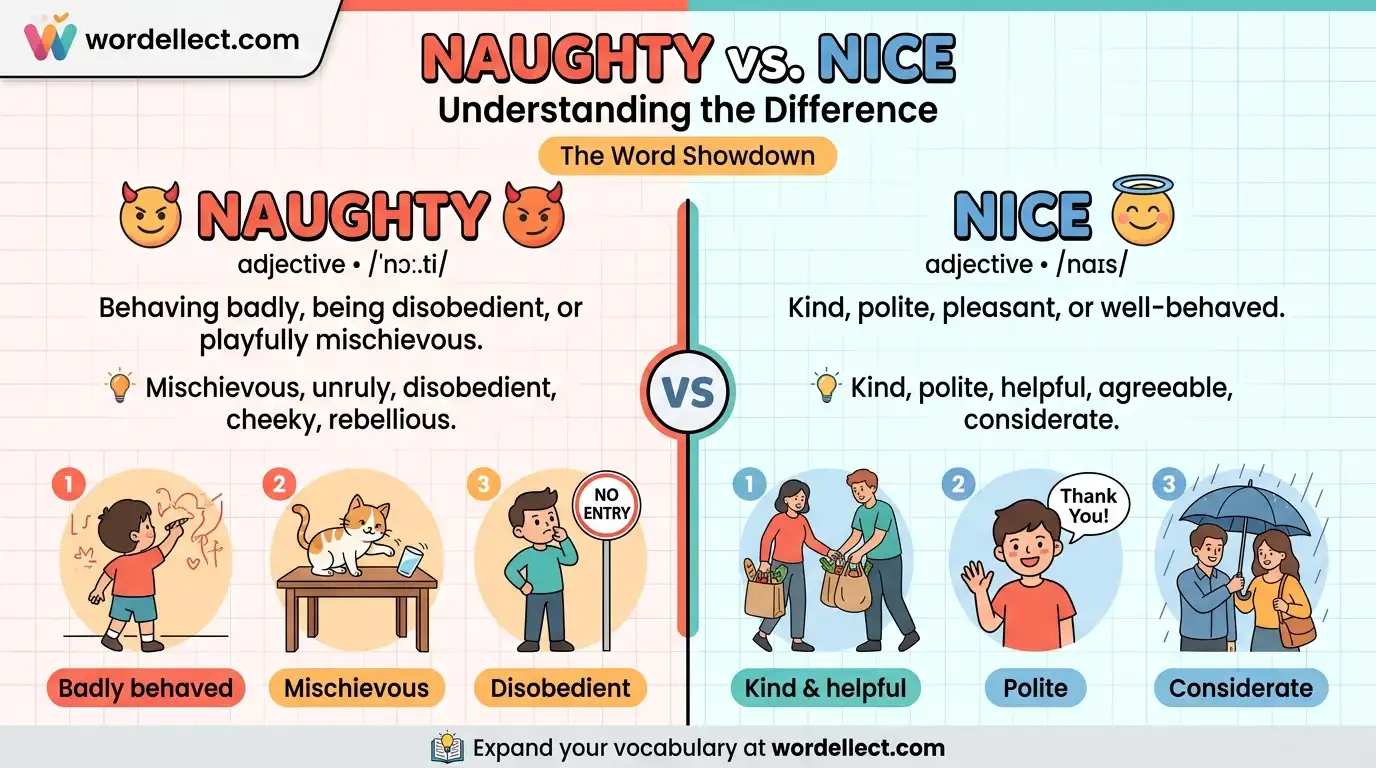
In simple terms, nice means well-behaved, kind, or good, while naughty means badly behaved, mischievous, or disobedient. The phrase is often used in a playful way, especially around Christmas.
For example:
“Have you been naughty or nice this year?”
This question is usually not meant to be serious. It comes from the traditional Christmas story in which Santa keeps track of children’s behavior and gives gifts to those on his “nice list.”
What Does “Naughty or Nice” Mean?
The phrase presents two opposite choices:
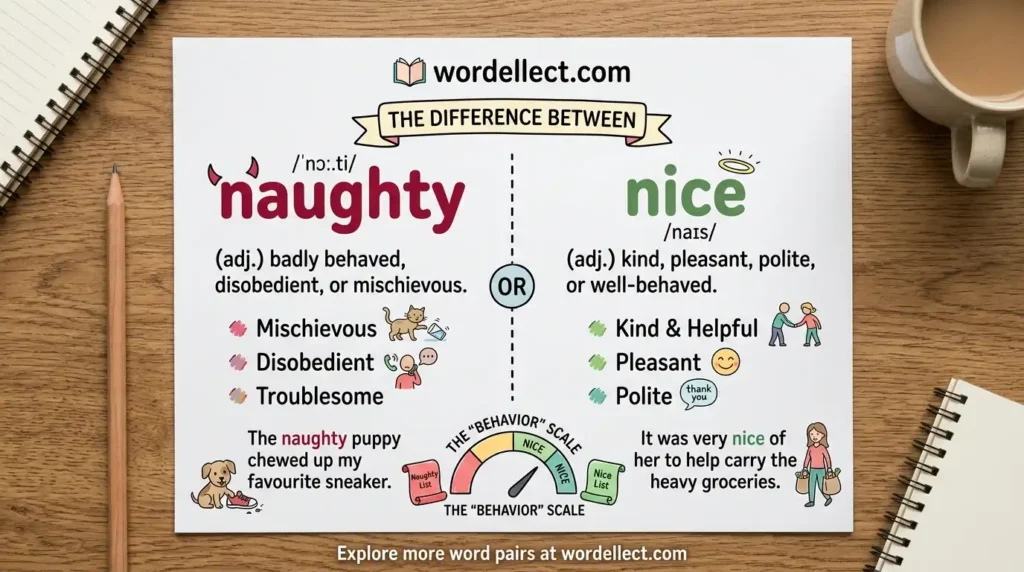
- Naughty: behaving badly, being disobedient, or getting into trouble
- Nice: behaving well, being kind, polite, or helpful
When someone asks if you are naughty or nice, they are usually asking whether you have behaved well or badly.
The meaning can change slightly depending on the situation. During Christmas, it almost always refers to Santa’s famous “naughty list” and “nice list.”
Simple example
Child: “Am I on Santa’s nice list?”
Parent: “You have been very helpful this year, so I think you’re safe!”
The idea is playful and is often used to make Christmas more fun for children.
Naughty vs. Nice
| Word | Meaning | Example |
| Naughty | Badly behaved or mischievous | The naughty child broke the toy. |
| Nice | Kind, polite, or well-behaved | She was nice to everyone. |
The two words are opposites in this common expression.
However, naughty does not always mean seriously bad. It can describe harmless mischief.
For example:
“The puppy was naughty and stole my sock.”
This does not necessarily mean the puppy did something terrible. It simply means the puppy behaved in a playful or troublesome way.
What Is the “Nice List”?
The nice list is part of the traditional Santa Claus story.
According to the familiar Christmas tradition, Santa keeps a list of children who have behaved well. These children are placed on the nice list and are said to receive Christmas presents.
The phrase is often used jokingly with children:
“You better be nice if you want to stay on Santa’s list!”
There is no real official Santa list. It is part of the fictional and cultural tradition surrounding Christmas.
What Is the “Naughty List”?
The naughty list is the opposite of the nice list.
In the traditional story, children who misbehave are placed on Santa’s naughty list. The idea is that Santa knows who has been good and who has been bad.
Parents and other adults may use this idea playfully:
“Don’t make me put that on your naughty list!”
Today, the phrase is often used as a joke rather than as a serious warning.
Why Does Santa Ask If You Are Naughty or Nice?
The idea comes from the long-running Christmas tradition that Santa knows whether children have behaved well during the year.
The basic story is simple:
- Santa watches children’s behavior.
- Children who behave well go on the nice list.
- Children who misbehave may go on the naughty list.
- Santa visits on Christmas Eve.
- He delivers presents as part of the Christmas tradition.
This story helps explain why “naughty or nice” has become such a recognizable Christmas phrase.
Is “Naughty or Nice” a Question?
Yes, “naughty or nice?” can be used as a short question.
It is an informal way of asking:
“Have you been good or bad?”
The full sentence might be:
“Have you been naughty or nice this year?”
But in casual conversation, someone may simply say:
“Naughty or nice?”
The shorter version is especially common in Christmas jokes, decorations, cards, advertisements, and social media posts.
- He promised to be nice before Christmas.
These examples show that the phrase can be used in both questions and statements.
“Naughty or Nice” for Adults
Although the expression is strongly associated with children and Santa Claus, adults also use it.
Adults may use it as a playful Christmas joke:
“I’ve been working hard all year, so I hope I’m on the nice list.”
You may also see “naughty or nice” on Christmas cards, shirts, signs, decorations, and social media posts.
In these situations, the phrase is often humorous rather than literal.
The exact meaning depends on the context. In a normal Christmas setting, it simply refers to the traditional good-versus-bad idea connected with Santa.
Is “Naughty” the Same as “Bad”?
Not always.
Naughty can mean badly behaved, but it often sounds lighter and more playful than bad.
Compare these sentences:
“The child was naughty.”
This may mean the child was mischievous or disobedient.
“The child was bad.”
This can sound stronger and may suggest more serious behavior depending on the context.
For children, parents often use naughty for minor misbehavior.
For example:
“Don’t be naughty. Put your toys away.”
The word can therefore sound less severe than directly calling someone bad.
Is “Nice” the Same as “Good”?
They can be similar, but they are not always interchangeable.
Nice often describes someone who is kind, pleasant, polite, or friendly.
Good has a much wider range of meanings.
For example:
“She is a nice person.”
This usually means she is kind or pleasant.
“She is a good student.”
This usually means she performs well at school or behaves responsibly as a student.
In the Christmas expression “naughty or nice,” however, nice means behaving well and being good in the general sense.
Common Mistake:
It is not a formal phrase.
It is mainly a playful, informal expression associated with Christmas and Santa Claus.
You would normally use it in:
- Casual conversations
- Christmas greetings
- Children’s activities
- Christmas decorations
- Jokes
- Social media posts
- Holiday advertising
For formal writing, a clearer phrase such as “well-behaved or badly behaved” may be more appropriate.
Common Mistake: Assuming “Naughty” Always Means Serious Misbehavior
The word naughty can describe anything from mild mischief to more serious disobedience, depending on context.
For example:
“My dog was naughty and knocked over the Christmas tree.”
This sounds playful.
But:
“The student was punished for naughty behavior.”
This could describe more serious misbehavior, depending on what happened.
Context determines how strong the word sounds.
Where You May See “Naughty or Nice”
The phrase is especially common during the Christmas season.
You may see it on:
- Christmas cards
- Holiday decorations
- Gift tags
- Children’s books
- Christmas sweaters
- Party invitations
- Santa-themed events
- Social media posts
- Holiday advertisements
Its short and memorable form makes it easy to use as a Christmas slogan.
“Naughty or Nice” vs. “Good or Bad”
Both expressions can describe opposite behavior, but they have different tones.
Good or bad is more direct and can be used in many serious situations.
Naughty or nice sounds more playful and is strongly associated with Christmas.
For example:
“Was his decision good or bad?”
This is a normal question about a decision.
But:
“Have you been naughty or nice?”
sounds like a playful reference to Santa.
That is why naughty or nice is especially popular during the holiday season.
Why the Phrase Is So Popular at Christmas
The phrase is short, easy to understand, and closely connected with one of the best-known Santa traditions.
It also creates a simple contrast:
Naughty = misbehaved
Nice = behaved well
That clear contrast makes the expression useful for children’s stories, Christmas decorations, jokes, and holiday conversations.
It has become a familiar part of Christmas language in English-speaking culture.
Frequently Asked Questions
What does “naughty or nice” mean?
“Naughty or nice” means badly behaved or well-behaved. It is most commonly associated with the Christmas tradition of Santa keeping a naughty list and a nice list.
Is “naughty or nice” about Santa?
Usually, yes. The phrase is strongly connected with the traditional story that Santa knows which children have behaved well and which have misbehaved.
What is the opposite of naughty?
In the phrase “naughty or nice,” the opposite is nice. Depending on the context, other opposites of naughty can include well-behaved, obedient, or good.
What is the difference between naughty and nice?
Naughty describes someone who behaves badly, disobeys, or causes trouble. Nice describes someone who is kind, polite, pleasant, or well-behaved.
Can adults use “naughty or nice”?
Yes. Adults often use the phrase playfully during Christmas. It can appear in jokes, greetings, decorations, parties, and social media posts.
Is “naughty or nice” grammatically correct?
Yes. “Naughty or nice?” is a natural shortened question. The complete version could be “Have you been naughty or nice?”
Final Takeaway
“Naughty or nice” is a playful Christmas expression that asks whether someone has behaved badly or well. Naughty means mischievous or badly behaved, while nice means kind, polite, or well-behaved.
The phrase is best known for its connection to Santa Claus and the traditional naughty list and nice list. It is informal, familiar, and commonly used in Christmas conversations, decorations, cards, jokes, and holiday activities.

Ethan Carter is a language writer at Wordellect who helps readers understand word differences, grammar rules, and spelling variations through simple and accurate guides.