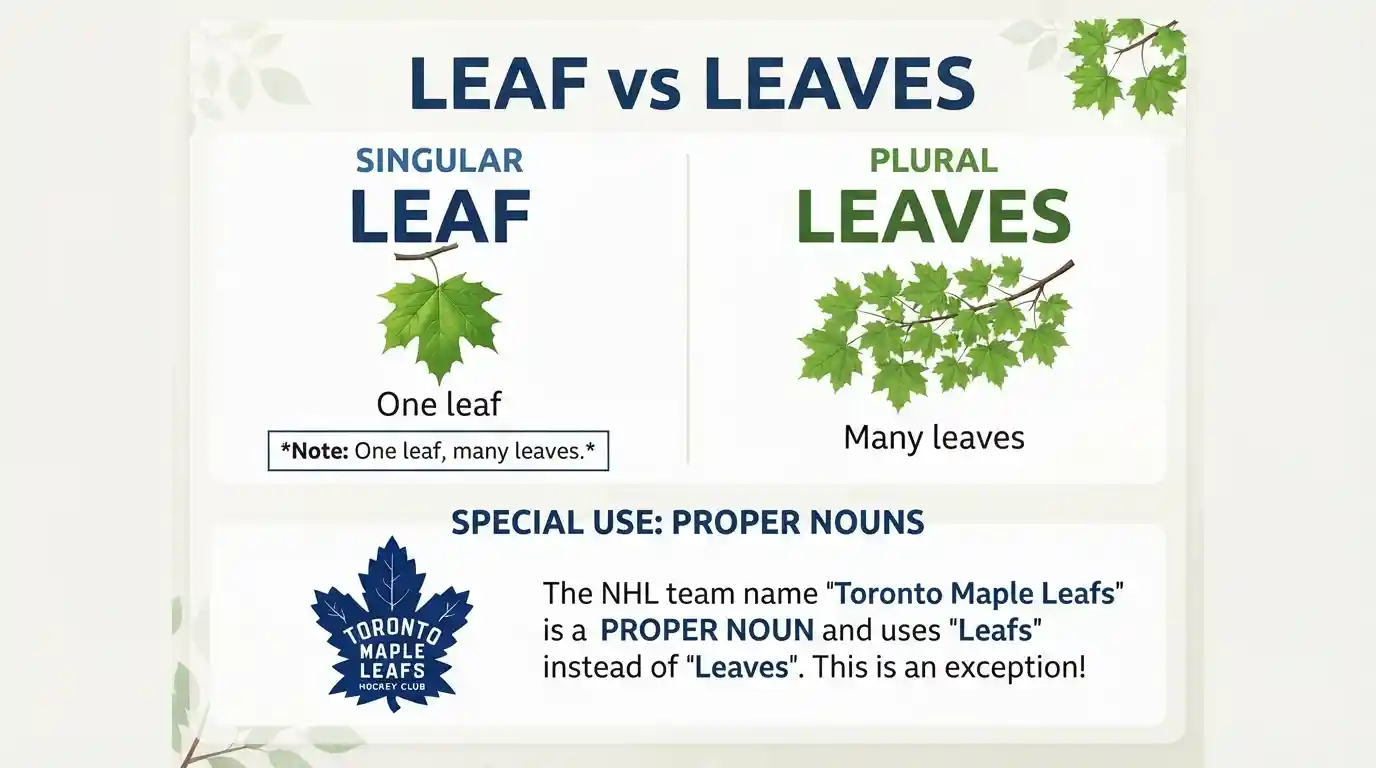
The main question is simple: “leafs or leaves” depends on what you mean. If you are talking about the plural of the noun leaf, the correct form is leaves. For example, “The leaves are falling from the tree.”
Leafs can also be correct, but it has a much narrower use. It is mainly used as part of the proper name of sports teams, such as the Toronto Maple Leafs. It can also appear as the third-person singular form of the verb leaf in rare or technical use, but that is not common in everyday English.
This is why many writers get confused. The normal plural of leaf does not follow the simple rule of adding -s. Instead, the spelling changes from leaf to leaves.
In this guide, you will learn the difference between leafs and leaves, when to use each form, common mistakes, pronunciation, examples, and the difference between British and American English.
Leafs or Leaves – Quick Answer
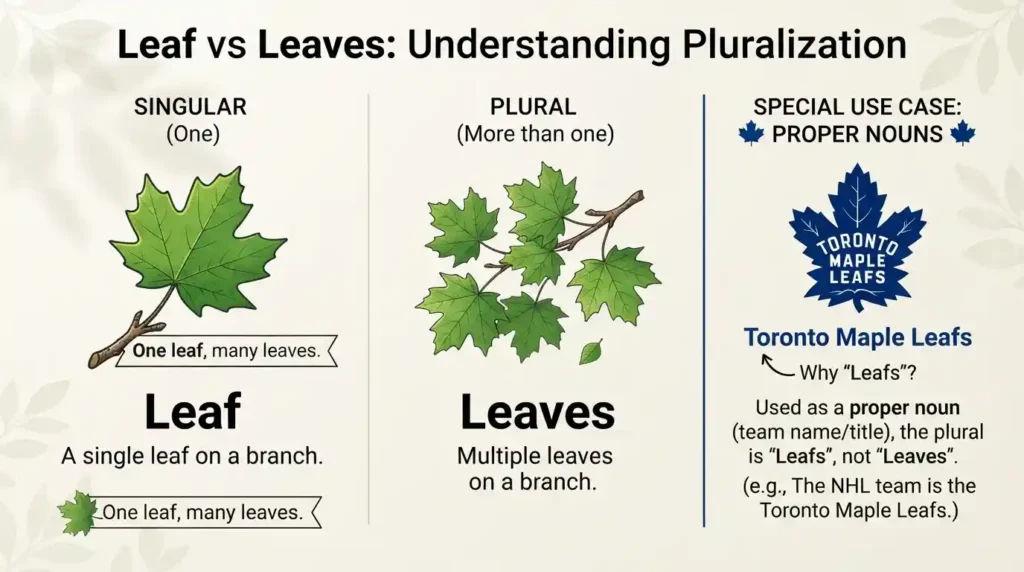
Leaves is the correct plural of leaf when you mean more than one leaf.
- Singular: leaf
- Plural: leaves
Example:
“The tree has green leaves.”
Leafs is not the normal plural of leaf. However, it is used in names such as Toronto Maple Leafs.
So, for normal English writing:
One leaf, two leaves.
What Is the Difference Between Leafs and Leaves?
The main difference is how each word is used.
Leaves is the standard plural form of leaf. A leaf is the flat, usually green part of a plant or tree.
For example:
- “A leaf fell from the tree.”
- “Several leaves covered the ground.”
Leafs has a different and much less common use. It appears in some proper names, most famously the Toronto Maple Leafs, a professional ice hockey team.
The word leaf can also be used as a verb. In some contexts, leafs can be the third-person singular present form of that verb. This use is uncommon and depends on the context.
Leaf vs Leaves
Think of the basic pattern like this:
Leaf = one
Leaves = more than one
Examples:
- one leaf
- two leaves
- many leaves
- fallen leaves
- green leaves
- autumn leaves
Why Does Leaf Change to Leaves?
English has several nouns that change their spelling when they become plural.
For leaf, the final f changes to v, and -es is added:
leaf → leaves
This is similar to:
- wolf → wolves
- knife → knives
- wife → wives
- life → lives
However, English has exceptions. Not every word ending in -f changes to -ves.
For example:
- roof → roofs
- belief → beliefs
- chef → chefs
So you should learn the plural form of each word rather than applying one rule to every word.
Main Differences Between Leafs and Leaves
| Term | Meaning | Common Use | Example |
| leaf | One leaf of a plant | Singular noun | “I found a leaf.” |
| leaves | More than one leaf | Normal plural | “The leaves are green.” |
| leafs | A rare verb form or part of a proper name | Special contexts | “The Toronto Maple Leafs won.” |
For everyday writing about plants and trees, leaves is the word you usually need.
Origin and History of Leaf and Leaves
The word leaf has a very old history. It comes from Old English lēaf, meaning a leaf or foliage.
Over time, the word developed into the modern English leaf.
The plural form leaves developed from older English plural patterns. The change from f to v is connected to changes that happened in the sounds of English over time.
Today, leaves is the standard plural form in modern English.
The spelling may look unusual, but it follows a pattern found in several common English words.
British English vs American English
There is no major British-American spelling difference between leaf and leaves.
Both British and American English normally use:
- leaf for one
- leaves for more than one
For example:
British English:
“The leaves are falling.”
American English:
“The leaves are falling.”
The same spelling works in both forms of English.
The word leafs is also not the normal plural in either variety of English. If you are writing about trees, plants, or more than one leaf, use leaves.
Which One Should You Use?
Use leaves when you mean more than one leaf.
Use “leaves” for:
- trees
- plants
- gardens
- forests
- autumn foliage
- fallen leaves
- green leaves
- dry leaves
Example:
“The leaves turned yellow in autumn.”
Use leafs only when the context specifically requires it.
For example, Toronto Maple Leafs is the official team name. You should keep the spelling of the proper name.
Simple rule
If you mean the plural of leaf, write:
leaves
If you are referring to a specific name or a special verb use, leafs may be correct.
Common Mistakes With Leafs and Leaves
1. Writing “leafs” as the normal plural
Incorrect:
“The tree has many leafs.”
Correct:
“The tree has many leaves.”
The standard plural of leaf is leaves.
2. Adding only “s”
Incorrect:
“I picked three leafs.”
Correct:
“I picked three leaves.”
The plural spelling changes from f to v.
3. Using “leaves” for the team name
Incorrect:
“Toronto Maple Leaves”
Correct:
“Toronto Maple Leafs”
Here, Leafs is part of the official team name.
4. Confusing “leaves” with the verb “leave”
The word leaves can also come from the verb leave.
Example:
“She leaves home at 8 a.m.”
Here, leaves does not mean parts of a plant.
It means that someone goes away.
5. Using “leafs” in normal school writing
Incorrect:
“The leafs fall in autumn.”
Correct:
“The leaves fall in autumn.”
For normal writing about trees, plants, or nature, use leaves.
6. Assuming every word ending in “f” becomes “ves”
This rule does not work for every English word.
For example:
- leaf → leaves
- knife → knives
- wolf → wolves
But:
- roof → roofs
- chef → chefs
- belief → beliefs
English has several plural patterns.
10 Everyday Examples
- The leaves are falling from the tree.
- I found a yellow leaf on the ground.
- The wind blew the dry leaves across the road.
- The garden has large green leaves.
- Please remove the dead leaves from the plant.
- The children collected colorful leaves.
- A single leaf was floating on the water.
- The leaves changed color in the fall.
- She pressed a leaf inside her notebook.
- The Toronto Maple Leafs are a well-known hockey team.
Notice that the first nine examples use leaf or leaves in the normal sense. The last example uses Leafs as part of a proper name.
Real-Life Usage
In conversations
People normally say leaves when talking about trees and plants.
“There are leaves all over the yard.”
In school
Students may use the word when writing about plants, seasons, or nature.
“Plants use their leaves to help make food.”
In work or formal writing
You may see leaves in reports about gardening, farming, plants, or landscaping.
“Remove damaged leaves from the plant.”
In emails
A person might write:
“Please clear the leaves from the entrance.”
In sports writing
You may see Leafs when someone refers to the Toronto Maple Leafs.
“The Maple Leafs played last night.”
Related Search Questions
Is “leafs” a correct word?
Yes, leafs can be a correct word in specific situations. It is famously part of the name Toronto Maple Leafs. However, it is not the standard plural of the noun leaf.
What is the plural of leaf?
The standard plural is leaves.
Leaf → leaves
For example:
“The leaves are falling.”
Why is the plural of leaf “leaves”?
The spelling comes from an older English plural pattern. The f changes to v, followed by -es.
This gives:
leaf → leaves
The same pattern appears in words such as knife → knives.
Is “leafs” ever used for more than one leaf?
In normal modern English, leaves is the standard plural. Leafs may appear in special contexts, especially as part of a proper name, such as the Toronto Maple Leafs.
Are “leaves” and “leafs” pronounced the same?
No. Leaves is pronounced with a v sound, while leafs has an f sound.
This difference can help you remember the spelling.
Is “leaves” British or American English?
Leaves is used in both British and American English. There is no major regional spelling difference for this plural form.
Usage and Search Trends
People who search for leafs or leaves are usually trying to solve a spelling or grammar question. The confusion often comes from the fact that many English plurals simply add -s, while leaf changes to leaves.
There is no need to use a different spelling for British English or American English. Both normally use leaves for the plural of leaf.
The special spelling Leafs is most likely to appear when the word is part of a proper name, especially in sports.
Exact search volume or Google Trends numbers are not included here because reliable, current figures were not provided.
Leafs vs Leaves Comparison Table
| Feature | Leafs | Leaves |
| Normal plural of leaf | No | Yes |
| Refers to plant parts | Usually no | Yes |
| Used in normal writing | Rare | Very common |
| Used in a sports team name | Yes | No |
| British English | Special use | Standard plural |
| American English | Special use | Standard plural |
| Example | Toronto Maple Leafs | Green leaves |
FAQs
1. Which is correct, leafs or leaves?
Leaves is correct when you mean more than one leaf. For example, “The leaves are falling.” Leafs has special uses, such as the proper name Toronto Maple Leafs. So, when talking about plant parts, choose leaves.
2. Why do we say leaves instead of leafs?
English has several nouns that change their spelling when they become plural. In leaf, the f changes to v, and -es is added. This gives leaves. Similar examples include knife → knives and wolf → wolves.
3. Is Leafs grammatically correct?
Leafs can be correct in certain contexts. The best-known example is Toronto Maple Leafs, where it is part of the team’s proper name. It is not, however, the normal plural form of leaf when you are talking about plants.
4. What is the singular of leaves?
The singular form of leaves is leaf when you mean a part of a plant. For example, “One leaf fell from the tree.” However, leaves can also be a verb form of leave, as in “She leaves work at five.”
5. What is the difference between leaves and leafs?
Leaves is the normal plural of leaf. Leafs is mainly used in special contexts, including proper names. The most common example is the Toronto Maple Leafs. The two forms should not be treated as interchangeable.
6. Do British people say leaves or leafs?
British English uses leaves as the normal plural of leaf, just like American English. There is no major British spelling difference here. Leafs remains a special form used in particular contexts.
7. How do you remember the correct spelling?
Use this simple pattern:
One leaf → two leaves
Think of other similar words:
- knife → knives
- wife → wives
- wolf → wolves
But remember that not every word ending in f follows this pattern.
Conclusion
When you are choosing between leafs or leaves, the correct word for the plural of leaf is leaves.
Use leaf when you mean one part of a plant. Use leaves when you mean two or more. For example, “A leaf fell from the tree” and “The leaves covered the ground.”
The spelling changes from f to v, which is why the plural is not simply leafs. This pattern also appears in words such as knife and wolf, although English has some exceptions.
Leafs still has valid uses. The clearest example is the proper name Toronto Maple Leafs. It can also appear in less common verb contexts.
There is no important British-American difference here. Both forms of English use leaves as the normal plural.
So, for everyday writing, remember the simple rule:
One leaf, many leaves.
If you are talking about trees, plants, gardens, or fallen foliage, leaves is almost always the form you need.

Ethan Carter is a language writer at Wordellect who helps readers understand word differences, grammar rules, and spelling variations through simple and accurate guides.