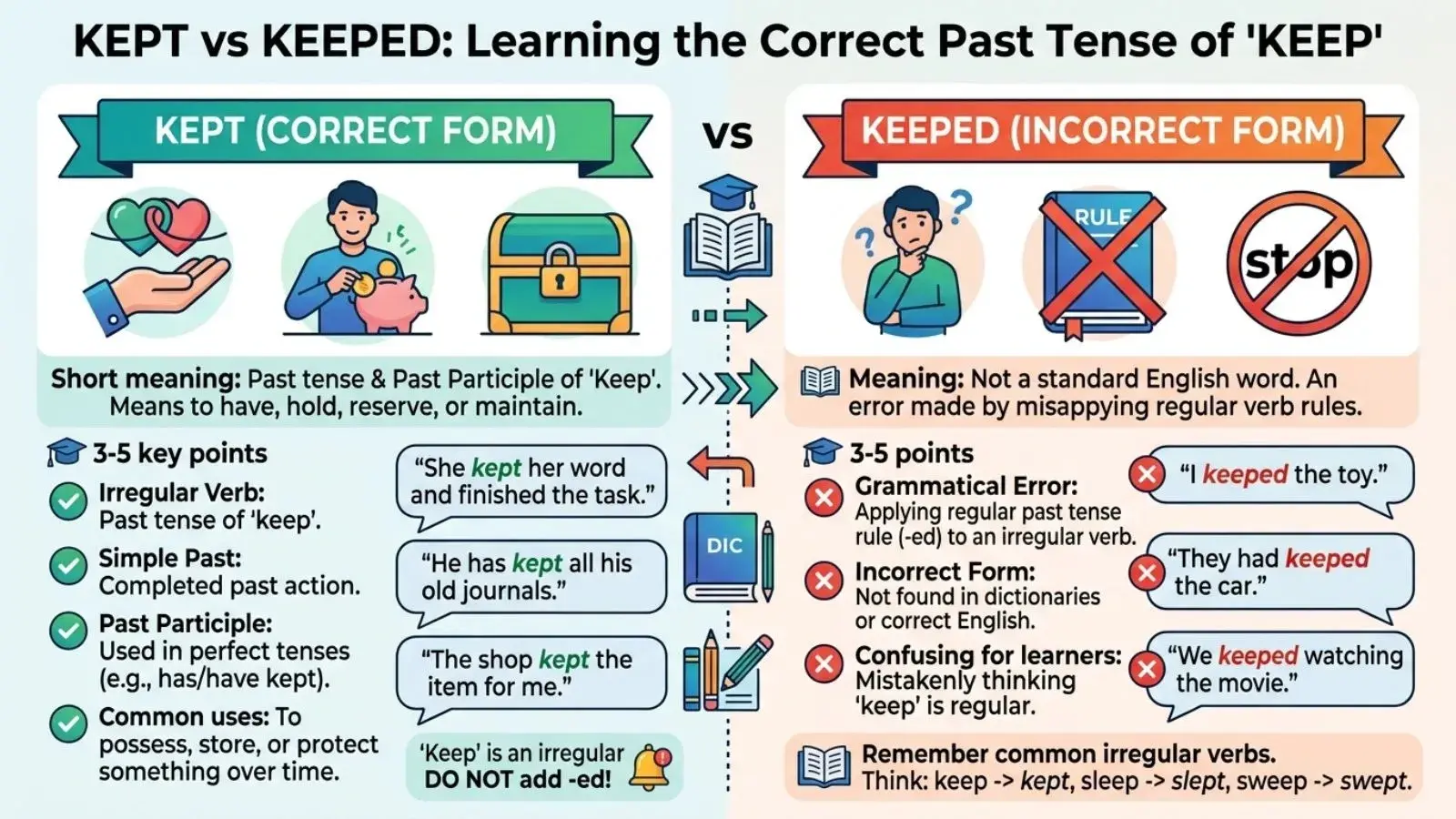
Have you ever typed keeped and then wondered if it was the right word? You are not alone. Many English learners and even native speakers sometimes get confused about the past tense of the verb keep. Since many English verbs form the past tense by adding -ed, it seems logical that keep would become keeped. However, English grammar does not always follow simple rules.
The confusion between keeped or kept is very common because keep is an irregular verb. Unlike regular verbs such as work/worked or play/played, the verb keep changes in a different way when talking about the past. The correct past tense and past participle form is kept.
People search for keeped or kept because they want a quick answer, but they also want to understand why one form is correct and the other is not.
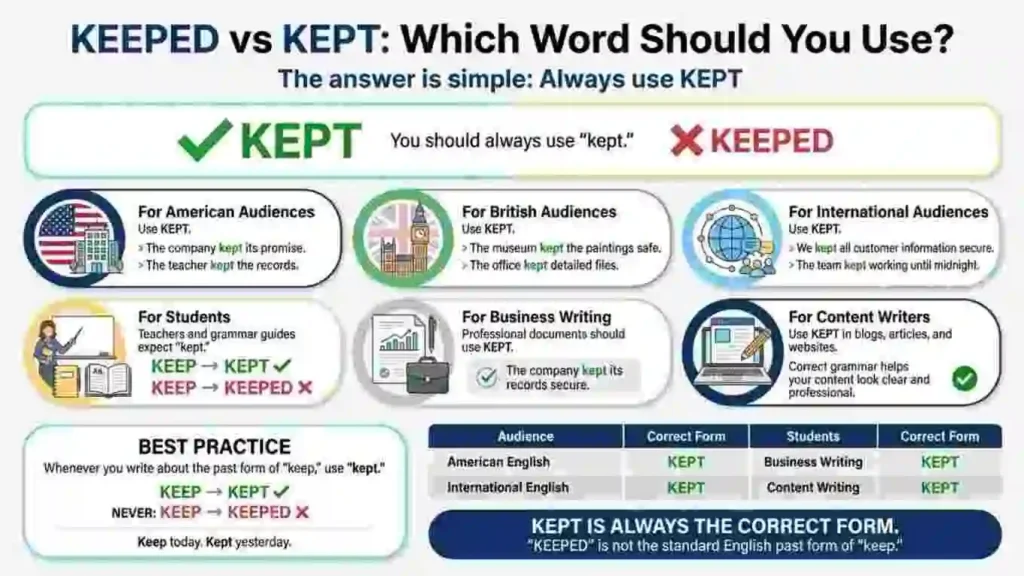
Keeped or Kept – Quick Answer
The correct word is kept.
❌ Keeped
✅ Kept
The word kept is the correct past tense and past participle of the verb keep.
Examples
- I kept my promise.
- She kept the letter.
- They kept the door closed.
- We kept the secret safe.
- He kept all the receipts.
The form keeped is not accepted in standard English grammar.
Quick Comparison
| Word | Correct? | Meaning |
| Keeped | ❌ No | Incorrect form of keep |
| Kept | ✅ Yes | Past tense and past participle of keep |
Simple Rule
If you are talking about something that happened in the past, use kept, never keeped.
The Origin of Keeped or Kept
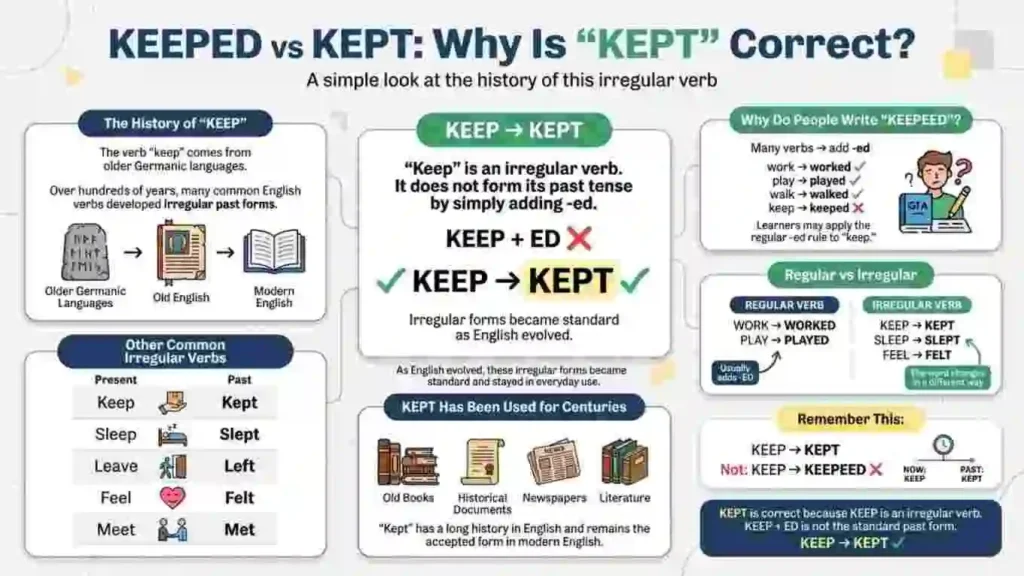
To understand why kept is correct, it helps to know a little about the history of the word.
The verb keep comes from older Germanic languages. Over hundreds of years, many common English verbs developed irregular forms. These verbs did not follow the normal pattern of adding -ed.
For example:
| Present | Past |
| Keep | Kept |
| Sleep | Slept |
| Leave | Left |
| Feel | Felt |
| Meet | Met |
As English evolved, these irregular forms became standard and remained in use.
The word kept has been used in English for centuries. It appears in old books, historical documents, newspapers, and literature. Because it has such a long history, it became the accepted form in modern English.
The form keeped usually appears when learners apply a regular grammar rule to an irregular verb. Since many verbs add -ed, people naturally assume that keep follows the same pattern.
Why the Confusion Exists
English has two main types of verbs:
Regular Verbs
These add -ed to form the past tense.
Examples:
- Walk → Walked
- Play → Played
- Clean → Cleaned
- Watch → Watched
Irregular Verbs
These change form instead of adding -ed.
Examples:
- Keep → Kept
- Sleep → Slept
- Go → Went
- Write → Wrote
Because keep belongs to the second group, the correct form is kept.
British English vs American English Spelling
Many English words have different spellings in British and American English.
Examples:
| American English | British English |
| Color | Colour |
| Favorite | Favourite |
| Organize | Organise |
| Center | Centre |
However, keeped or kept is not one of these cases.
Both American English and British English use kept.
American English Examples
- The company kept detailed records.
- She kept the original receipt.
British English Examples
- The company kept detailed records.
- She kept the original receipt.
The spelling remains exactly the same in both versions of English.
Comparison Table
| English Version | Correct Form | Example |
| American English | Kept | He kept the documents. |
| British English | Kept | He kept the documents. |
| Canadian English | Kept | He kept the documents. |
| Australian English | Kept | He kept the documents. |
| New Zealand English | Kept | He kept the documents. |
There is no major English-speaking country where keeped is considered correct standard English.
Which Spelling Should You Use?
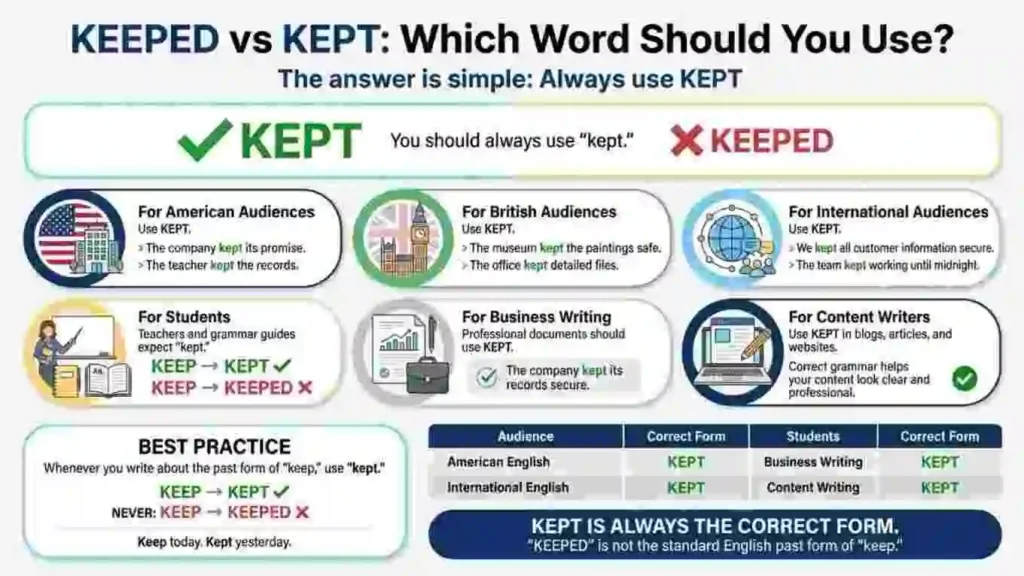
The answer is simple.
You should always use kept.
For American Audiences
Use kept.
Examples:
- The company kept its promise.
- The teacher kept the records.
For British Audiences
Use kept.
Examples:
- The museum kept the paintings safe.
- The office kept detailed files.
For International Audiences
Use kept.
Examples:
- We kept all customer information secure.
- The team kept working until midnight.
For Students
Teachers and grammar guides expect the word kept.
For Business Writing
Professional documents should always use kept.
For Content Writers
Blogs, articles, and websites should use kept for correct grammar and better credibility.
Best Practice
Whenever you write about something that happened in the past, choose kept.
Common Mistakes with Keeped or Kept
Many people make the same grammar mistakes when using the verb keep.
Mistake 1
❌ I keeped the ticket.
✅ I kept the ticket.
Mistake 2
❌ She keeped all the emails.
✅ She kept all the emails.
Mistake 3
❌ We have keeped the information private.
✅ We have kept the information private.
Mistake 4
❌ They had keeped the documents for years.
✅ They had kept the documents for years.
Mistake 5
❌ The company keeped customer records.
✅ The company kept customer records.
Mistake 6
❌ He keeped his promise.
✅ He kept his promise.
Easy Memory Trick
Think of these pairs:
- Sleep → Slept
- Keep → Kept
Both words follow a similar pattern.
Keeped or Kept in Everyday Examples
The word kept appears in many everyday situations.
In Emails
- I kept a copy of the contract for future reference.
- We kept your request on file.
In News Articles
- The government kept its promise to voters.
- The company kept profits steady during the year.
On Social Media
- I kept this photo for ten years!
- We kept the surprise secret until today.
School Writing
- The student kept all assignments organized.
- She kept her notes in one notebook.
Business Writing
- The organization kept accurate records.
- The manager kept employees informed.
Formal Writing
- Researchers kept detailed observations throughout the study.
- The institution kept historical documents secure.
Daily Conversation
- I kept your book safe.
- We kept the room clean.
- She kept her word.
Keeped or Kept – Google Trends & Usage Data
Search engines show that many people search for keeped or kept every month.
Most searches come from:
- Students
- English learners
- Content writers
- Teachers
- Business professionals
People often search because they are unsure whether keep follows the regular -ed rule.
Usage in Real Writing
The word kept appears millions of times in:
- Books
- Newspapers
- Academic papers
- Websites
- Business reports
- Online articles
The word keeped appears very rarely and is usually found in:
- Grammar mistakes
- Learner writing
- Informal online discussions
Popular Countries Searching This Keyword
- United States
- United Kingdom
- Canada
- Australia
- India
- Pakistan
Usage Comparison Table
| Word | Search Interest | Usage in Professional Writing |
| Kept | Very High | Very Common |
| Keeped | Moderate Search Interest | Extremely Rare |
The data clearly shows that kept is the accepted form used across the English-speaking world.
Keeped vs Kept Comparison Table
| Feature | Keeped | Kept |
| Standard English | ❌ No | ✅ Yes |
| Correct Grammar | ❌ No | ✅ Yes |
| Past Tense of Keep | ❌ No | ✅ Yes |
| Past Participle of Keep | ❌ No | ✅ Yes |
| Used in Schools | ❌ No | ✅ Yes |
| Used in Business Writing | ❌ No | ✅ Yes |
| Used in Newspapers | ❌ No | ✅ Yes |
| Accepted Worldwide | ❌ No | ✅ Yes |
| Recommended for SEO Content | ❌ No | ✅ Yes |
FAQs:
Is keeped a real word?
Keeped sometimes appears in learner English, but it is not accepted as standard English grammar.
What is the correct past tense of keep?
The correct past tense of keep is kept.
What is the past participle of keep?
The past participle is also kept.
Example:
- I have kept the receipt.
Why is kept correct instead of keeped?
Because keep is an irregular verb. Irregular verbs do not simply add -ed.
Is kept used in British English?
Yes. British English uses kept.
Is kept used in American English?
Yes. American English also uses kept.
Can I use keeped in formal writing?
No. Formal writing should always use kept.
How can I remember the correct form?
Remember the pattern:
- Sleep → Slept
- Keep → Kept
Is kept correct in academic writing?
Yes. Academic writing, reports, and research papers all use kept.
Conclusion:
When comparing keeped or kept, the correct choice is always kept. Although many English verbs form the past tense by adding -ed, the verb keep is irregular. Because of this, its past tense and past participle form is kept, not keeped.
It is the form used in schools, universities, businesses, newspapers, books, and professional writing.
. However, English contains many irregular verbs such as sleep/slept, feel/felt, and leave/left. The verb keep follows the same pattern and becomes kept when referring to the past.
If you want clear, professional, and grammatically correct writing, always choose kept. Whether you are writing an email, article, report, assignment, or social media post, kept is the only standard form you should use.

Ethan Carter is a language writer at Wordellect who helps readers understand word differences, grammar rules, and spelling variations through simple and accurate guides.







