Have you ever heard someone say “the gist of it” and then wondered how to spell it? If you searched jist or gist, you are not alone. These two forms sound the same when spoken, so it is easy to choose the wrong spelling when writing.
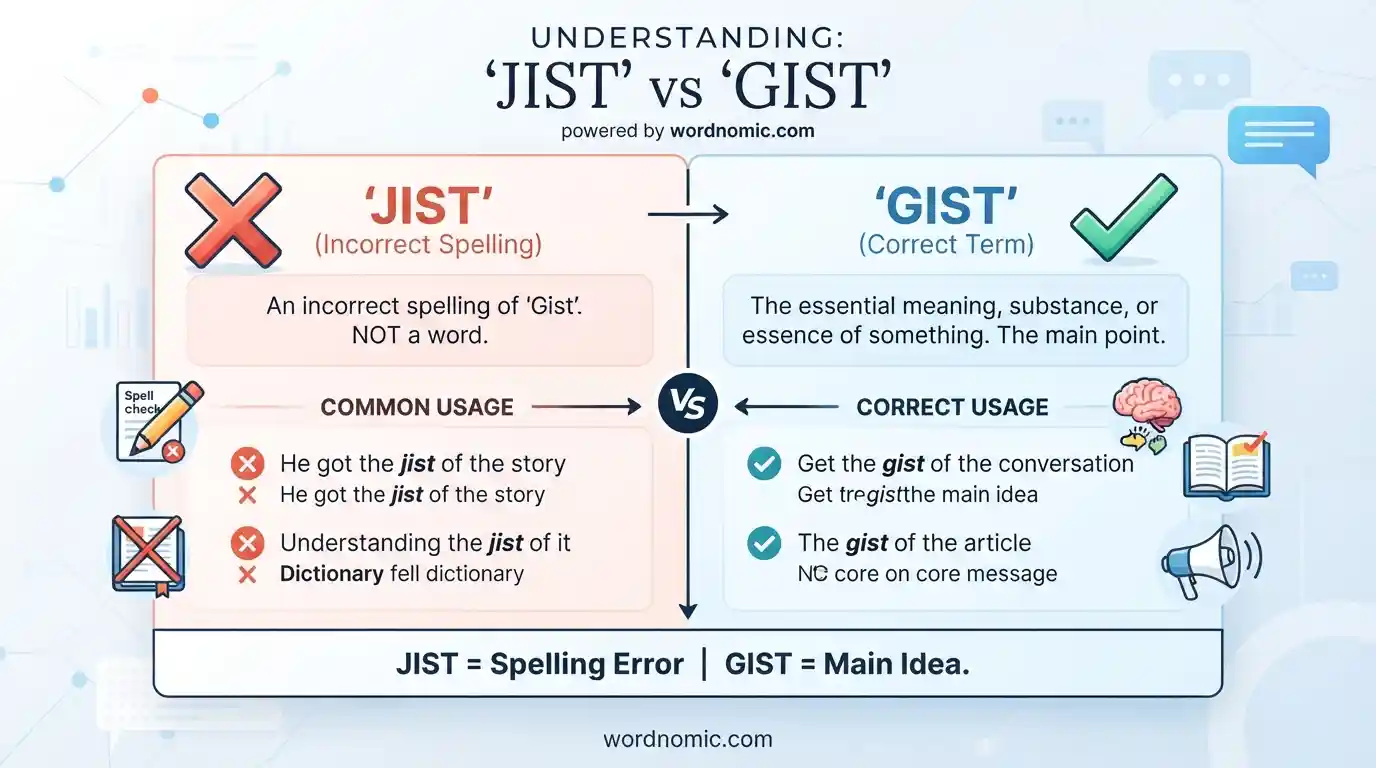
The good news is that the answer is simple: gist is the correct spelling when you mean the main idea, main point, or general meaning of something. Jist is normally a misspelling of gist in standard English.
The word gist is common in phrases such as “the gist of the story” and “get the gist.” You can use it when you do not need every small detail but want to understand the main point.
This guide explains the difference between jist and gist, what gist means, how to use it, where the word came from, and how to avoid the common spelling mistake.
Jist or Gist – Quick Answer
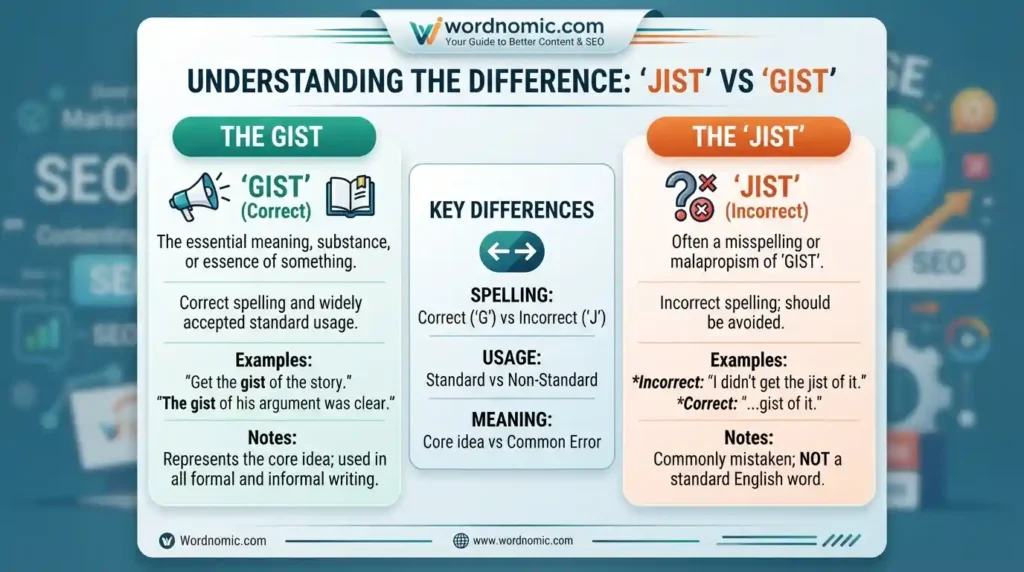
Gist is the correct spelling.
Jist is usually a misspelling of gist.
The word gist means the main idea, main point, or general meaning of something.
Correct:
I got the gist of the story.
Incorrect:
I got the jist of the story.
Both words may sound the same when spoken, but only gist is the standard spelling for this meaning.
A simple way to remember it is:
Gist = the general idea.
What Does Gist Mean?
Gist is a noun. It means the main point or general meaning of something.
You can use it when talking about:
- A story
- A book
- A speech
- A conversation
- An email
- A report
- An argument
- A lesson
- An article
- An idea
For example:
I did not read the whole report, but I know the gist.
This means the person knows the main idea but may not know every detail.
Another example is:
Can you tell me the gist of the meeting?
This means:
Can you tell me the main points of the meeting?
Oxford defines gist as the main or general meaning of a piece of writing, speech, or conversation.
Jist vs Gist: Main Difference
The main difference is very simple.
Gist is the correct word.
Jist is normally a spelling mistake when someone means “main idea” or “main point.”
The confusion comes from pronunciation. Gist is pronounced with a soft “g” sound, so it sounds like it starts with a “j.”
This can make people think the spelling should be jist.
But English spelling does not always match the sound exactly.
Remember:
- gist = correct
- jist = incorrect in standard English
- gist = main idea or point
- get the gist = understand the main idea
Gist or Jist Comparison Table
| Term | Correct? | Meaning | Example |
| gist | Yes | Main idea or point | I got the gist of the story. |
| jist | No, for this meaning | Usually a misspelling of gist | I got the jist. ❌ |
There is no normal meaning difference between jist and gist when someone is trying to say “main idea.”
If you mean the main point, use gist.
How Do You Use Gist?
The most common pattern is:
the gist of + something
For example:
the gist of the story
the gist of the conversation
gist of the email
the gist of the report
You can also use the common phrase:
get the gist
This means to understand the main idea without knowing every detail.
Examples
I did not understand every word, but I got the gist.
Did you get the gist of what she said?
He gave me the gist of the plan.
You will often see gist with the word the.
For example:
I understand the gist.
Not:
I understand a gist.
Scribbr notes that gist is normally used with the definite article “the” in this common meaning.
Why Do People Spell Gist as Jist?
The main reason is pronunciation.
The word gist is pronounced roughly like “jist.”
The letter g can make a soft sound, as it does in words such as:
- giant
- gentle
- gym
- general
- gist
So when people hear the word, they may think it begins with the letter j.
That leads to the common spelling jist.
However, the correct written form is gist.
The pronunciation can help explain the mistake, but it does not change the standard spelling.
Origin and History of Gist
The word gist has an interesting history.
It came into English from Anglo-French legal language. Oxford traces it to Old French gesir, meaning “to lie,” and then to Latin jacēre, also meaning “to lie.”
The early legal use was linked to a phrase meaning that an action “lies” or has grounds to proceed.
Over time, gist developed another common meaning: the main point or essential part of something.
The meaning “essence” or main point became established later.
Today, most people know gist as a word for the main idea of a story, speech, conversation, or piece of writing.
British English vs American English
There is no spelling difference between British English and American English for this word.
Both use:
gist
Both do not normally use:
jist
The meaning is also the same in everyday use.
American English
I got the gist of the message.
British English
I got the gist of the message.
The pronunciation is also essentially the same. Dictionary sources list the pronunciation as /dʒɪst/.
So you do not need to change gist based on whether you are writing for readers in the United States or the United Kingdom.
Which One Should You Use?
Use gist whenever you mean the main idea, main point, or general meaning.
This applies to:
Everyday Writing
I got the gist of what you said.
School Writing
The student explained the gist of the story.
Business Writing
Please send me the gist of the meeting.
Emails
Can you give me the gist of the report?
Formal Writing
Use gist when it fits the meaning.
The gist of the argument was easy to understand.
Online Writing
I did not read the whole post, but I got the gist.
In all of these cases, choose gist, not jist.
Common Mistakes With Jist and Gist
Mistake 1: Writing “jist”
Incorrect:
I understand the jist.
Correct:
I understand the gist.
Why?
The standard spelling is gist.
Mistake 2: Writing “jist of it”
Incorrect:
What is the jist of it?
Correct:
What is the gist of it?
Why?
The phrase is the gist of it, meaning the main point.
Mistake 3: Thinking the sound tells you the spelling
You may hear:
“jist”
But the word is spelled:
gist
English has many words where spelling and sound do not match in a simple way.
Mistake 4: Using “a gist”
Less natural:
Give me a gist of the story.
Better:
Give me the gist of the story.
The common expression uses the gist.
Mistake 5: Thinking gist means every detail
Incorrect idea:
Gist means all the details.
Correct idea:
Gist means the main idea or important point.
If you know the gist, you understand the main message. You do not need to know every small detail.
10 Everyday Examples of Gist
Here are some simple examples:
- I got the gist of the story.
- Can you give me the gist of the email?
- She explained the gist of the lesson.
- I did not read the whole book, but I know the gist.
- Did you get the gist of his message?
- He gave us the gist of the plan.
- The gist of the speech was easy to understand.
- Please tell me the gist of the meeting.
- I missed the first part, so I do not know the gist.
- After reading the report, I understood its gist.
These examples all use gist to mean the main idea or general meaning.
Real-Life Use of Gist
In Conversation
Someone may ask:
What happened at the meeting?
You do not need to tell the whole story. You can say:
I will give you the gist.
Then give the main points.
At School
A teacher may ask students to find the gist of a passage.
This means students should understand the main idea instead of focusing only on small details.
At Work
A manager may ask:
What is the gist of this report?
The manager wants a short explanation of the most important point.
In an Email
You may write:
Here is the gist of the changes.
This tells the reader that you are giving the main points.
On Social Media
Someone may read a long post and say:
I got the gist.
This means they understood the main message.
Related Search Questions
What is the correct spelling: jist or gist?
The correct spelling is gist. When you mean the main idea, main point, or general meaning, use gist. Jist is normally a misspelling of this word.
What does “the gist of it” mean?
“The gist of it” means the main point or general meaning of something. For example, if someone gives you the gist of a long story, they tell you the important part without giving every detail.
How do you pronounce gist?
Gist is pronounced like “jist.” This soft “g” sound is one reason people often spell the word incorrectly as jist. The pronunciation does not change the correct spelling.
Is jist a word?
For the meaning “main point” or “general meaning,” jist is not the standard spelling. It is normally treated as a misspelling of gist. Use gist in school, work, business, and formal writing.
Is “get the gist” correct?
Yes. Get the gist is a common and correct expression. It means to understand the main idea or general meaning of something.
Can gist be used in formal writing?
Yes. Gist is a standard English word and can be used in formal writing when it fits the sentence. For example: “The gist of the report was clear.” Avoid the misspelling jist.
Usage and Search Trends
People often search for jist or gist because the two forms sound the same.
Common searches include:
- gist or jist
- jist or gist
- is it gist or jist?
- which is correct, gist or jist?
- what does gist mean?
- the gist of it meaning
- get the gist meaning
- how do you spell gist?
- gist meaning in English
- is jist a word?
These searches all point to the same basic spelling question.
There is no need to use made-up search volume or keyword numbers. The main language issue is clear: gist is the standard spelling for the meaning “main idea” or “main point.” Major dictionary and language references support this usage.
Gist vs Jist: Quick Comparison
| Feature | Gist | Jist |
| Standard English | Yes | No, for this meaning |
| Meaning | Main idea or point | Usually a misspelling of gist |
| Pronunciation | /dʒɪst/ | Usually intended to sound the same |
| Formal writing | Correct | Avoid |
| School writing | Correct | Avoid |
| Business writing | Correct | Avoid |
| Common phrase | The gist of it | The jist of it ❌ |
| Example | I got the gist. | I got the jist. ❌ |
Gist in Legal English
There is also a legal meaning of gist.
In legal use, gist can refer to the main grounds or essential point of a legal action. Dictionaries still list this meaning.
For most everyday readers, however, the more common meaning is simply:
the main idea or essential point.
So if you see the word in a normal conversation, email, article, or school text, it usually refers to the main meaning or point.
Easy Memory Trick
Here is a simple way to remember the spelling:
Gist = General idea.
Both words begin with G.
Think:
G = General idea = Gist
This can help you remember that the correct spelling has G, not J.
Another useful phrase to remember is:
Get the gist.
If you remember this common phrase, it becomes easier to remember the spelling.
Gist or Jist Exercise
Choose the correct word in each sentence.
- I got the ___ of the story.
- a) jist
- b) gist
- Can you give me the ___ of the report?
- a) gist
- b) jist
- Did you get the ___ of what she said?
- a) jist
- b) gist
- He explained the ___ of the meeting.
- a) gist
- b) jist
- What is the ___ of the article?
- a) jist
- b) gist
- I did not understand every detail, but I got the ___.
- a) gist
- b) jist
Answers
- gist
- gist
- gist
- gist
- gist
- gist
The answer is gist in every case because it is the standard spelling for “main idea” or “main point.”
FAQs About Jist or Gist
1. Is gist or jist correct?
Gist is correct. It means the main point, main idea, or general meaning of something. Jist is normally a spelling mistake. If you are writing an email, essay, report, or school assignment, use gist.
2. Why do people spell gist as jist?
People often spell it jist because that is close to how gist sounds. The word has a soft “g” sound, which sounds like the letter “j.” However, the correct spelling remains gist.
3. What does “get the gist” mean?
Get the gist means to understand the main idea without knowing every detail. For example, you may read a long article and understand its main message even if you do not remember every fact.
4. Is “the gist of it” correct?
Yes. The gist of it is a correct and common phrase. It means the main point or general meaning of something. For example: “I do not know every detail, but I understand the gist of it.”
5. Is gist used in British English?
Yes. Gist is used in British English and American English. The spelling and basic everyday meaning do not change between the two forms of English.
6. Can I use gist in an essay?
Yes. Gist is a standard English word, so you can use it when it fits your meaning. For example: “The gist of the author’s argument is clear.” Always spell it gist, not jist.
7. What is another word for gist?
Common words with a similar meaning include main point, main idea, essence, substance, and general meaning. The best choice depends on the sentence. In everyday English, gist is often a simple way to say “the main idea.”
Conclusion
When choosing between jist or gist, the answer is simple: gist is the correct spelling when you mean the main idea, main point, or general meaning of something.
The word may sound like it starts with a “j,” but it is spelled with a g. This is why many people write jist by mistake. The standard form is gist.
You can use gist in many everyday situations. You can talk about the gist of a story, the gist of a conversation, the gist of an email, or the gist of a report. They can also use the common phrase get the gist, which means to understand the main idea.
There is no British or American spelling difference here. Both forms of English use gist.
So, if you are unsure whether to write jist or gist, remember this simple rule:
Gist = the main idea.
Write gist, not jist, in your school work, emails, business writing, and other standard English writing.

Ethan Carter is a language writer at Wordellect who helps readers understand word differences, grammar rules, and spelling variations through simple and accurate guides.







