You’re writing “this affects everybody’s plans” and you pause. Should that be “everybody’s” or “everybodies”? It looks like it could go either way, especially if you’re thinking about it like a normal plural word.
This one shows up a lot in casual writing, texts, and even school papers. People search “everybody’s or everybodies” while trying to show that something belongs to a whole group of people. It feels like it should work like other words, but “everybody” plays by its own rules.
Here’s the short answer. Only one of these is a real word. Let’s look at why, where “everybody” comes from, and how to always get this one right without needing to guess.
Key Points to Know
- Everybody’s is correct. It shows that something belongs to everybody.
- Everybodies is not a real word at all.
- “Everybody” is already a word for a whole group, so it never needs to be made plural.
- This mix-up happens because people try to treat “everybody” like a normal noun.
What’s in This Article
- Everybody’s or Everybodies – Fast Answer
- Why Does This Mistake Happen?
- Is This a UK vs US Thing?
- Which One Should You Use?
- Common Mistakes with Everybody’s or Everybodies
- Words That Work the Same Way
- Everybody’s or Everybodies in Real Life
- A Quick Checklist Before You Post
- Everybody’s or Everybodies – Search Trends
- Comparison Table
- FAQs
- Conclusion
Everybody’s or Everybodies – Fast Answer
Only one of these forms is a real word.
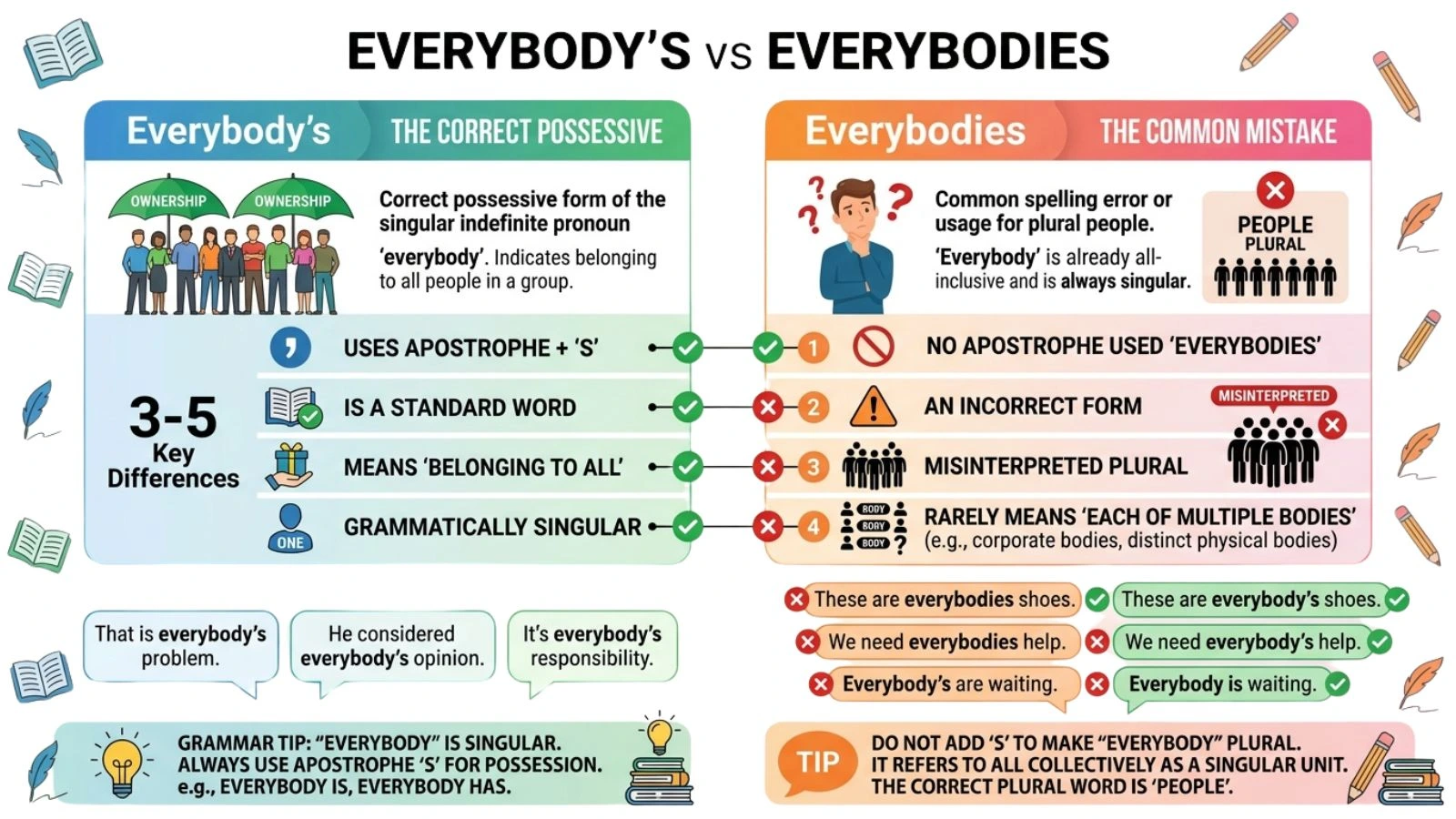
- Everybody’s is correct. The mark before the “s” shows that something belongs to everybody, like “everybody’s coat” or “everybody’s opinion.”
- Everybodies is not a real word. “Everybody” does not have a plural form.
Easy Examples
- Everybody’s phone buzzed at the same time.
- This news affects everybody’s plans for the weekend.
- ❌ Everybodies phone buzzed at the same time.
Simple Rule
Use everybody’s, every time you want to show something belongs to the whole group.
| Word | Correct? | Use |
| Everybody’s | Yes | Shows something belongs to everybody |
| Everybodies | No | Not a real word |
Why Does This Mistake Happen?
This one happens because “everybody” looks and feels like a normal word, similar to “body” or “family,” words that can become plural, like “bodies” and “families.”
But “everybody” is not that kind of word. It already means “every single person” all on its own. It’s already talking about a whole group, so there’s no need, and no correct way, to make it plural. Adding an “s” to turn it into “everybodies” just doesn’t work, since there’s nothing left to multiply. It’s already as “all-inclusive” as it can get.
Is This a UK vs US Thing?
No. This isn’t a spelling case like “colour” and “color.” Both “everybody’s” and the mistake “everybodies” work the exact same way in UK English and US English. “Everybody’s” is correct everywhere, with no difference by country.
Comparison Table
| English Style | Correct Word | Common Mistake |
| British English | Everybody’s | Everybodies |
| American English | Everybody’s | Everybodies |
Example Sentences
- UK: Everybody’s invited to the party this weekend.
- US: Everybody’s invited to the party this weekend.
Which One Should You Use?
Since only one form is correct, this comes down to simply remembering the rule.
Always Use “Everybody’s” When:
- Showing that something belongs to everybody
- Writing “everybody’s” as a short form of “everybody is,” like “everybody’s here”
- Writing casual or formal messages, emails, or papers
Never Use “Everybodies”:
- There’s no situation where this spelling is correct
Quick Check
| Question | Answer |
| Do I need to show something belongs to the group? | Use “everybody’s” |
| Is “everybodies” ever correct? | No |
Common Mistakes with Everybody’s or Everybodies
A few patterns keep coming up with this word.
Mistakes
1: Trying to Make “Everybody” Plural
- ❌ Everybodies opinion matters here.
- ✅ Everybody’s opinion matters here.
2: Dropping the Mark by Mistake
- ❌ This affects everybodys schedule.
- ✅ This affects everybody’s schedule.
3: Confusing It with Similar Words Like “Everyone’s”
- “Everyone’s” works the exact same way as “everybody’s,” and both are correct, just slightly different words with the same basic meaning.
Easy Way to Remember
“Everybody” already means the whole group. There’s no need to add anything extra to make it “more plural.”
Words That Work the Same Way
“Everybody” isn’t alone here. A few other words follow this same pattern, no plural form, but they do take a mark to show belonging.
| Word | Correct Possessive Form |
| Everybody | Everybody’s |
| Everyone | Everyone’s |
| Someone | Someone’s |
| Nobody | Nobody’s |
None of these words ever need to be made plural. They already refer to a full group or a single unknown person, all on their own.
Everybody’s or Everybodies in Real Life
In Everyday Messages
- Everybody’s coming over for dinner tonight, so excited!
- This mix-up really affected everybody’s plans for the trip.
In News or Formal Writing
- The change in policy will affect everybody’s tax return this year.
- Officials said the new rule applies to everybody’s application, without exception.
On Social Media
- Everybody’s talking about this new show, have you seen it yet?
- This heat is ruining everybody’s weekend plans, ugh.
In School or Work Writing
- Please make sure everybody’s name is spelled correctly on the list.
- The manager confirmed that everybody’s feedback will be reviewed.
A Quick Checklist Before You Post
- Ask yourself if you’re showing something belongs to the whole group.
- If yes, add the mark before the “s”: everybody’s.
- Never add an “s” without the mark to try to make “everybody” plural.
- If you typed “everybodies” anywhere, fix it, it’s simply not a word.
Everybody’s or Everybodies – Search Trends
People search for this pair often while writing quick messages, school papers, or just double-checking grammar before posting online.
Why People Search for This
- Writing texts or social media posts
- Checking grammar before sending an email
- School writing and grammar practice
- Learning English as a second language
- General spelling and grammar checks
How Each Form Is Searched
| Form | Common Use | Search Interest |
| Everybody’s | Everyday writing, correct form | Very high |
| Everybodies | Common mistake | Low, mostly people checking |
Everybody’s vs Everybodies – Side by Side
| Feature | Everybody’s | Everybodies |
| Correct? | Yes | No |
| Found in Dictionaries | Yes | No |
| Meaning | Shows something belongs to everybody | Not a real word |
| Common Cause of Mistake | N/A | Trying to make “everybody” plural |
| Spelling by Country | Same in UK and US | Same in UK and US |
FAQs:
Is “everybodies” ever a real word? No. It is not found in any standard dictionary and has no correct use in English.
Why can’t “everybody” be made plural? Because “everybody” already means every single person in a group. There’s nothing left to multiply, so a plural form doesn’t make sense.
Is this a British vs American spelling issue? No. “Everybody’s” is correct everywhere English is written, with no difference by country.
What is the correct way to show something belongs to everybody? Add the mark before the “s”: everybody’s, as in “everybody’s coat” or “everybody’s turn.”
Does “everyone’s” work the same way? Yes. “Everyone’s” follows the exact same pattern as “everybody’s,” and both are correct.
Will spell check catch “everybodies” as a mistake? Yes, in most cases, spell check will flag it right away.
Are there other words that don’t have a plural form like this? Yes. Words like “someone,” “nobody,” and “everyone” all work the same way, no plural form, but they do take a mark to show belonging.
Conclusion:
This one has a clean, simple answer. Everybody’s is correct. Everybodies is not a real word, since “everybody” already means the whole group and never needs a plural form. The mix-up usually happens because people try to treat “everybody” like a normal word that can be made plural, the same way “body” becomes “bodies.”
This isn’t a British versus American spelling issue either. Both regions use “everybody’s,” and only “everybody’s,” with no exceptions. The key to remembering it is simple: “everybody” is already as big as it gets, so there’s nothing left to multiply.
Next time you want to show something belongs to a whole group of people, remember the easy rule: everybody’s, with the mark before the “s,” every single time.

Ethan Carter is a language writer at Wordellect who helps readers understand word differences, grammar rules, and spelling variations through simple and accurate guides.