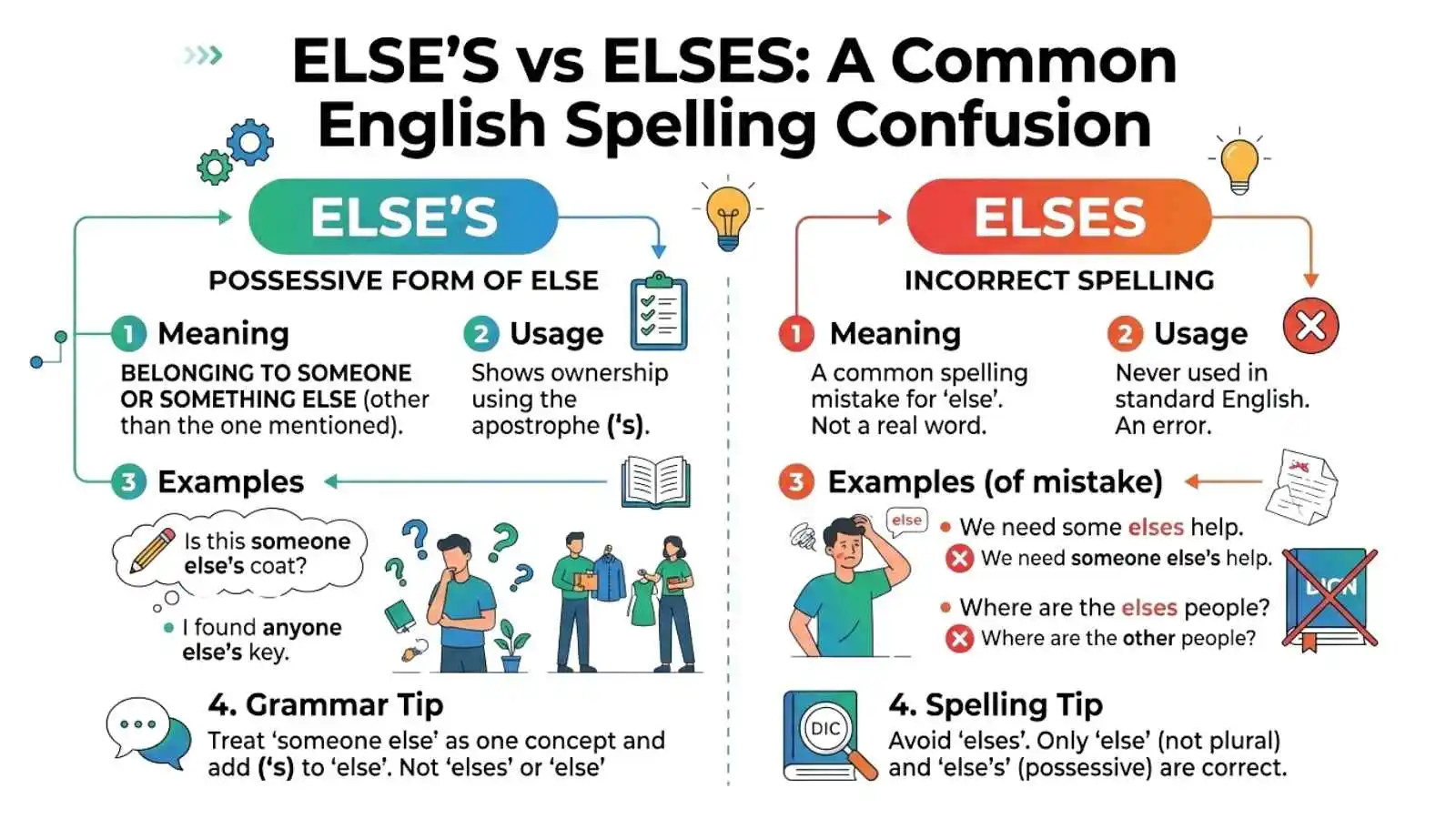
You’re writing “that’s someone else’s phone” and you stop. Does the mark go after “else”? Or somewhere else? And is “elses” even a real word?
This one trips up a lot of people, mostly because it just looks strange no matter how you write it. People search “else’s or elses” while texting, writing school work, or just checking a sentence before they hit send. It feels like a small thing, but it can make a sentence look off if you get it wrong.
Here is the short answer. Only one of these is correct, and it is not close. Let’s look at why, where this word comes from, and how to always get it right without having to think twice.
Key Points to Know
- Else’s (with the mark before the “s”) is the correct form.
- Elses is not a real word at all.
- The mark always goes right after “else,” not after the word before it.
- This mistake happens a lot with words like “someone,” “everyone,” and “nobody.”
What’s in This Article
- Else’s or Elses Fast Answer
- Why Does This Mistake Happen?
- Is This a UK vs US Thing?
- Which One Should You Use?
- Common Mistakes with Else’s or Elses
- Words That Work the Same Way
- Else’s or Elses in Real Life
- A Quick Checklist Before You Send It
- Else’s or Elses Search Trends
- Comparison Table
- FAQs
- Conclusion
Else’s or Elses Fast Answer
This is not a case of two correct choices. Only one form is right.
- Else’s is correct. The little mark, called an apostrophe, goes right before the “s” at the end of “else.”
- Elses is not a real word. It shows up sometimes by mistake, but it has no real use in English.
Easy Examples
- That’s someone else’s coat, not mine.
- I think this is everyone else’s problem too.
- ❌ That’s someone elses coat, not mine.
Simple Rule
Use else’s, every time, with the mark right before the final “s.”
| Word | Correct? | Example |
| Else’s | Yes | Someone else’s bag |
| Elses | No | Not a real word |
Why Does This Mistake Happen?
Here’s what makes this one tricky. Words like “someone,” “everyone,” and “nobody” already have their own ending built in. So when you want to show that something belongs to “someone else,” it feels like the mark should go somewhere in the middle, maybe right after “someone.”
But that’s not how it works. The word “else” is really its own small word, added on to show a different person or thing. Since “else” is the last full word in the phrase, the mark for showing something belongs to someone goes right after it, not after “someone,” “everyone,” or any other word before it.
Think of “someone else” as one whole idea, almost like a name. You wouldn’t put the mark in the middle of a name, and the same idea applies here.
Is This a UK vs US Thing?
No. This is not a spelling case like “colour” and “color.” Both “else’s” and the mistake “elses” work the exact same way in UK English and US English. “Else’s” is correct everywhere English is written, with no exceptions by country.
Comparison Table
| English Style | Correct Form | Common Mistake |
| British English | Else’s | Elses |
| American English | Else’s | Elses |
Example Sentences
- UK: This must be someone else’s umbrella.
- US: This must be someone else’s umbrella.
Which One Should You Use?
Since only one form is right, this really just comes down to breaking a habit if you’ve picked up the mistake.
Always Use “Else’s” When:
- Showing something belongs to another person, like “someone else’s”
- Writing casual texts, emails, or formal work
- Talking about anyone other than the person already named
Never Use “Elses”:
- It has no accepted use anywhere in standard English
Quick Check
| Question | Answer |
| Does this belong to another person? | Use “else’s” |
| Is “elses” ever correct? | No |
Common Mistakes with Else’s or Elses
A few patterns show up again and again with this word.
Mistakes
1: Putting the Mark in the Wrong Spot
- ❌ This is someone’s else bike.
- ✅ This is someone else’s bike.
2: Leaving the Mark Out Completely
- ❌ Thats someone elses coat.
- ✅ That’s someone else’s coat.
3: Doing the Same Thing with Other Words
- ❌ Is this everyones else’s turn?
- ✅ Is this everyone else’s turn?
Easy Way to Remember
Picture “someone else” as one full phrase. The mark always goes at the very end, right after “else.”
Words That Work the Same Way
This same pattern shows up with a whole group of words. Once you learn one, you know them all.
| Full Phrase | Correct Form |
| Someone else | Someone else’s |
| Everyone else | Everyone else’s |
| Nobody else | Nobody else’s |
| Anybody else | Anybody else’s |
No matter which word comes before “else,” the mark always lands after “else,” not before it.
Else’s or Elses in Real Life
In Everyday Messages
- I think I grabbed someone else’s charger by mistake.
- This looks like it could be anybody else’s umbrella.
In News or Formal Writing
- The lawyer argued the property belonged to someone else’s family.
- Officials said the mistake affected everyone else’s paperwork too.
On Social Media
- Pretty sure I’m wearing someone else’s jacket right now, lol.
- Feels like everyone else’s life is more put together than mine some days.
In School or Work Writing
- Please do not use anybody else’s password to log in.
- The report was mistakenly filed under someone else’s name.
A Quick Checklist Before You Send It
- Find the word “else” in your sentence.
- Put the mark right after it, before the final “s.”
- Read the sentence out loud. It should sound just like “else” plus a quick “s” sound.
- If you typed “elses” anywhere, fix it, it’s never correct.
Else’s or Elses Search Trends
People search for this pair a lot while texting fast or double-checking a sentence before sending something more formal.
Why People Search for This
- Fast texting or messaging
- Checking grammar before sending an email
- Writing school papers
- Learning English as a second language
- General spelling and grammar checks
How Each Form Is Searched
| Form | Common Use | Search Interest |
| Else’s | Everyday writing, correct form | Very high |
| Elses | Common mistake | Low, mostly people checking |
Else’s vs Elses Side by Side
| Feature | Else’s | Elses |
| Correct? | Yes | No |
| Found in Dictionaries | Yes | No |
| Common Use | Showing something belongs to another person | Not used at all |
| Spelling by Country | Same in UK and US | Same in UK and US |
FAQs:
Is “elses” ever correct? No. It is not a real word in standard English at all.
Why doesn’t the mark go on “someone” instead of “else”? Because “someone else” works as one full idea. The mark always goes at the end of that full phrase, right after “else.”
Is this a British vs American spelling issue? No. “Else’s” is correct in both British and American English, with no regional difference.
What is the correct way to write “everyone else” when showing ownership? The correct form is “everyone else’s,” as in “this is everyone else’s responsibility too.”
Does this same rule apply to other words like “nobody” and “anybody”? Yes. Words like “nobody else” and “anybody else” follow the same pattern: “nobody else’s” and “anybody else’s.”
Will spell check catch this mistake? Yes, most spell checkers will flag “elses” and suggest “else’s” instead.
Is this the same kind of mistake as mixing up “its” and “it’s”? It is a similar type of mistake, since both involve placing an apostrophe correctly, though the exact rule is a bit different for each one.
Conclusion:
This one has a clean, simple answer. Else’s is correct. Elses is not a real word at all. The mistake usually happens because people expect the mark to go on the word before “else,” like “someone” or “everyone,” instead of on “else” itself.
This is not a British vs American English issue either. Both regions use “else’s,” and only “else’s,” with no exceptions. The key is remembering that “someone else,” “everyone else,” and similar phrases work as one full idea, so the mark always lands at the very end.
Next time you’re writing about something that belongs to another person, just picture the full phrase first, then add the mark right after “else.” Simple as that.

Ethan Carter is a language writer at Wordellect who helps readers understand word differences, grammar rules, and spelling variations through simple and accurate guides.







