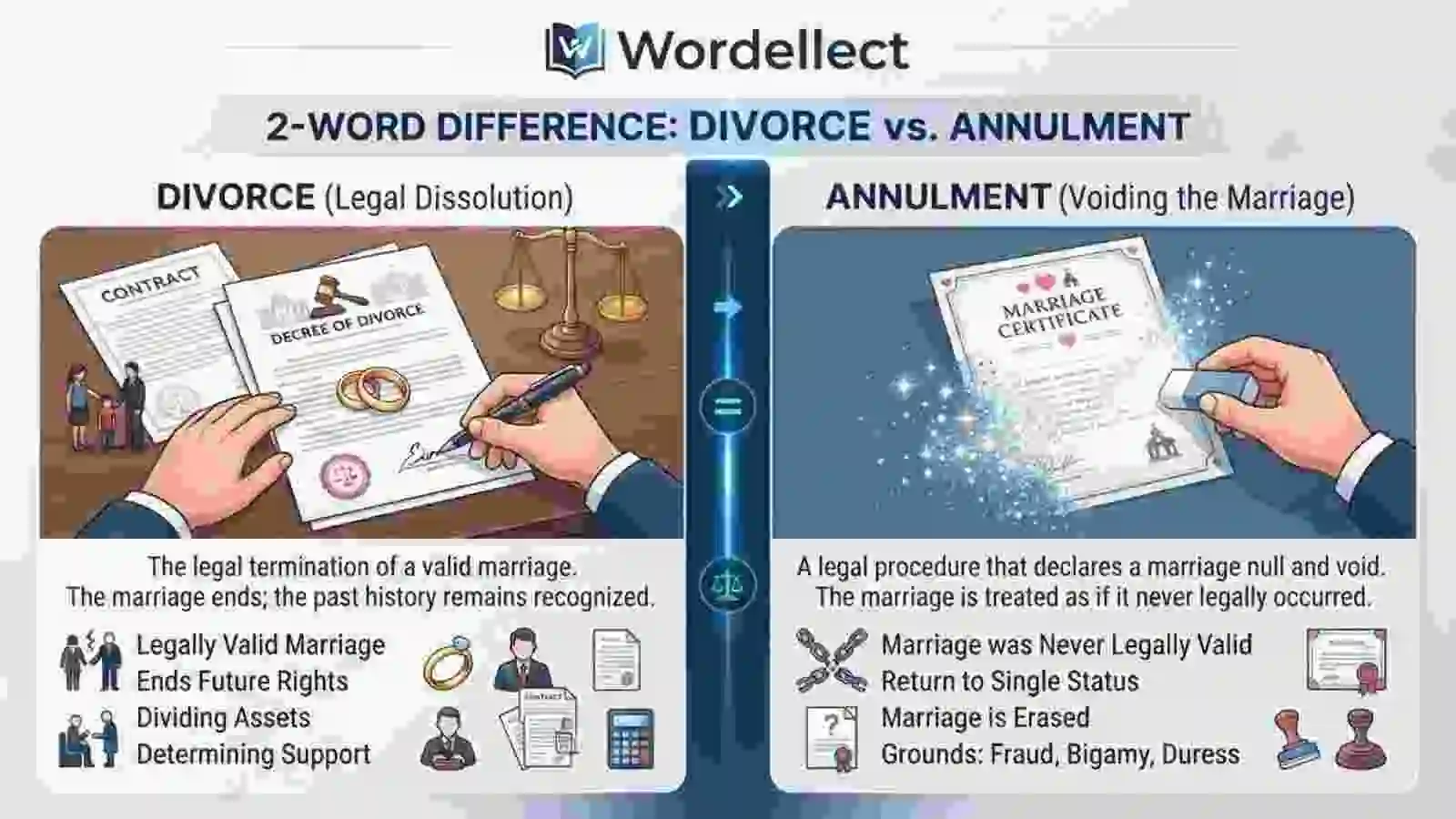
When a marriage ends, people often hear two legal terms: divorce and annulment. These words may sound similar, but they do not mean the same thing.
Both can legally end a marriage. However, they work in different ways.
A divorce ends a valid marriage. The law accepts that the marriage existed, but the couple decides, or the court decides, that the marriage should end.
An annulment is different. It is a legal process that says a marriage was not valid from the start, or that a legal reason existed to treat it as invalid. The exact rules for annulment can vary by country or state.
This difference is important because people often think an annulment simply means a faster divorce. That is not always true.
In this guide, you will learn the difference between divorce and annulment, how each works, common reasons for each, how they affect records, and when each option may apply.
Divorce or Annulment: Quick Answer
Divorce legally ends a valid marriage.
Annulment can declare that a marriage was legally invalid or should be treated as invalid from the beginning, depending on local law.
| Divorce | Annulment |
| Ends a valid marriage | Challenges the legal validity of the marriage |
| The marriage existed legally | The law may treat the marriage as invalid |
| More common | Usually available only in certain situations |
| Can involve property and support issues | Can also involve legal and financial issues |
| Rules vary by location | Rules vary greatly by location |
Simple example
If two people have a valid marriage but later decide they cannot stay married, they may seek a divorce.
If a serious legal problem existed when they married, an annulment may be possible under local law.
What Is Divorce?
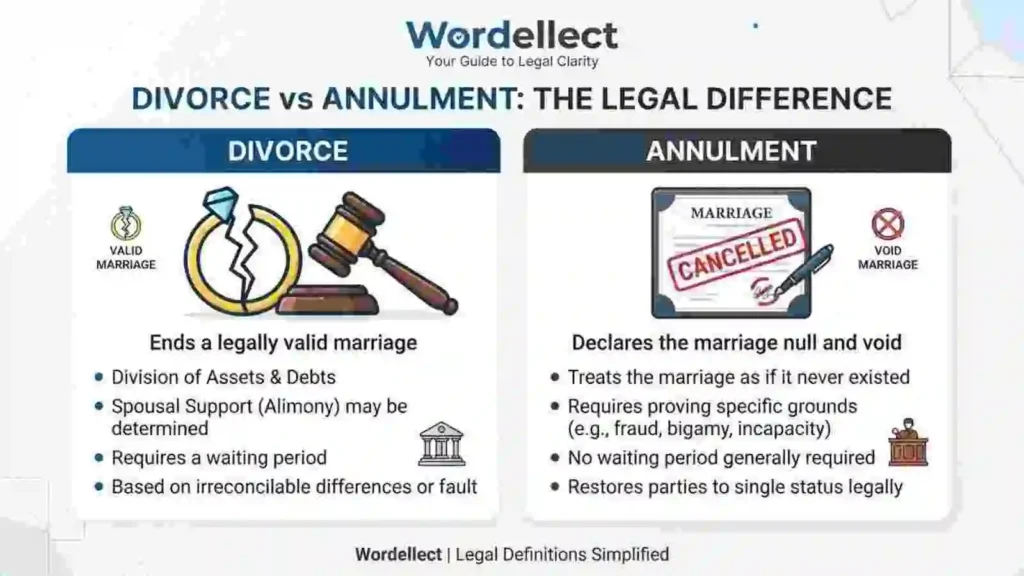
Divorce is the legal ending of a marriage.
When a court grants a divorce, the marriage ends under the law.
A divorce may deal with several issues, such as:
- Property
- Money
- Debts
- Child custody
- Child support
- Spousal support
- Other family matters
The exact process depends on the laws where the couple lives.
Example
John and Sarah have been married for five years. Their marriage was legally valid, but they no longer want to stay married.
They may seek a divorce.
The divorce recognizes that the marriage existed and legally ends it.
What Is Annulment?
An annulment is a legal process that can declare a marriage invalid.
The important point is that annulment is not simply another word for divorce.
An annulment may apply when a legal problem existed at the time of the marriage.
The exact grounds vary by jurisdiction.
Possible grounds in some places may include:
- Fraud
- Lack of legal capacity
- Lack of valid consent
- Certain forms of coercion
- A marriage that was prohibited by law
- Certain age-related issues
Not every reason applies everywhere.
Because annulment laws differ, you should check the law in your state or country before assuming that you qualify.
Divorce vs Annulment: Main Difference
The easiest way to remember the difference is:
Divorce ends a valid marriage.
Annulment concerns the legal validity of the marriage itself.
A divorce generally accepts that a valid marriage existed.
An annulment may result in a legal finding that the marriage was invalid under the law.
This is why the two processes have different legal requirements.
Common Reasons for Divorce
People seek divorce for many reasons.
Some common reasons include:
- The couple no longer wants to stay married.
- The relationship has broken down.
- The couple cannot resolve serious problems.
- The spouses have separated.
- There are serious family or personal conflicts.
Some legal systems allow divorce without requiring one spouse to prove that the other spouse did something wrong.
The rules vary by location.
Common Reasons for Annulment
Annulment usually requires a specific legal ground.
Depending on the jurisdiction, possible grounds may include:
Fraud
One person may have hidden an important fact or used deception to obtain the marriage.
However, not every lie is enough for an annulment. The legal test depends on local law.
Lack of Consent
A marriage may be challenged if a person did not give valid consent.
For example, serious pressure or coercion may affect whether consent was legally valid.
Lack of Legal Capacity
Some laws allow annulment when a person lacked the legal ability to marry.
The exact rules vary.
Prohibited Marriage
Some marriages may be legally prohibited.
For example, a marriage may violate certain family relationship rules or other legal requirements.
Age
Some jurisdictions have special rules involving the age of a person at the time of marriage.
The rules can be complex and depend on local law.
Is Annulment the Same as Saying the Marriage Never Happened?
Not exactly.
People often say that an annulment means the marriage “never happened.” That is an oversimplification.
An annulment is a legal finding about the validity of a marriage.
The legal effect can differ from one jurisdiction to another.
For example, an annulment does not necessarily erase every event or legal consequence connected with the relationship.
Issues involving children, property, or financial matters may still need legal attention.
Divorce or Annulment for Children
Divorce and annulment do not simply remove parental rights or responsibilities.
If a couple has children, the court may still need to address matters such as:
- Child custody
- Parenting time
- Child support
- Other child-related issues
The exact rules depend on local law.
An annulment does not automatically mean that children lose legal protections.
Divorce or Annulment and Property
Property can become an important issue in either type of case.
With divorce, the law may provide rules for dividing marital property and debts.
With annulment, property rules can be different because the legal status of the marriage is being challenged.
However, an annulment does not always mean that property issues disappear.
Courts may still need to deal with money, property, debts, or other financial matters.
Divorce or Annulment and Spousal Support
Spousal support rules also vary by jurisdiction.
A divorce may allow one spouse to seek support from the other under local law.
An annulment can involve different rules.
You should not assume that an annulment automatically prevents every type of financial claim.
If money or property is involved, local legal advice can be important.
How Long Does Divorce Take?
There is no single answer.
The time can depend on:
- Where you live
- Whether both spouses agree
- Whether children are involved
- Property disputes
- Court schedules
- Required waiting periods
- Other legal requirements
Some divorces may take a relatively short time.
Others can take much longer.
How Long Does an Annulment Take?
An annulment can also take different amounts of time.
The process depends on:
- The local law
- The legal ground
- Evidence
- Whether the other spouse agrees
- Court procedures
An annulment is not automatically faster than a divorce.
Some people assume that annulment means a quick way to end a marriage. That is not always the case.
Which Is Easier: Divorce or Annulment?
In many situations, divorce may be more straightforward because it does not usually require proving that the marriage was invalid.
An annulment often requires a person to meet specific legal requirements.
You may also need evidence to support the reason for annulment.
Therefore, the easier option depends on the facts of the case and the law where you live.
British English vs American English
The words divorce and annulment are used in both British and American English.
The spelling does not change.
British English
They applied for a divorce.
The marriage was declared void through an annulment.
American English
They filed for a divorce.
They sought an annulment.
The basic meanings remain the same.
However, the legal rules are not the same across all English-speaking countries.
Legal terminology can also vary.
Which One Should You Use?
If you are talking about a legal process that ends a valid marriage, divorce is usually the correct term.
If you are talking about a legal process that challenges the validity of a marriage, annulment may be the correct term.
Do not choose annulment simply because you want the marriage to end quickly.
You normally need a legal ground recognized by the relevant law.
If you are dealing with a real legal case, check the rules in your state or country or speak with a qualified family-law professional.
Common Mistakes
Mistake 1: Thinking divorce and annulment are synonyms
They are not.
A divorce ends a valid marriage.
An annulment concerns whether the marriage was legally valid.
Mistake 2: Thinking every short marriage qualifies for annulment
A short marriage does not automatically qualify for annulment.
The person usually needs a recognized legal ground.
Mistake 3: Thinking annulment is always faster
An annulment can still require legal proceedings and evidence.
It is not automatically quicker than divorce.
Mistake 4: Thinking annulment erases everything
An annulment does not necessarily erase every legal issue connected to the relationship.
Children, property, and financial matters may still need attention.
Mistake 5: Using the terms without checking local law
Family law differs by location.
A rule that applies in one state or country may not apply somewhere else.
Everyday Examples
Example 1: Valid marriage
Mark and Lisa have a valid marriage but decide to separate permanently. They may seek a divorce.
Example 2: Possible legal problem
A person discovers that a serious legal issue existed when the marriage took place. Depending on local law, an annulment may be possible.
Example 3: Family matter
The couple is divorcing and must also decide how to handle child custody.
Example 4: Legal validity
The court must decide whether the marriage meets the legal requirements for annulment.
Example 5: General use
They are considering whether to file for divorce or seek an annulment.
Real-Life Usage
You may see divorce much more often in everyday conversations.
People commonly say:
- Get a divorce
- File for divorce
- Divorce proceedings
- Divorce lawyer
- Divorce settlement
- Final divorce
Annulment appears more often in legal discussions because it applies to more specific situations.
You may see phrases such as:
- Seek an annulment
- File for annulment
- Annulment case
- Annulment petition
- Annulment of marriage
The exact legal terms depend on the jurisdiction.
Related Search Questions
People searching for divorce or annulment may also ask:
- What is the difference between divorce and annulment?
- Is annulment better than divorce?
- Is annulment faster than divorce?
- Can I get an annulment after years of marriage?
- What are the grounds for annulment?
- Does an annulment mean the marriage never happened?
- Is annulment the same as divorce?
- What happens to children after an annulment?
- What happens to property after an annulment?
- How long does a divorce take?
- How long does an annulment take?
Usage and Search Trends
The search phrase “divorce or annulment” usually shows that someone wants to understand which legal process applies to their situation.
Searchers often want a simple answer to questions such as:
- Which process should I choose?
- What is the legal difference?
- Can I qualify for an annulment?
- Is an annulment easier?
- Is an annulment faster?
The important point is that divorce and annulment have different legal purposes.
Because family law changes by location, search results should not replace local legal advice for an actual case.
Comparison Table
| Feature | Divorce | Annulment |
| Main purpose | Ends a valid marriage | Challenges the validity of a marriage |
| Marriage legally valid? | Yes | May be found invalid |
| Common availability | Broad | More limited |
| Specific legal ground needed | Depends on local divorce law | Usually yes |
| Children | Rights and responsibilities can remain | Rights and responsibilities can remain |
| Property issues | May be addressed | May still need to be addressed |
| Spousal support | May apply | Depends on local law |
| Time | Varies | Varies |
| Rules | Depend on jurisdiction | Depend on jurisdiction |
FAQs
Is divorce better than annulment?
Neither is automatically better. Divorce usually applies when a valid marriage needs to end. Annulment may apply when a legal problem affects the validity of the marriage.
Is an annulment the same as a divorce?
No. Divorce ends a valid marriage. Annulment concerns the legal validity of the marriage.
Is annulment faster than divorce?
Not necessarily. The time depends on the local law, facts, evidence, and court process.
Can a long marriage be annulled?
It depends on the law and the facts. A long marriage does not automatically make annulment impossible everywhere, but specific legal requirements may apply.
Do children matter in an annulment?
Yes. Children can still have legal rights and protections. An annulment does not automatically remove parental responsibilities.
Does annulment erase a marriage from legal records?
The effect depends on the jurisdiction and the court order. An annulment should not be understood as simply erasing every record or event connected with the marriage.
Should I choose divorce or annulment?
That depends on your legal situation. If you are considering a real case, check the law in your location or speak with a qualified family-law professional.
Featured Snippet Answer
Divorce ends a legally valid marriage, while annulment challenges the legal validity of a marriage. Divorce is generally used when a valid marriage needs to end. Annulment usually requires a specific legal ground recognized by local law.
E-E-A-T and Trust Note
Family law is different in each country and can also differ between states or provinces.
The information in this article gives a general explanation of the terms divorce and annulment. It is not a substitute for legal advice.
For a real case, use current information from the relevant court or government website and consider speaking with a qualified family-law professional.
Conclusion
The difference between divorce and annulment is important.
A divorce legally ends a valid marriage. An annulment deals with the legal validity of the marriage and may be available when a specific legal problem exists.
Divorce is generally the more common way to end a valid marriage. Annulment is usually more limited and may require a specific legal reason.
The rules can vary greatly from one place to another. The same situation may have different legal results in different states or countries.
If you are only learning the terms, remember this simple rule:
Divorce ends a valid marriage. Annulment challenges the validity of a marriage.
If you are dealing with a real marriage or legal case, do not rely only on a general online article. Check the current law where you live or get advice from a qualified legal professional.
SEO Meta Title
Divorce or Annulment: What Is the Difference?
URL Slug
/divorce-or-annulment/

Ethan Carter is a language writer at Wordellect who helps readers understand word differences, grammar rules, and spelling variations through simple and accurate guides.







