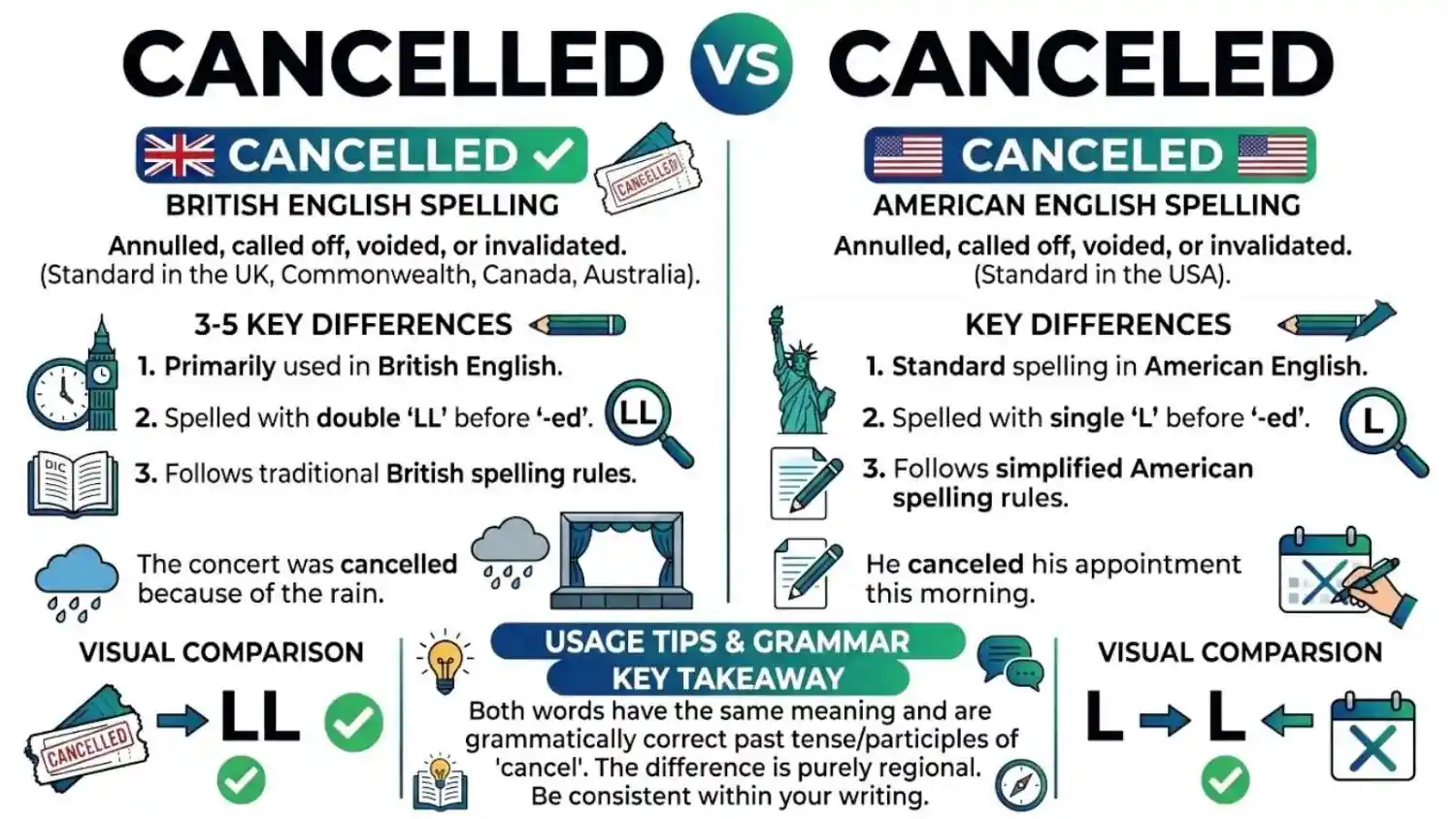
Many English learners get confused when they see two spellings of the same word: cancelled and canceled. At first look, it feels like one of them must be wrong. But the truth is different. Both spellings are correct, and both are used in real writing around the world.
This confusion happens because English is not the same everywhere. Different countries follow different spelling rules. For example, British English and American English often spell words differently. This is why you see cancelled with double “l” and canceled with single “l”.
People search for this topic because they want to write correctly in exams, emails, blogs, and office work. They do not want spelling mistakes that look unprofessional. Many students also get confused in tests when both versions appear in books or online content.
This guide will explain everything in very simple language. You will learn the meaning, origin, differences, usage, examples, mistakes, and correct rules. After reading this, you will never feel confused again about cancelled or canceled.
Key Points to Know
- Cancelled (two “l”) is British English.
- Canceled (one “l”) is American English.
- Both spellings mean the exact same thing: something planned was stopped.
- The key rule is to pick one style and stay with it through your whole piece of writing.
What’s in This Article
- Cancelled or Canceled – Fast Answer
- The Origin of Cancelled or Canceled
- British English vs American English Spelling
- Which Spelling Should You Use?
- Common Mistakes with Cancelled or Canceled
- Other Words That Follow This Same Double-Letter Rule
- Cancelled or Canceled in Everyday Life
- A Quick Checklist Before You Publish
- Usage Difference in Countries
- FAQs
Cancelled or Canceled – Quick Answer
Both words are correct.
- Cancelled = British English (UK, Pakistan, India, Australia, etc.)
- Canceled = American English (USA)
Simple meaning:
Both mean:
“Something planned is stopped or called off.”
Easy examples:
- The match was cancelled due to rain. (British English)
- The meeting was canceled because of weather. (American English)
So remember: meaning is same, only spelling is different.
The Origin of Cancelled or Canceled
The word cancel comes from the Latin word cancellare.
It means:
“to cross out”
“to block or stop something”
In old times, people used to draw crossed lines over written text to cancel it. That is how the idea of “cancel” started.
Later, the word entered English language as cancel.
When we change it into past form, we normally add “-ed”:
- cancel → canceled or cancelled
But over time, English changed in different countries:
British English:
- Kept old spelling rules
- Uses double “l”
- Example: cancelled, travelled, labelled
American English:
- Simplified spelling
- Uses single “l”
- Example: canceled, traveled, labeled
So both forms came from the same root, just changed over time in different regions.
British English vs American English Spelling
English has two major writing styles:
British English
- More traditional spelling
- Often uses double letters
- Example:
- cancel → cancelled
- travel → travelled
- model → modelled
American English
- More simplified spelling
- Removes extra letters
- Example:
- cancel → canceled
- travel → traveled
- model → modeled
Simple Comparison Table
| Base Word | British English | American English |
| cancel | cancelled | canceled |
| travel | travelled | traveled |
| label | labelled | labeled |
| model | modelled | modeled |
| canceling form | cancelling | canceling |
You can see American English is shorter and simpler.
Other Words That Follow This Same Double-Letter Rule
“Cancelled/canceled” is part of a much bigger pattern in English. Many other words switch between one “l” and two “l” letters the exact same way, based on British or American style.
| British English (Double L) | American English (Single L) |
| Cancelled | Canceled |
| Travelled | Traveled |
| Labelled | Labeled |
| Modelled | Modeled |
| Signalled | Signaled |
Once you spot this pattern, you can quickly guess the correct spelling for many similar words, just by knowing which English style you’re writing in.
Which Spelling Should You Use?
This depends on your reader or audience.
Use “cancelled” if:
- You are writing for UK readers
- You are in Pakistan, India, or other Commonwealth countries
- Your school uses British English
- You are writing formal British English content
Use “canceled” if:
- You are writing for US audience
- You are working with American companies
- Your blog targets US traffic
- You are following American English rules
Best tip:
Always choose ONE style and stay consistent in your whole writing.
Mixing both looks confusing and unprofessional.
Common Mistakes with Cancelled or Canceled
Many learners make simple mistakes. Let’s fix them.
1. Mixing both forms
❌ The event was cancelled and then canceled
2. Wrong spelling
❌ canceld
❌ cancelld
✔ canceled / cancelled
3. Wrong tense usage
❌ The flight cancel yesterday
✔ The flight was canceled yesterday
4. Thinking meaning is different
❌ cancelled = permanent, canceled = temporary
✔ Wrong idea
Both mean the same thing: “stopped”
Cancelled or Canceled in Everyday Life
Let’s see how people use this word in daily situations.
1. Emails
- “Your order has been cancelled due to payment issues.”
- “Your subscription was canceled successfully.”
2. School or College
- “The exam has been cancelled due to a holiday.”
- “Classes were canceled because of the weather.”
3. News
- “All flights were canceled after storm warning.”
- “The concert was cancelled at the last moment.”
4. Social Media
- “Plans got canceled again ”
- “Movie show is cancelled, stay safe!”
5. Office work
- “The meeting has been cancelled by management.”
Cancelled or Canceled – Usage Difference in Countries
Different countries use different styles:
United States
- Mostly uses “canceled”
- Seen in newspapers, websites, business writing
United Kingdom
- Uses “cancelled”
- Standard in schools and media
Pakistan, India, Australia
- Mostly British English
- So “cancelled” is more common
Online content
- Both are used depending on audience
Why Two Spellings Exist
This is a very important question.
English language changed over time:
- Dictionaries were not standard
- American English was simplified in the 1800s
- British English kept traditional spelling
So both versions became correct in their own regions.
That is why today we have:
- cancelled (UK)
- canceled (US)
Tips to Remember Easily
Here are simple tricks:
- British = Double letters = cancelled
- American = Short spelling = canceled
Think like this:
UK likes “extra letters”
US likes “short words”
A Quick Checklist Before You Publish
Use this short checklist before you send an email, post, or paper.
- Pick your audience first. UK, Pakistan, India, Australia? Use “cancelled.” US audience? Use “canceled.”
- Check the rest of your writing. If you already used “colour” or “travelled,” stay consistent and keep the double “l” style.
- Never mix both spellings in one piece. Pick one and use it the whole way through.
- Remember the meaning never changes. Both spellings mean the same thing, so this is purely a style choice, not a mistake to fix.
FAQs – Cancelled or Canceled
1. Which spelling is correct?
Both are correct depending on region.
2. Is cancelled British English?
Yes.
3. Is canceled American English?
Yes.
4. Do they have different meanings?
No, meaning is exactly the same.
5. Which one should I use in exams?
Use the style your school follows.
6. Can I mix both?
No, always stick to one style.
7. Why is spelling different?
Because UK and US English evolved differently.
Conclusion:
The difference between cancelled and canceled is simple but important for writing. Both are correct spellings of the same word, and both mean “to stop something planned.”
The only difference is regional usage. British English uses cancelled, while American English uses canceled. Neither is wrong, but you must choose based on your audience.
If you are writing for UK readers, use “cancelled.” If your readers are from the US, use “canceled.” The most important rule is consistency. Do not mix both in one article or document.
Understanding this small difference helps you write better emails, blogs, assignments, and professional content. It also improves your grammar confidence and reduces mistakes.
Now you can use both spellings correctly without confusion and write more clearly in any situation.

Ethan Carter is a language writer at Wordellect who helps readers understand word differences, grammar rules, and spelling variations through simple and accurate guides.







