Have you ever wondered whether to write Ms. or Mrs. before a woman’s name? Both titles are used before names, but they have different meanings and uses. Choosing the right one can help you write emails, letters, forms, and other messages correctly.
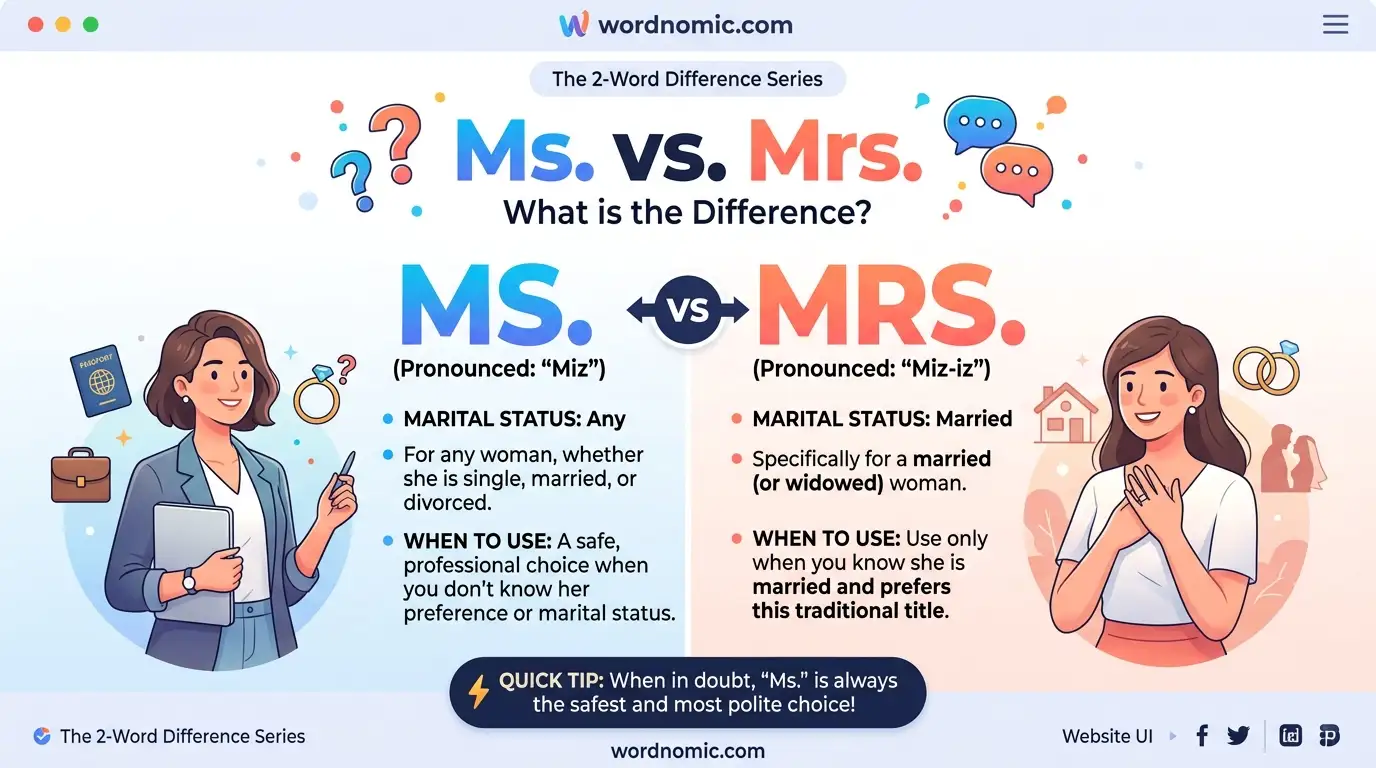
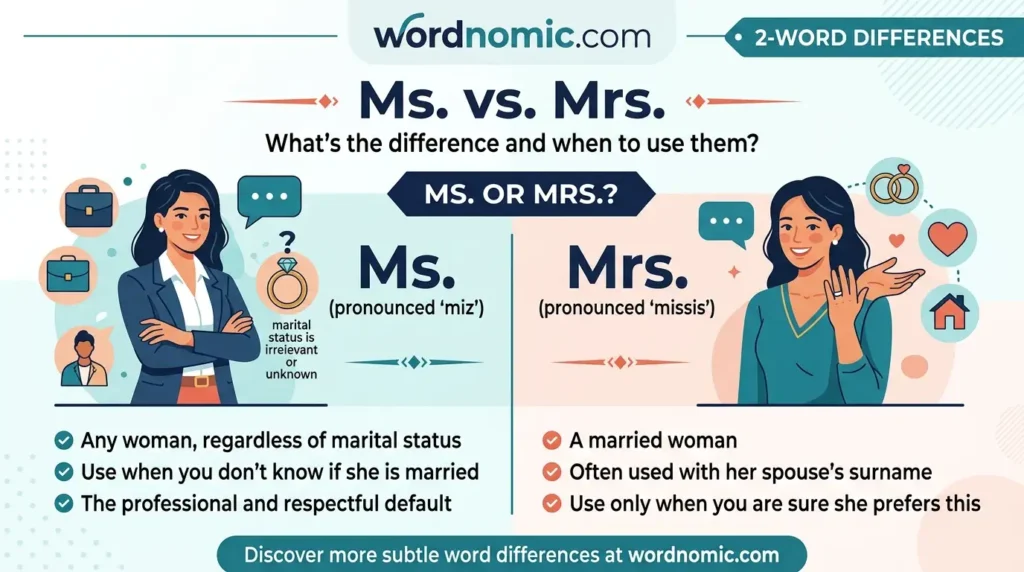
The main difference is simple. Mrs. is traditionally used for a married woman, while Ms. can be used for a woman without saying whether she is married or single. This makes Ms. a useful choice when you do not know a woman’s marital status or when it is not important.
For example, you might write “Mrs. Smith” if you know that the woman uses this title. You might write “Ms. Smith” if you are unsure which title she prefers.
However, there is one important rule: a woman’s own choice matters. Some married women prefer Ms., and some unmarried women may also use it. This guide explains the difference between Ms. and Mrs., gives simple examples, and shows you how to choose the right title in everyday situations.
Ms. vs. Mrs.: Quick Answer
Ms. and Mrs. are titles placed before a woman’s name.
- Ms.: A title that does not show whether a woman is married or single.
- Mrs.: A title traditionally used for a married woman.
For example:
- Ms. Sarah Jones
- Mrs. Sarah Jones
Both titles are correct when they match the woman’s preference. If you do not know which title she uses, Ms. is often a safe and polite choice.
What Does Ms. Mean?
Ms. is a title used before a woman’s name without showing her marital status. It can be used for a married woman, an unmarried woman, a divorced woman, or a widow.
The title became more common because women did not always want their title to show whether they were married. It also made it easier to address women when their marital status was unknown or unrelated to the situation.
For example:
- Ms. Emily Brown
- Ms. Laura Smith
- Ms. Jessica Wilson
You may see Ms. in workplaces, schools, business letters, and formal emails.
When Should You Use Ms.?
Use Ms. when:
- You do not know whether a woman is married.
- You do not know which title she prefers.
- Her marital status is not important.
- You are writing a formal email or business letter.
- She has asked you to use Ms.
Example:
Dear Ms. Brown,
Thank you for your email. I will send the requested information tomorrow.
In this example, Ms. is polite and professional. It does not make any claim about the woman’s marital status.
What Does Mrs. Mean?
Mrs. is a title traditionally used for a married woman. It is placed before her name in letters, emails, invitations, and other forms of communication.
For example:
- Mrs. Sarah Jones
- Mrs. Emma Wilson
- Mrs. Olivia Brown
In the past, Mrs. was commonly linked to a woman’s married status and was often used with her husband’s surname. Today, many women use their own surnames after marriage, so the title does not tell you which surname a woman uses.
When Should You Use Mrs.?
Use Mrs. when:
- You know that the woman is married and uses this title.
- She has asked you to address her as Mrs.
- You are following a form of address that she has already chosen.
Example:
Dear Mrs. Wilson,
We are pleased to invite you to our school event next Friday.
This is suitable if Mrs. Wilson is the title the woman prefers.
Remember that not every married woman uses Mrs. Some prefer Ms., so it is best not to guess when you can ask.
Main Differences Between Ms. and Mrs.
The main difference is whether the title shows marital status.
| Feature | Ms. | Mrs. |
| Meaning | Does not show marital status | Traditionally used for a married woman |
| Used for married women | Yes | Yes |
| Used for unmarried women | Yes | Not traditionally |
| Shows marital status | No | Traditionally, yes |
| Common in workplaces | Yes | Yes |
| Best when preference is unknown | Often a good choice | Use only when appropriate |
Both titles are polite. The right choice depends on the woman’s preference and the situation.
How Do You Pronounce Ms. and Mrs.?
Ms. and Mrs. have different pronunciations.
- Ms. sounds like “miz.”
- Mrs. sounds like “miss-iz.”
The pronunciation of Mrs. may sound like “missus” in everyday speech.
Here are two examples:
- Ms. Brown: “Miz Brown”
- Mrs. Brown: “Miss-iz Brown”
Ms. and Mrs. may look similar when written, but they do not sound the same when spoken.
What Is the Difference Between Miss, Ms., and Mrs.?
Miss is another title used before a woman’s name. It is traditionally used for an unmarried woman or girl.
The three titles have different uses:
- Miss: Traditionally used for an unmarried woman or girl.
- Ms.: Does not show whether a woman is married or single.
- Mrs.: Traditionally used for a married woman.
For example:
- Miss Anna Smith
- Ms. Anna Smith
- Mrs. Anna Smith
In modern English, Ms. is often a useful choice because it does not require you to know a woman’s marital status. However, always use the title the person prefers when you know it.
Should You Use Ms. or Mrs. in an Email?
If you are writing a formal email and do not know the woman’s preferred title, Ms. is often the safer choice.
For example:
Using Ms.
Dear Ms. Taylor,
I am writing to ask about the job opening at your company.
Thank you for your time.
Kind regards,
Alex
Using Mrs.
Dear Mrs. Taylor,
Thank you for confirming your attendance at the meeting.
Kind regards,
Alex
Use Mrs. when you know that the person uses this title. If you are unsure, you can use the person’s full name or simply ask which title they prefer.
For example, “Dear Taylor Morgan” may work in some settings, but the most suitable greeting depends on the workplace and the person’s role.
Ms. or Mrs. on Forms and Applications
Some forms ask you to select a title, such as Ms., Mrs., Miss, or Mr. These titles are often included as a way to address the person.
If you are completing a form for yourself, choose the title you prefer. You do not have to choose Mrs. simply because you are married.
If you are completing a form for another person, use the title they have provided. If it is not known and the form allows it, you may choose Ms. or leave the title blank.
A title is not the same as a legal name. It should not be used to guess personal details about someone.
Is Ms. Only for Unmarried Women?
No. Ms. is not limited to unmarried women.
A woman may use Ms. whether she is single, married, divorced, or widowed. The title does not tell the reader her marital status.
For example, a married woman may use Ms. Brown at work because she prefers a title that does not focus on whether she is married.
This is one reason Ms. is common in professional settings. It allows people to address women politely without making assumptions about their personal lives.
Can a Married Woman Use Ms. Instead of Mrs.?
Yes. A married woman can use Ms. if that is her preference.
Marriage does not require a woman to use Mrs. Some women choose Ms. for work, official communication, or everyday use. Others prefer Mrs.
For example, a woman named Emma Wilson may use Ms. Wilson even after marriage. Another married woman may prefer Mrs. Wilson.
Neither choice is wrong. The important thing is to respect the title each person uses.
Common Mistakes When Using Ms. and Mrs.
Here are some mistakes to avoid when choosing these titles.
1. Thinking Ms. Means Unmarried
Ms. does not mean that a woman is single. It does not reveal her marital status.
2. Assuming Every Married Woman Uses Mrs.
Some married women prefer Ms. Always respect the person’s chosen title.
3. Using Mrs. Without Knowing Her Preference
Knowing that a woman is married does not always mean she wants to be called Mrs. If you are unsure, Ms. is often a better choice.
4. Confusing the Pronunciation
Ms. sounds like “miz,” while Mrs. sounds like “miss-iz.”
5. Forgetting the Full Name
Place the title before the name. For example, write “Ms. Sarah Brown,” not “Sarah Ms. Brown.”
Simple Example Sentences
Here are ten examples to help you understand how to use Ms. and Mrs.
- Ms. Carter will lead the meeting tomorrow.
- Mrs. Davis invited us to her home.
- Please send the letter to Ms. Green.
- Mrs. Wilson is our new school principal.
- I used Ms. because I did not know her preferred title.
- The invitation was addressed to Mrs. Taylor.
- Ms. Adams works in the sales department.
- Mrs. Clark asked for a copy of the report.
- A married woman may prefer Ms. instead of Mrs.
- Always use the title that the person prefers.
Frequently Asked Questions
1. What is the main difference between Ms. and Mrs.?
Ms. does not show whether a woman is married or single. Mrs. is traditionally used for a married woman.
2. Is Ms. for married or unmarried women?
Ms. can be used for both married and unmarried women. It does not reveal marital status.
3. Is Mrs. only for married women?
Mrs. is traditionally used for married women. However, a person’s own preferred title should guide how you address them.
4. Which is better: Ms. or Mrs.?
Neither is always better. If you do not know the woman’s preference, Ms. is often a safe and polite choice.
5. Can I use Ms. for my married teacher?
Yes, if your teacher prefers Ms. You should use the title she asks you to use.
6. How do you pronounce Ms.?
Ms. is pronounced “miz.”
7. How do you pronounce Mrs.?
Mrs. is commonly pronounced “miss-iz” or “missus.”
8. Is Ms. more professional than Mrs.?
Both can be professional. Ms. is often useful in workplaces because it does not show marital status.
9. What should I write if I do not know whether a woman is married?
Ms. is often a good choice. You can also use the person’s full name if that fits the situation.
Conclusion
Ms. and Mrs. are both polite titles used before a woman’s name, but they have different meanings. Ms. does not show whether a woman is married or single, while Mrs. is traditionally used for a married woman.
For example, you can write Ms. Sarah Brown when you do not know her marital status or when she prefers Ms. You can write Mrs. Sarah Brown when she uses Mrs. as her title.
If you are unsure which title to use, Ms. is often a safe choice in formal emails, business letters, and workplaces. However, the best option is always the title the woman prefers. Do not assume that every married woman wants to be called Mrs. or that every unmarried woman wants to be called Miss.
Once you understand this simple difference, choosing between Ms. and Mrs. becomes much easier.

Ethan Carter is a language writer at Wordellect who helps readers understand word differences, grammar rules, and spelling variations through simple and accurate guides.